Archive

Archive for 2009

Share Your Quote for Sherpa’s Wisdom Report

December 18th, 2009

The year is almost over, which means it’s time for us to compile our annual Marketing Wisdom report.

So before you enjoy some time off for the holidays, please take a minute to share a story about a great test result, campaign lesson or other insight you gained during 2009. The deadline is Dec. 31, 2009.

Here’s the form where you can share your contribution:
http://sherpa.wisdomreport.sgizmo.com

In January, we’ll release our 2010 Wisdom Report at no cost to readers. It’s like a crowd-sourced marketing guidebook, compiling the best campaign lessons, test ideas, inspirational stories and creative solutions to common problems — all based on the experiences of the Sherpa reader community.

Here’s how it works. Your quote — a short story told in your own words — must be based on a real-life experience.

A few suggestions for your entry:
– How you coped with the recession and limited resources to execute your 2009 marketing strategy
– A test campaign that worked better (or worse) than anticipated
– Lessons learned about specific tactics, such as social media marketing, lead scoring, email autoresponders, etc.
– Career stories — everything from hiring to budgeting to dealing with office politics

So think back on your challenges and achievements of the past year. We’re sure you’ve got a great story to tell that will help make us all better marketers in 2010.

Here’s the entry form link again:
http://sherpa.wisdomreport.sgizmo.com

Thanks!
Testing Multiple Twitter Feeds

December 15th, 2009

One great thing about social media networks is they’re cost-free. Sure, they can be time consuming. You might even need to hire a manager. But you won’t have to write checks to Facebook, MySpace or Twitter to be there.

Also, social networks are showing some marketers big returns. We ran a great article this week on how Threadless, an online community-based tee-shirt retailer, used Twitter to give more life to a promotion. Check out how they micro-blogged their way to a record sales day.

We spoke with Cam Balzer, VP, Marketing, Threadless.com, for the piece. Balzer mentioned that, apart from their main feed, they also experiment with different Twitter feeds. Hey, why not? Feeds are free to create. Here are two alternatives they’ve tried:

– Customer service

In November, they launched a Threadhelp feed to handle customer service inquiries through Twitter. The thread is managed by members of Threadless’ customer service team. Other companies have tried this strategy as well.

Separating customer service and community-oriented feeds helps keep the fun and useful messages apart from the frustrated customer messages. It also helps customers get the attention they need more directly.

– Single promotion feeds

For Halloween, the team set up an account alleging to be maintained by a zombie. The joke feed put some spin on a holiday promotion. Although it did not capture many followers, the feed was an inexpensive experiment that helped the team learn more about the channel.

Has your team experimented with multiple Twitter feeds? Or different Facebook groups perhaps? Let us know in the comments…

Convincing Skeptics that Social Media Belongs in your Marketing Strategy

December 10th, 2009

Last week, I sat in on a webinar presented by HubSpot and MarketingSherpa that discussed the importance of inbound marketing tactics for B2B lead generation. Sherpa’s research director, Stefan Tornquist, and Rick Burnes, Inbound Marketing Manager, HubSpot, shared data and real-life examples of how the combination of relevant content, social media and search engine optimization is helping marketers reach out to prospects and engage them in their nurturing funnels.

But as in many webinars, it was something from Q&A segment that really caught my ear.

One attendee asked how to get executive buy-in for a serious content development and social media marketing strategy. It seems this attendee’s boss, like some other C-level executives, isn’t convinced that content like videos, podcasts, tweets and blog posts really count as marketing — or that social networks are where marketers need to spend their time.

Here’s the advice that Stefan and Rick offered (with a bit of my own thoughts) to help explain the value of social media to C-level executives:

Tactic #1. Ask your bosses where they get their information

A simple conversation with executives can open their eyes to how much they use social media every day. Do they read blogs? Do they interact with their peers on social networks like LinkedIn?

You can point out that your team needs to create the same kind of content and features that attract them to these information sources.

Tactic #2. Show them the case studies

Most executives can relate to proven results, so provide examples of other companies that have achieved strong results from social media or inbound marketing. I’ve talked to several marketers who have numbers to demonstrate their success, such as:

– The team at Acoustics By Design, who created a company blog that now accounts for 53% of natural search visits to their site.

– The team at BreakingPoint systems, whose big push into blogging, Twitter, LinkedIn, and other channels helped increase unique Web visitors 155%. As a result, inbound Web visitors accounted for 55% of their leads, and 75% of their marketing-influenced pipeline.

Or just look at HubSpot’s own results: Rick Burnes said his team’s SEO leads have grown 12% since July 2008, and social media leads are up 72% in that same period.

– Tactic #3. Quietly launch a pilot program to prove the concept

If you’re able to operate with a lot of freedom, Rick Burnes suggested launching a small pilot program, like a blog or social network discussion group. Testing tactics and measuring the results you achieve on this small scale can give you the data you need to lobby for a broader push.

Custom Sell-Sheet Emails

December 2nd, 2009

Marketing and sales teams should work together to achieve the best results possible. Dave Mossop, Interactive Media Specialist, Expedia CruiseShipCenters, is no stranger to this concept.

Mossop’s team handles much of the online marketing for the brick-and-click cruise agency’s 2,500+ sales agents. We published an article today describing the team’s effort to support agents with customized marketing via email, a website, and a customer relationship management system.

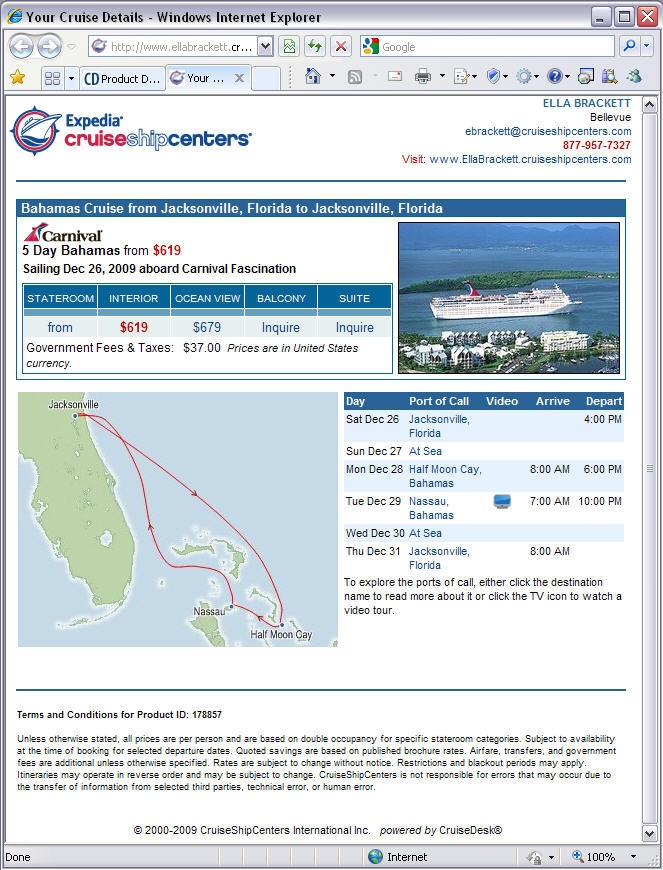
Click for a larger view

One interesting tactic we did not mention is the team’s “sell-sheet” emails. Ordinarily, Mossop’s team manage email sent to prospective customers. The emails are customized as if they were sent directly from cruise agents to clients.

However, agents can identify cruises that individual clients might be interested in and send them a sell-sheet email. These emails are integrated into the CRM system agents use regularly.

“With basically one click, type in an email address and they’ll get a copy of what the itinerary is, what the ship looks like, a little about the weather, and it’s personalized with [the agent’s] information as a contact,” Mossop says.

You’ll also notice that the emails are customized with the agent’s contact information. They are just one more way that Mossop’s team uses customized messaging and streamlined processes to help agents save time and sell more.

You can find out more about how Expedia CruiseShipCenters combines email, social media and mobile marketing at MarketingSherpa’s 2010 Email Marketing Summit in January.

Interviewing In-House Experts for Audio/Video Content

November 23rd, 2009

Our recent case study about Level 3 Communications’ video eBook highlighted a great tactic for getting non-marketing colleagues to help create marketing content. It can be hard to convince a busy VP or engineering-type to write something for you, but they’ll often agree to be interviewed on a subject for a video or audio piece.

Interviews are a great way to let knowledgeable staff members share their expertise in a low-pressure, low-commitment way:
o You can give them questions in advance so they can gather their thoughts
o The process can take as little as 15 or 20 minutes
o A little post-production editing can highlight the best bits, even if they ramble a little.

But you have to choose the right people to interview and manage the process carefully to ensure the content is trustworthy and relevant to your prospects. Here are a couple more tips on getting the best out of your subject matter experts:

– Avoid using salespeople for lead-gen interviews.

Nothing against salespeople – they are great at what they do, and know your products’ features and benefits inside and out. But using a salesperson may send the wrong message to prospects.

The vast majority of the audience for your video or podcast isn’t yet ready to talk to a salesperson. Instead, you should feature an authoritative voice from within your organization, such as a technical expert or product manager, who can project an educational, authoritative tone. Save the sales team’s role for negotiating with leads once they’ve been qualified through your marketing process.

– Don’t let subjects read their answers.

People reading off a script almost never sound natural. You want the content to be conversational, not scripted.

If the interview subject is working off of notes and it’s not sounding great, ask them to try it again without reading their notes. Tell them to focus on talking to the interviewer as if it were a one-on-one conversation — not a presentation.

And remember, editing is your friend. You can always delete pauses, “ums” and “ahs” or repetitive statements after the fact.

Sharable Holiday Wish Lists

November 12th, 2009

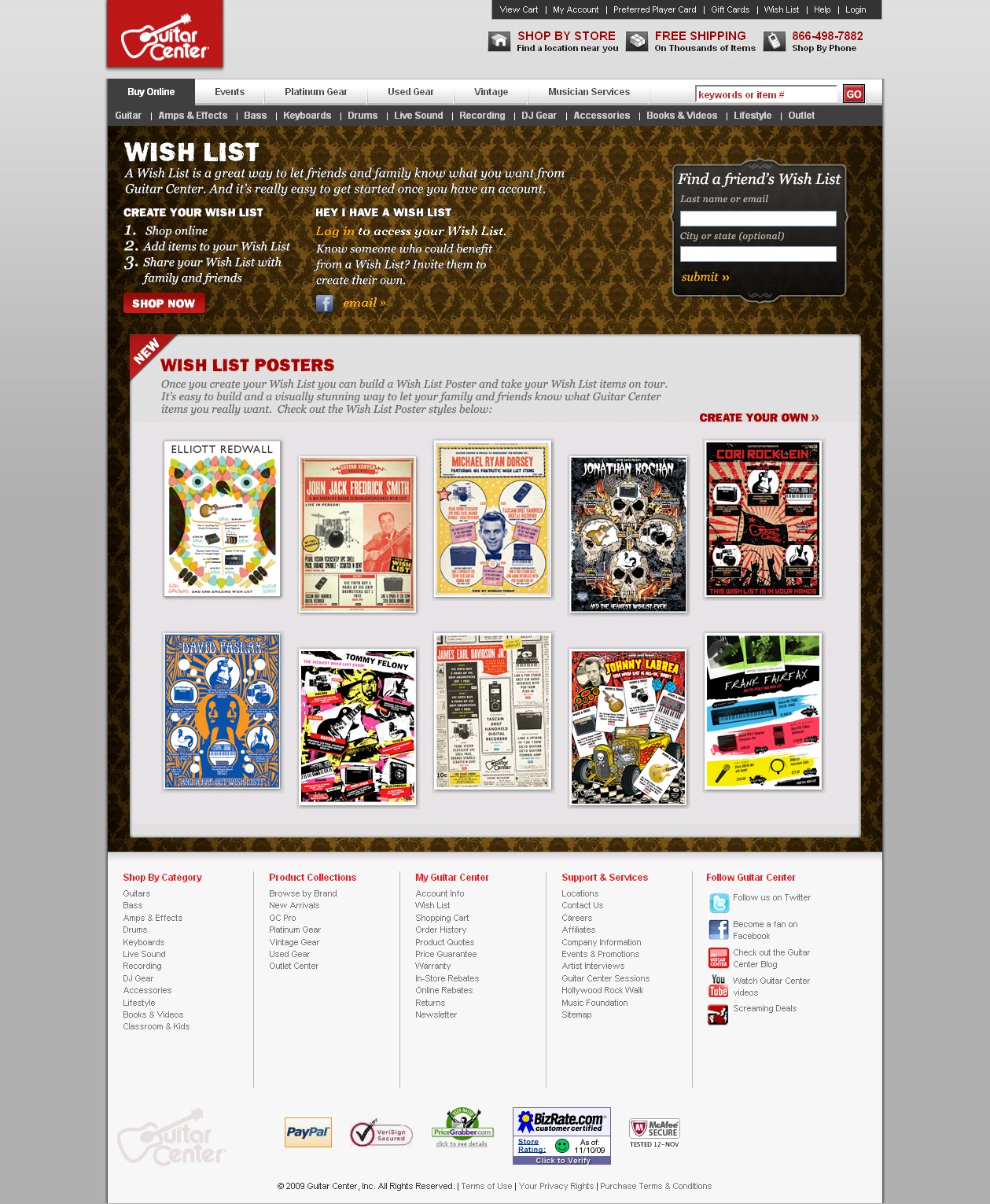
Marketers at multichannel music equipment retailer Guitar Center this week launched customizable wish lists to help customers steer friends and family toward their desired holiday gifts.

The lists are designed by professional concert poster artists to resemble posters from different musical genres, says Scott Archambault, Director, Customer Acquisition, Guitar Center.

Guitar Center Wish Lists

Shoppers can browse, click to add products, and launch a browser-based Flash app to choose a design. Dragging-and-dropping automatically blends products with a design, and shoppers can add a title and an image to certain lists.

Shoppers can click to share lists on several social networks including Facebook, MySpace and Twitter.

The posters won’t appeal to everyone, and shoppers have the option to create and share a more traditional list, Archambault says.

Why offer sharable lists? Archambault says that gift shopping for musicians can be difficult due to the range of product choices and each player’s preferences.

“It’s not enough to just buy a guitar off the shelf,” he says.

The team created the effort with Organic of San Francisco and expects it to extend into next year. They later intend to drive custom marketing efforts based on the products customers select.

“If you have a lot of guitar instruments or something that maps toward an instrument preference, the emails that you get and the reminders that you get will speak to those very specifically.”

Blogger Video Sharing Data

November 6th, 2009

Knowing which bloggers are most likely to embed or link to a video can help focus your pitching strategy. Take a look at a new report from social media business intelligence provider Sysomos to find out which bloggers are sharing videos.

Sysomos analyzed over 100 million blog posts from July to September 2009 to measure bloggers’ video sharing. The report breaks down the bloggers’s demographics and the services they use.

Below is some U.S. data from the report. Check out the full report if you want more detail and international data.

– U.S. Market Share
o YouTube – 81.6% of bloggers use YouTube to embed or link to video
o Vimeo – 10.6%
o Dailymotion – 1.8%

– Top U.S. Cities for Video Sharing Via Blogs
o New York, NY – number one worldwide
o Los Angeles, CA – number six worldwide
o Chicago, IL – number 10 worldwide

– Top U.S. States for Video Sharing Via Blogs
o CA – 19.0%
o NY – 10.9%
o TX – 5.4%
o PA – 5.0%
o FL – 4.8%

– Age of North American Bloggers who Embed Video
o 20 to 35 – 62.7%
o 35 to 60 – 25.9%
o 13 to 19 – 9.5%
o Over 60 – 1.9%
o Under 13 – 0.0%

Worldwide, males (60.33%) are more actively sharing video through blogs than females (39.67%). The most active days are Tuesday, Wednesday and Monday, respectively. The most active hours are 11 a.m. to noon, followed by noon to 1 p.m.

If you’re making viral videos, this data helps show who is most likely to share them on a blog. You can use it to help guide your pitching strategy, and possibly help decide if viral video is the right strategy for your audience.

Nominate Your Best Email Campaigns

November 3rd, 2009

We’re currently accepting nominations for MarketingSherpa’s 2010 Email Marketing Awards. But hurry — the deadline to submit your campaign is Friday, Nov. 20.

Here’s the link to the entry form:
http://sherpa.EmailAwards2010.sgizmo.com

The competition recognizes the best B2B and B2C email marketing campaigns of the previous year — with a focus on savvy testing tactics, personalization strategies, automation, and creative that gets results. Think response rates, conversions and ROI.

Got a campaign you think is worth a Gold or Silver award? Share the details with us, and you could be among the winners announced at MarketingSherpa’s Email Summit ’10, taking place Jan. 20-22 in Miami.

Here’s the link again:
http://sherpa.EmailAwards2010.sgizmo.com

We’re always blown away by the caliber of the campaigns nominated in this competition, so we can’t wait to see what you’ve achieved in the past year.

GPS Ads Drive Store Traffic

October 30th, 2009

Marketers have increased response by segmenting online consumers by location, especially with paid search marketing. These strategies often use IP addresses to target online ads to visitors from specific regions or cities.

Now GPS is being added to mobile devices. The coordinates are accurate within a matter of feet, rather than miles. This is opening an opportunity for much sharper location-based advertising.

GPS-based location-driven ads have the potential to be very effective, according to a survey by Marketing Research Services Inc., on behalf of NAVTEQ. NAVTEQ provides digital mapping services to companies including Garmin and BMW.

MRSI sampled 757 users of NAVTEQ ad-enabled GPS devices who were 18 and older with an average household income over $50,000. They found:

o 72% viewed the ads as acceptable to the navigation experience

o At least 50% of respondents recalled seeing an ad for each of the advertised brands (aided and unaided)

o 19% of people who recalled seeing a specific ad clicked through for more information

o Up to 6% visited a business location because of seeing an ad on their navigation device

The release describing the survey lacks some important details, such as what the ads look like, if they included offers and what “up to 6%” really means. However, I do not dispute the validity of the data. I expect that GPS-targeted ads will become very popular and effective in the mobile advertising world.

Customer Data via Twitter

October 23rd, 2009

Twitter’s rapid growth this year has given the micro-blogging service a reputation as a powerful way to reach and research consumers.

I recently interviewed Craig Greenfield, VP, Search and Performance Media, Performics, about his team’s Twitter use. They use it to help promote Performics’ marketing services, as well as enhance their clients’ campaigns and research.

Here’re six ways Greenfield sees Twitter contributing to his team’s success:

#1. Improved natural search

– Content promotion – A simple tweet with a short URL link is enough to drive traffic and capture more links to content, and in turn, help search rankings.

“Depending on who re-tweets our links and how they do it…we tend to see a snowball effect that results in more and more valuable SEO links,” Greenfield says.

– Keyword research – Through Twitter’s search and the team’s proprietary tools, they are able to mine Twitter’s data to look for new keywords related to their client’s products.

#2. Capture paid-search opportunities

Twitter helps Greenfield’s team monitor trends in consumer interest. By tracking non-branded industry keywords (such as ‘jeans’ and ‘shirt’ for clothing retailers) they can see both positive and negative reactions to new brands, styles or features.

#3. Reputation management

Twitter is one of many social media sites that Greenfield and his team uses to monitor consumer sentiment around brands and products.

By using software to identify statements about a company or its products, the team is able to see whether consumers are talking about the company in a positive or negative light and respond appropriately.

#4. Landing page design

Greenfield’s team started mining conversations on social media outlets like Twitter to develop new landing page designs. They monitor conversations related to a brand or product and create a “tag cloud” based on the feedback. The team references these groups of text when brainstorming new ideas for landing pages, he says.

#5. Driving direct sales

Threadless, a tee shirt design and retail company, and one of Greenfield’s clients, has attracted more than 1.2 million followers to its Twitter feed and uses Twitter to generate sales, Greenfield says. Threadless tweets about promotions and content, and typically includes a URL link to their website.

#6. B2B lead generation

Greenfield and his team use their Twitter feed to update followers on:
o Company news
o Blog posts
o New whitepaper downloads
o Monthly webinars

The last two items are often used for lead generation, making Twitter one of several ways the team increases their pool of qualified leads for sales.