Recent Comments

  • Deven Pravin Shah: Adam – great point that if people came using the branded keywords, then they knew about the...
  • Jeanne Jennings: Thanks all for the comments! Darren — I totally agree. Relevant engaging content, judged as...
  • Rahul Kohli: While I agree that including social sharing icons in your e-mail is a good idea to generate viral...
  • Steven Clift: Duh. Web developers/social media gurus have “always on” blinders on and simply do not...
  • John Schuster: I have to set up filters on my email to sort out all the social site emails that I receive.

5 Most Popular Blog Posts

Recognition

Big List - Search Marketing Blogs

Sean Donahue

Capitalize on media attention to build relationships: Two approaches

This week brought us dueling product announcements from Google and Microsoft that, naturally, got a lot of attention from media and bloggers. But as I was reading about Microsoft’s new search engine, Bing, and Google’s upcoming Wave communication tool, I noticed something interesting about how the companies are trying to capitalize on crush of media attention and Web traffic.

- Google’s Wave homepage features a prominent blue button that says, “Let me know when it’s ready,” which takes users to a quick survey and email sign-up form to be sent future updates about the product.

It’s a smart tactic: Product-launch alert campaigns are a great way to capture opt-ins, and those messages tend to generate strong open and clickthrough rates.

- Microsoft’s Bing homepage, on the other hand, doesn’t feature an email sign-up form (as far as I could see). Instead, it appears the Microsoft team is using social media to make connections with interested visitors.

The Bing site features a link to a Bing Facebook group, and invites visitors to follow Bing on Twitter.

I haven’t seen data or done a case study yet on using social media to keep potential customers in the loop about product announcements. I’d be very interested to see how it compares to email in generating interest and activity after launch.

But in both cases, Google and Microsoft are being smart about weaving an engagement strategy into a big publicity push. Whether you’re using email, Twitter or another channel, you can make a direct connection with your audience that turns a sudden, transitory wave of interest in your company or products into the first step of a long-term relationship.
 

1 Comment »


Adam T. Sutton

Consumers’ Mobile Shopping Preferences

Billing Revolution released some results today from a survey it commissioned on consumers’ mobile shopping preferences. Harris Interactive conducted the survey and queried 2,029 US adults, ages 18 and older, from April 29 to May 1 of this year.

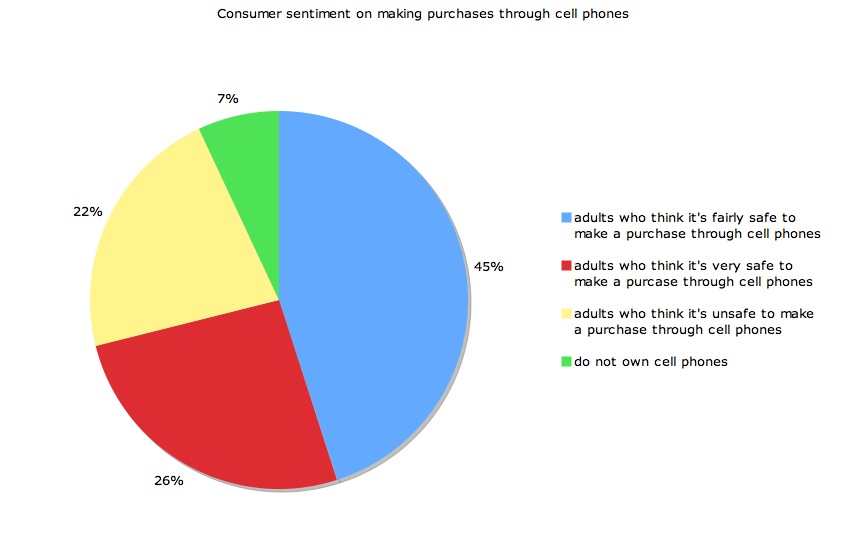
Of adults who receive bills from cell phone and credit card companies, 57% said they trust card companies more than cell phone companies for accurate billing. Here’s a pie chart with more results (you can click it for a larger version):

consumer-sentiment_safety_final

Of mobile users, more younger users (59%; ages 18 to 34) thought it was at least somewhat safe to purchase through a mobile phone than older users (34%; ages 55+). More male mobile users thought it was at least somewhat safe (50%) than female users (39%).

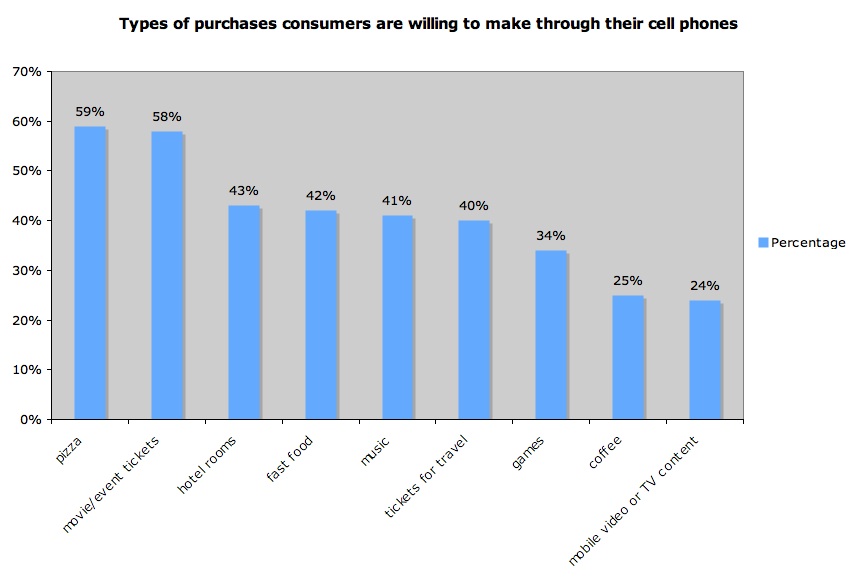
Of those willing to make purchases:
o 75% would be willing to buy entertainment items, such as:
- Event/movie tickets (58%)
- Music (41%)
- Games (34%)
- Mobile video or TV content (24%)

o 68% would be willing to purchase food or drink items, such as:
- Pizza (59%)
- Fast food (42%)
- Coffee (25%)

o 43% would be willing to purchase hotel rooms
o 40% would be willing to purchase travel tickets

types-of-purchases_broken-into-categories


No Comments


Adam T. Sutton

Twitter Surveys for Quick Opinions

Marketing decisions are best made with a level of certainty about an audience’s preferences. You don’t want to start offering a feature that customers aren’t interested in. And you don’t want to push a marketing offer that they don’t care about.

Social media and data mining can be used to find an audience’s preferences. And as we outline in a case study recently, online surveys are still effective strategy. Then last week I interviewed Glenn Edelman, VP Marketing, Wine Enthusiast, who has recently combined social media and surveying.

Edelman is responsible for Wine Enthusiast’s wine accessories ecommerce site, and WineExpress.com’s direct-to-consumer ecommerce wine sales. His team uncovered a great strategy for selling wine via email with product pages that include “virtual wine tastings” in two- to three-minute videos (the case study will be published by eTail later this month, and then by MarketingSherpa).

When adding video to the wines’ product pages, Edelman’s team wondered whether the videos should automatically play, or wait to be clicked by visitors before playing. The team asked Wine Enthusiast’s Twitter followers about the idea.

“We thought about testing it but said ‘hey, let’s ask our audience.’ And we got a huge, huge response to never do auto-play. ‘We hate auto-play,’ they said. It was such as negative response that we didn’t even bother testing,” Edelman says.

There you have it. Twitter can be used as a quick way to get your audience’s opinion, in addition to its other marketing applications, such as branding, PR, and promotion.


3 Comments »


Adam T. Sutton

Reaching Local Searchers

I had an interesting conversation with Scott Dunlap, CEO, NearbyNow, last week. NearbyNow helps consumers find products in local stores through its website, mobile apps, and the major search engines.

A consumer looking for a particular product in his or her area will typically be alerted via an email or a text message on the product’s availability. This service has several interesting applications for marketers–such its OnTheWay ads. These ads allow marketers to advertise in the alert messages to consumers who’ve indicated that they’re planning to visit a store near their own.

Some marketers, Dunlap says, have leveraged these ads to emphasize the core motivations that consumers have for searching for local products. The top three motivations that Dunlap’s team has uncovered,:
1. Consumers want the products immediately
2. They want to see, hold, and test the products (particularly relevant for apparel, shoes and gadgets, Dunlap says)
3. They do not like the hassles or costs of shipping

How have these motivations been applied to the ads? Some marketers are pushing immediacy to the extreme. They will give 20% off products in their stores for the next two hours. That can force some consumers to consider visiting the advertiser’s store before visiting their intended destination.

Local search and sales for products–with real time inventory updates–looks like it holds a lot of potential for retailers and brands alike. I expect the major search engines to start rolling out more ways for marketers to connect with consumers looking for products locally.


No Comments


Sean Donahue

Two Weeks Notice: Seeking Speakers For Demand Generation Summit

In case you haven’t seen the link in our newsletters or on our homepage, we’re currently accepting speaking proposals for our 2009 B-to-B Demand Generation Summit.

With the deadline for submissions just two weeks away — May 21 — I wanted to give our readers another heads up. This is your chance to stand up and share your best practices, most successful campaign tactics, or insights into what works now in B2B marketing.

Again, we’re most interested in your own experiences, campaign war stories, case studies and lessons learned in areas such as:
o Lead nurturing
o Lead scoring
o International demand generation
o B-to-B email
o Paid search advertising and SEO
o Social media marketing
o Events
o Creating marketing content

Take a few minutes to submit your proposal here.

Don’t forget, this the the Summit will be held September 23-24 in San Francisco, and October 5-6 in Waltham, MA.


No Comments


Adam T. Sutton

Online Leads and Offline Conversion

I recently talked with Chris Knoch, Principal Consultant in the Best Practices Group at Omniture, about how to best measure and monitor a site’s SEO results (keep an eye out for the article in our search newsletter).

Knoch provided a wealth of information. One bit I found particularly interesting was about connecting offline conversions to online behavior. Many marketers invest loads of time and effort into search marketing to generate leads that will convert offline. Most of these marketers are certain of how many leads they’re getting, but are less certain of which channels generate the best leads; those most likely to convert.

A rental car company, for example, might collect leads online by pointing traffic to an online registration form. The customers convert and pay when they arrive on-site to pick up the car. So leads are generated online, but not all of them will arrive on-site to complete the conversion.

For marketers in this boat, connecting online lead gen to offline conversions is essential to determining which efforts are pulling in the best leads. Is it paid search? If so, which keywords? Is it natural search? Is it display advertising? You should strive to segment the performance of each channel, Knoch says.

“If you’re not mapping your online [lead gen] to your [in-store] conversions, you may be judging your natural search just the same as your display–which is not a good thing to do,” Knoch says. “If you’re not optimizing to offline data metrics, then you’re missing the full picture and you may be spending money on the wrong keywords or the wrong channels.”


2 Comments »