
Archive

Archive for October, 2009

GPS Ads Drive Store Traffic

October 30th, 2009 No comments

Marketers have increased response by segmenting online consumers by location, especially with paid search marketing. These strategies often use IP addresses to target online ads to visitors from specific regions or cities.

Now GPS is being added to mobile devices. The coordinates are accurate within a matter of feet, rather than miles. This is opening an opportunity for much sharper location-based advertising.

GPS-based location-driven ads have the potential to be very effective, according to a survey by Marketing Research Services Inc., on behalf of NAVTEQ. NAVTEQ provides digital mapping services to companies including Garmin and BMW.

MRSI sampled 757 users of NAVTEQ ad-enabled GPS devices who were 18 and older with an average household income over $50,000. They found:

o 72% viewed the ads as acceptable to the navigation experience

o At least 50% of respondents recalled seeing an ad for each of the advertised brands (aided and unaided)

o 19% of people who recalled seeing a specific ad clicked through for more information

o Up to 6% visited a business location because of seeing an ad on their navigation device

The release describing the survey lacks some important details, such as what the ads look like, if they included offers and what “up to 6%” really means. However, I do not dispute the validity of the data. I expect that GPS-targeted ads will become very popular and effective in the mobile advertising world.
Share and Enjoy:
  • LinkedIn
  • StumbleUpon
  • Facebook
  • del.icio.us
  • Digg

Customer Data via Twitter

October 23rd, 2009 No comments

Twitter’s rapid growth this year has given the micro-blogging service a reputation as a powerful way to reach and research consumers.

I recently interviewed Craig Greenfield, VP, Search and Performance Media, Performics, about his team’s Twitter use. They use it to help promote Performics’ marketing services, as well as enhance their clients’ campaigns and research.

Here’re six ways Greenfield sees Twitter contributing to his team’s success:

#1. Improved natural search

- Content promotion – A simple tweet with a short URL link is enough to drive traffic and capture more links to content, and in turn, help search rankings.

“Depending on who re-tweets our links and how they do it…we tend to see a snowball effect that results in more and more valuable SEO links,” Greenfield says.

- Keyword research – Through Twitter’s search and the team’s proprietary tools, they are able to mine Twitter’s data to look for new keywords related to their client’s products.

#2. Capture paid-search opportunities

Twitter helps Greenfield’s team monitor trends in consumer interest. By tracking non-branded industry keywords (such as ‘jeans’ and ‘shirt’ for clothing retailers) they can see both positive and negative reactions to new brands, styles or features.

#3. Reputation management

Twitter is one of many social media sites that Greenfield and his team uses to monitor consumer sentiment around brands and products.

By using software to identify statements about a company or its products, the team is able to see whether consumers are talking about the company in a positive or negative light and respond appropriately.

#4. Landing page design

Greenfield’s team started mining conversations on social media outlets like Twitter to develop new landing page designs. They monitor conversations related to a brand or product and create a “tag cloud” based on the feedback. The team references these groups of text when brainstorming new ideas for landing pages, he says.

#5. Driving direct sales

Threadless, a tee shirt design and retail company, and one of Greenfield’s clients, has attracted more than 1.2 million followers to its Twitter feed and uses Twitter to generate sales, Greenfield says. Threadless tweets about promotions and content, and typically includes a URL link to their website.

#6. B2B lead generation

Greenfield and his team use their Twitter feed to update followers on:
o Company news
o Blog posts
o New whitepaper downloads
o Monthly webinars

The last two items are often used for lead generation, making Twitter one of several ways the team increases their pool of qualified leads for sales.

Share and Enjoy:
  • LinkedIn
  • StumbleUpon
  • Facebook
  • del.icio.us
  • Digg

Homepage Overlay Boosts Subs

October 19th, 2009 No comments

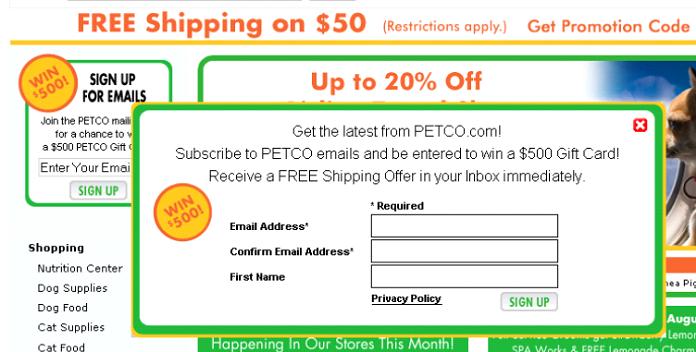
The folks at PETCO  tested an email registration overlay ad that helped lift subscriptions more than 400%.

Carol Ott, Director, Finance Reporting and Web Analytics, PETCO, and the team used Amadesa’s Customer Experience Suite to A/B test the ad (and other offers) on the homepage since June.

As you can see in the image below (click for a larger one), the overlay offers visitors two rewards for submitting email addresses:
1. Chance to win a $500 gift card
2. A free shipping offer

PETCO Email Registration Overlay

“We were impressed with the results. We were testing offers that we thought would drop our average order value and were pleasantly surprised when it did not have any effect,” Ott says.

Share and Enjoy:
  • LinkedIn
  • StumbleUpon
  • Facebook
  • del.icio.us
  • Digg

Liable for Bloggers’ Claims

October 7th, 2009 1 comment

The Federal Trade Commission on Monday published the final version of its Guides Concerning the Use of Endorsements and Testimonials in Advertising. These new rules will govern how companies can use consumer, expert and organizational endorsements to make claims about products.

There are many important updates, which become effective Dec. 1. MarketingSherpa is working on an article describing the changes that marketers need to know. In the meantime, I want to point out one change that should concern anyone who sends free products to bloggers to generate buzz.

If a blogger writes a positive review of a product that you sent free-of-charge, that post may be considered an “endorsement.” It depends on the value of the product and whether the blogger routinely receives such requests.

“If the blogger frequently receives products from manufacturers because he or she is known to have wide readership within a particular demographic group…the blogger’s statements are likely to be deemed to be ‘endorsements,’” according to the guidelines.

“Similarly, consumers who join word-of-mouth marketing programs that periodically provide them products to review publicly (as opposed to simply giving feedback to the advertiser) will also likely be viewed as giving sponsored messages.”

Now here’s the kicker: if the post is deemed an “endorsement” and the blogger writes false claims into the review, the blogger and the advertiser are liable for the misleading statements.

So if you, a phone manufacturer, send a free phone to a popular tech blogger who writes a positive review that the phone also makes a fantastic life raft — you are liable for that claim.

The guidelines suggest that advertisers who send free products to bloggers (directly or through a service) make sure that they provide guidance to ensure that the bloggers’ statements are truthful and substantiated.

“The advertiser should also monitor bloggers who are being paid to promote its products and take steps necessary to halt the continued publication of deceptive representations when they are discovered,” according to the guidelines.

So if you are sending out free products to bloggers, your job might be more difficult after Dec. 1. Stay tuned for more info as MarketingSherpa digs into the details.

Share and Enjoy:
  • LinkedIn
  • StumbleUpon
  • Facebook
  • del.icio.us
  • Digg

Random Internet Stats Tool

October 2nd, 2009 No comments

I was doing some much-needed browsing of the blogs this afternoon when I noticed a post from Steve Rubel pointing out this Internet Stats tool on Google’s UK domain.

The tool lets you search and browse data on:
o Macro economic trends
o Technology
o Consumer trends
o Media consumption
o Media landscape

The topics can be broken into subcategories, and the data is supplied by a few dozen research companies. The tool does not seem to have a ton of data, which gives it a more random than comprehensive quality. But nonetheless, there are some interesting stats, such as:

o Users are 1.5 times more attentive when browsing YouTube than when watching TV.
- Motorola (with Mindshare) and GM, partnered with YouTube, December 2008

o 5% of all time online is spent on Facebook.
- Comscore, April 2009

o 34% of Brits spend a whole day trying to find the best holiday deal online.
- Greenbee.com survey, January 2009

o 50.1% of online shoppers who placed items in their shopping carts did not go on to place an order.
- Core Metrics, March 2009

o Japanese etail giants can make as much as one quarter of their sales via cellphones. Nearly half of Tokyo’s single females are accessing the mobile web more than five times a week, with the peak shopping time between 1pm and 3pm reflecting the part-time employment status of many young Japanese.
- Internet Retailing, May 2009

I do not believe that the tool has enough data to  be useful, yet, but there is plenty of potential. One thing is certain: the data is really, really interesting.

Share and Enjoy:
  • LinkedIn
  • StumbleUpon
  • Facebook
  • del.icio.us
  • Digg