Archive

Author Archive

Marketing Metrics: Do your analytics capture the real reasons customers buy from you?

April 16th, 2013 6 comments

How can you track the most impactful elements of your marketing funnel? Let’s start with an analogy …

I once had a crush on a girl.  I talked to her every day, but she rarely took notice of my existence.  She liked the “bad boys,” and I was kind of a nerd.  It seemed as if the stars were aligned against us.

I tried asking sweetly, coming up with inventive date ideas, even appealing to her sense of pity, all to no avail.  Finally, after a year or so of trying, I wrote her a letter telling how I felt.  She finally accepted my invitation and we went on a date.

My takeaway from this exchange was letters work best. (Admittedly, my letters are particularly awesome.)

What I didn’t know was my letter had relatively little to do with her decision.  Years later, I asked her why she finally decided to go out with me.  She admitted my persistence played a role, but the bigger factor was how she had her heart broken by one of the afore-mentioned “bad boys,” and decided to give a nice guy a chance.

I was floored.  I had no idea these events had ever transpired, and more importantly, had vastly overestimated my letter writing ability.

What I had was essentially a last click attribution model. This is the way in which countless organizations currently measure conversions.  We, as an industry, have come a long way in terms of being excited about measuring and testing our marketing efforts.

However, looking at the last click before conversion as a sole contributor to the conversion decision is as near-sighted as assuming the young lady accepted my date invitation based upon my letter writing skills.  The letter was a factor, but it wasn’t the only factor.

I need a better model.


Where should I spend my marketing dollars?

Using the last click attribution method, I can determine the value of a conversion generated from an email campaign.  I might arrive at the conclusion my marketing dollars are best spent on building email lists and optimizing email campaigns.

While there may be truth in that statement, it’s only partially correct.  The real story in this scenario might be a customer first interacted with my brand when a friend shared a product review on Facebook.  From there, a likely scenario of events could be:

  • The customer visited and liked my Facebook page, and then left.
  • Weeks later, I launched a new product via Facebook post.  The customer saw the post and then left the platform to do some research.
  • While researching the new product on Google, a PPC ad appeared and convinced the customer to click through to my site.
  • Once on the website, the customer joined my email list.
  • Two weeks later, I sent an email which the customer subsequently viewed and converted, purchasing my product.

From this example, it’s obvious the customer was nurtured to conversion through a series of interactions including social media, PPC, landing pages and email.  Now, how much of my marketing dollars should go to each channel, since in this case, they were all obviously necessary for conversion?


Attribution models

Solving this problem requires the use of a different attribution model, and not all attribution models are created equal. I remember how happy I was when I learned there were multiple varieties of steak.  I had always eaten sirloin, because that’s what my dad always cooked.  So, you can imagine my excitement the first time I tasted filet mignon!

Similarly, there are a wide variety of attribution models to suit everyone’s taste.

One example is the linear ratio model, which is a dynamic model that attributes different values to different purchase and research phases. For instance, it might:

  • Attribute 5% of revenue to Facebook for the research and awareness piece of our sample transaction above.
  • Assign 25% of that revenue to PPC ads.
  • Finish by assigning 70% of the attribution to the email campaign that caused the click.

There are many  implications to using a model such as this. The social media manager is very happy because he just went from being a nonexistent entity in this conversion to owning 5% of the revenue.

The email manager might not be quite as happy, but the marketing executive should be thrilled.

There are many more models to experiment with. First-click, U-shaped, custom models and linear modeling are just a few. We’re getting closer to really understanding why people buy our stuff, and how they arrive on our pages.

Moreover, we’ve attributed our revenue to particular interactions along the funnel, which should get us started in the process of assigning value to each marketing activity we undertake.

To learn more about each of the above attribution models, see Google Analytics’ definitions here.

  Read more…

Social Media Marketing: Is in-stream e-commerce possible?

April 4th, 2013 3 comments

E-commerce on Facebook was a horrible flop. That is to say, many brands found over the course of several years of experimentation the return on investment in terms of dollars spent developing their online storefronts didn’t measure up, so many of the most popular retail brands – such as The Gap, JC Penney and Nordstrom – were subsequently forced to close their Facebook shops. A recent study by W3B suggested just 2% of people with a Facebook account have made a purchase on the social network.

Yet, simultaneously, e-commerce sites in general (Amazon, Fab.com, etc.) have posted impressive growth figures.  For example, holiday e-commerce sales were up 13% to $34 billion in 2012.

Why is it that some sites sell, and others don’t? In particular, why are social media sites so horrible at conversion? I believe it’s a phenomenon related to (what I refer to as) the locus of conversion.


Facebook is a pub crawl

The environment on Facebook yields similarities to the dynamic of a pub crawl. Surrounded by acquaintances and, yes, a few old friends, we dive into topics of various levels of seriousness ranging from the patently absurd, to the politically charged before wandering aimlessly from topic to topic.

We do so without expecting to be inundated with marketing messaging, much the same as we would expect to not be rudely interrupted by an insurance salesman while we were in the middle of telling our best frat house story from college at the local bar.

However, if you are able to be interesting enough to become the topic of our buzzed conversation, I might be willing, in that instant, to purchase your product. I don’t want to leave the bar, mind you. I just want a magical product genie to appear and offer your purple widget to me at a reasonable price. If I don’t have to leave my bar stool, you just might have a sale.

Read more…

Social Media Marketing: Which type of content is appropriate for different platforms?

April 2nd, 2013 5 comments

When I was a kid fresh out of high school, I was a little socially awkward. I didn’t exactly understand the various types of social gatherings to which I was invited to, and I consequentially always showed up dressed incorrectly, saying the wrong things and bearing the wrong gifts. We all know the guy who shows up to the baby shower with a bottle of tequila, right?

Unfortunately, a similar situation exists in marketing circles when advertisers crash the proverbial wedding of social media platforms wearing board shorts and flip flops. That metaphor may be a little dense, so follow me…

For all of the analysis currently existing about how to best leverage social networks for marketing success, we actually understand comparatively little about how the various platforms work. Frequently, despite best efforts to the contrary, marketers end up looking like the odd man out simply by taking the wrong platform-specific tones with their campaigns.

Companies simply can’t expect to behave the same at different social functions and receive an overwhelmingly good response. Since we’re on the analogy train today, I’ll try to keep the theme going.


Facebook is a pub crawl

People spend most of their Facebook time interacting with their “friends.” In truth, most of the “friends” with whom we interact with on Facebook are merely acquaintances.

Nevertheless, the environment yields similarities to the dynamics of a pub crawl. Surrounded by acquaintances and, yes, a few old friends, we dive into topics of various levels of seriousness ranging from the patently absurd, to the politically charged before wandering aimlessly from topic to topic for a spell.

We do so without expecting to be inundated with marketing messaging, much the same as we would expect to not be rudely interrupted by an insurance salesman while we were in the middle of telling our best frat house story from college at the local bar.

In order to market effectively on Facebook, you first have to win a seat at the table, or be interesting enough to be the topic of our slightly buzzed conversation.


Twitter is a speed date

You’ve got 140 characters to impress me, so you’d better make it work for you.

I might spend a few extra minutes after the last round of speed dating with a particularly interesting person (company, product, etc.), but if I do, it will be because you have done or said something particularly compelling in your allotted time slot.  Equally as fun as interviewing potential dates, I can wander sneakily around the room to see what other people are saying about me …

“That guy has impeccable taste in clothing,” says one. “He’s stunningly good looking,” says another.

Brands can do the same with Twitter, getting a better idea of how the market is responding to their product offerings. In order to market on Twitter, you have to learn how to answer the question of what you’re into right now, and answer it in a compelling enough fashion for me to care when you’re done talking.

Read more…

Social Media Marketing: How I found the Facebook topic that was 371% more effective

October 25th, 2012 9 comments

I was a fat kid. Fat kids like cake. Once upon a time, when I was eight years old, I cleaned the entire house to surprise my mother. She rewarded me with a gigantic slice of cake. From that point, I scrubbed the entire floor, organized the pantry and washed the dishes in pursuit of that glorious reward — fresh cake.

The point is, if you do something right, and you recognize the relationship between your actions and the reward, it makes sense to put forth maximum effort to reproduce the action that resulted in being rewarded. The problem with social media efforts is that success usually goes largely unnoticed by businesses.


Find your hidden cake

I recently conducted a social media audit for a Research Partner. While working through massive amounts of data provided via Facebook Insight reports, I noticed something interesting. When filtering the most frequently syndicated content to reveal the five most viral posts ever produced by that partner, a pattern emerged. Three out of the top five posts were on the same topic, in the same format.

There’s more. The top five most syndicated posts averaged 22,424 stories created per post by users, whereas the bottom half of the top 10 averaged only 6,042 stories created per post by users.

So, not only were the top five posts more effective at causing syndication from users, but they were 371% more effective.

Since no fat kid would knowingly forgo cake, it’s probably a pretty safe assumption that no business would knowingly do less effective social posting if they knew they could be doing something more effective. (After all, cash is better than cake.) That means the company must be unaware of its achievement.

Read more…

Informal Study: Professional image content generates 121% more Facebook shares

October 19th, 2012 1 comment

All content is not created equal. For instance, according to a Nielsen report, men spend more than 247 million minutes per month viewing video via social media. Yet, women spend just 228 million minutes, despite the fact that more than 4,000 more women log on to social videos per day. Men just watch longer. If you want to engage men, videos are a superior form of content.

The still photograph remains king of the proverbial hill in terms of generating engagement with fans on social platforms. A 2012 study by ROI research found that 44% of users are likely to engage with brands if they post pictures, against 40% for regular status updates, and just 37% for video. Given that startling piece of information, a reasonable person might be led to ask the question:


Are all photographs created equal?

Do grainy, low-quality photographs thrown into a Facebook stream, more or less as afterthoughts, have the same impact as high-resolution, high-quality photography? Does it matter if the content is only photographic, or do graphical images also generate higher engagement numbers? Let’s look at one industry that is quite popular among the coveted 18-24 demographic on Facebook: entertainment (the companies shall remain nameless).

We begin by dividing the image content of several popular pages into two broad categories. First, there is the professional category. Images in this category tend to be high-resolution, feature-striking photography, be character based and contain only those graphics absolutely necessary to convey essential data. For example, look at the following image:


Click to enlarge

Read more…

Navigating the Four-Phase Social Media Process

October 9th, 2012 No comments

Everyone has been playing social media ROI hide-and-seek for some time now. How does social media drive sales? Does the extent to which a firm engages or fails to engage in social marketing impact the bottom line at all? Or, as some have suggested, is the return on social efforts akin to the Loch Ness monster — we’re pretty sure it exists, but nobody seems to be able to track it down.


 What if we’re looking at it from the wrong perspective?

What if social media is more of a process, a series of steps taken at every point in the sales process, which, in totality, makes it more likely to convert leads to clients but, in practice, is difficult or impossible to measure? Or, what if social media has to be done for a certain amount of time and at a certain level of devotion before those benefits manifest?

For instance, a recent study by Dr. Sounman Hong of Harvard University suggests that newspapers’ adoption of Twitter is positively associated with their number of online readers (readers = revenue, right?), and that the strength of the association increases the larger the social network is.

Common sense seems to suggest that social subscribers are added over time, and that a bigger subscriber list, in most cases, indicates a more mature social presence. In other words, we grow into our ROI by continuing to paint the fence and mature our social media efforts.

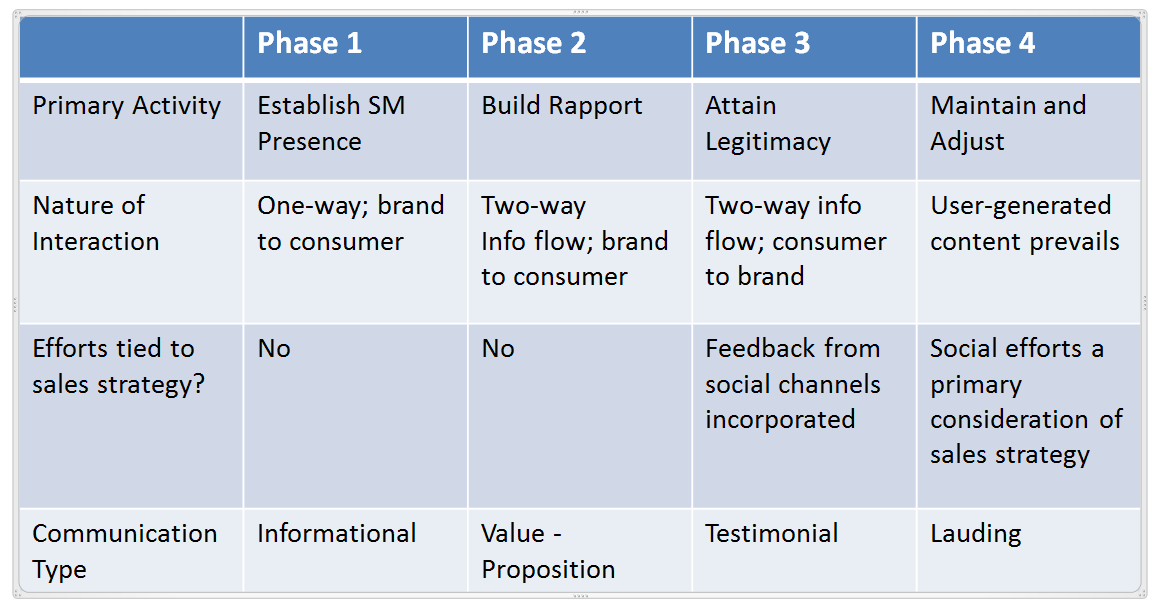
Another recent study, this one by James “Mick” Andzulis, Nikolaos G. Panagopoulos and Adam Rapp, goes so far as to break this social media evolution down into practical subdivisions. Now we begin to see a pattern emerge. Their take is that our social media efforts evolve though a series of four phases:


Click to enlarge

Read more…

Local Business Marketing: Social media is the new bare minimum to sell to Generation Y

September 21st, 2012 No comments

Let’s face it: Marketing used to be easier, especially for entrepreneurs running small, localized businesses. You once needed nothing more than a Yellow Pages ad to secure a steady stream of business as, let’s say, a local tire shop.

Then came the Internet, and it was still just a matter of having a webpage with your address and contact information. A minor inconvenience, but worth it for those businesses whose customer segments dictated taking extraordinary measures to reach the most tech-savvy people.

Next came Web 2.0, and suddenly it wasn’t enough to just have an online presence anymore. The Web was becoming social. Also, as the bell curve of innovation adoption for the Internet shifted toward mainstream acceptance, it became necessary to engage a wider range of age groups in digital format.


Can potential customers easily research your company and product?

Generation Y has proven itself to be savvy beyond belief in terms of product research, and discriminating to a fault against those brands that don’t make themselves available for online investigation.

A recent study by Lim Ying San and his colleagues from the Multimedia University in Malaysia indicates that a positive significant relationship exists between access and customers’ perceived online retail service quality. Online consumers often want to access a variety of informative sources to obtain up-to-date and useful information for making informed purchasing decisions.

Those sources may include social media, Google and other search engines, and online shopping resources, such as Amazon, as means of price comparison.

In other words, the bare minimum for online marketing and social media for small businesses has changed.


You have no choice

Increasingly, if you can’t be found on the first two pages of a Google search, you don’t exist. If young consumers cannot easily interact with your brand on Facebook, Twitter and, for some companies, even Pinterest, you are worse than out of sight. You are out of mind.

In my house, as I suspect is the case in many Generation Y abodes, we use phone books to hold up the broken coffee table where the leg used to be. Even if I wanted to look at the Yellow Pages, it would only result in spilled coffee. If you want to talk to me about your brand, you need to do the following:

Read more…

Social Media Metrics: Three touchy-feely numbers to help you benchmark and improve

September 14th, 2012 No comments

It’s no gigantic secret that marketing has taken a turn decidedly toward the more empathetic, conversationally oriented initiatives in the last decade. The days of corporate marketing czars sitting high atop the hill of commerce, and sipping Scotch while devising cleaver ways to manipulate consumers, have come and gone.

If you want to play the game in this new social marketing environment, you’ve got to learn how to engage people in meaningful conversations.

Given a Facebook page, the average marketer figures he or she is more social than a hipster with a smartphone. They’ve checked the social “box,” and now it’s time to return to the magical land of value propositions and conversion rates because, when measured within the context of the traditional marketing paradigm, there isn’t much return on the effort of being “social.”

Of course, we know social media marketing is valuable. For example, according to the MarketingSherpa 2012 Inbound Marketing Handbook, 85% of marketers surveyed said social media is increasing in importance as a lead source, while most marketers found tactics like telemarketing, direct mail and trade shows to be decreasing in importance over the last 12 months.


Social media metrics

The problem lies in the metrics we use to measure that value. The traditional “how many, how much” metrics of historical Web analytics simple won’t do. And, while the goal of any marketing program is ROI-based metrics that truly show impact on the bottom line, many social media marketers struggle with making the transaction all the way from a top-of-the-funnel activity, like social media marketing, to revenue recognition.

So, don’t overlook the touchy-feely metrics of the social sphere to help you understand where you are and what you can do to improve. Social media isn’t paid media advertising. It isn’t a one-way conversation. Here are three metrics to get you started evaluating if you’re taking advantage of the social nature of social media:

Read more…