Archive

Archive for the ‘Online Marketing’ Category

Marketing Career: Free salary guides for direct and online marketing

March 11th, 2011 4 comments

How much money do you make?

For whatever reason, that’s a question most of us never ask our peers. It’s such an uncomfortable topic to discuss. Yet, you’re curious, aren’t you? And well, you should be. How can you benchmark your salary without knowing what other VPs of Ecommerce, Search Engine Marketing Analysts and Advertising Agency Copywriters are earning?

That’s why I was so intrigued when I received a “Dear Editor” email from Wendy Weber, President, Crandall Associates, with two marketing salary reports attached (the DMA directs inquiries about salaries to Crandall). I gave Wendy a call, and she was kind enough to share these guides – for free – with the MarketingSherpa audience. So, here they are:

“The guides were compiled using salary data from conversations with over 1,100 direct and online marketing professionals, including both hiring managers and job seekers,” Weber said. The executive search firm, which specializes in the direct and online marketing industry, chose not to conduct a mail survey, as they generally have a bias toward larger companies and are never random, as respondents select themselves.

So, aside from the fact that there is a Corporate Copywriter banking $135,000, what else can you learn from this data? Here are two points that stuck out (and we’d love to hear your takeaways as well):

  • Digital marketing salaries continue to grow The average annual salary for digital marketing positions has shown a steady increase, according to Weber. For example, the average salary for Web Analytics Manager has grown 2.8% since 2010 to $78,200.
  • Optimization is a valuable skill – The top-paying Internet jobs require knowledge of optimization. For the VP of Online Marketing ($169,300-$198,200 with 7+ years experience), the job description calls for the ability to “manage and merchandise…site navigation and shopability, transaction processing, onsite promotion management…” And the Director of Ecommerce ($146,200-$168,700 with 7+ years of experience) specifically asks for “landing page optimization.”

In fairness, since we just announced our new Optimization Summit, I may have optimization on the brain – so I’d love to hear your takeaways as well.

Related Resources

Optimization Summit 2011 – June 1 -3

From Corporate America to Entrepreneur: Giving up steady pay for a steady say

Marketing Career: You must be your company’s corporate conscience

Marketing Career: Can you explain your job to a six-year-old?

“How to Become Indispensable to Your CEO” Special Report

MarketingSherpa Job Listings

MarketingExperiments Careers

Share and Enjoy:
  • LinkedIn
  • StumbleUpon
  • Facebook
  • del.icio.us
  • Digg

Content Marketing: How to get your subject matter experts on your corporate blog

December 17th, 2010 6 comments

At MarketingSherpa, we’ve noticed that inbound marketing is a growing tactic that is starting to show consistent results for marketers, which is why we’re launching an Inbound Marketing newsletter in 2011. For example, according to the MarketingSherpa 2011 B2B Marketing Benchmark Report, the majority of B2B organizations are increasing their marketing budgets for inbound tactics like social media and SEO.

How to get your subject matter experts on your corporate blog

So, I was a little surprised by a recent statistic that came across my desk. Out of 534 Fortune 1000 CMOs surveyed byBlog2Print, only 23.2 % utilize corporate blogs. As a content marketing insider, I thought everyone and their sister (well, my sister is at least) is blogging. But that’s my problem. As a content marketing insider, I get all tingly when I see my blogs’ names up in lights on a tree (no, that’s not a Christmas reference. For a creative interesting inbound marketing tactic, check out The Blog Tree by Eloqua and Jess3. And thanks, Joe!)

So I pulled another Sherpa book off my shelf (the 2010 Social Media Marketing Benchmark Report, for those keeping score at home), and noticed that while marketers find blogging to be one of the most effective social media tactics (behind only blogger relations and microblogging), it is also one of the most difficult (second only to blogger relations).

So, to help you kick start your blog in the new year (or kick start the new year with a new blog), here’s a three-part answer to a question that I find marketers often struggle with: How can I get subject matter experts onto my corporate blog?

Step #1: Make it easier

While I have the luxury of a highly talented team of reporters and writers here on the MarketingSherpa blog, over on the MarketingExperiments blog we rely on subject matter experts who have better things to do than write blog posts. Their time is valuable. And one way they don’t want to spend it is figuring out a blog platform.

Yet, when I first started with that blog, our research analysts were publishing their own posts. They were going into WordPress, wrestling with picture layouts, the whole nine. We quickly removed that impediment. All we require is a poorly written Word document. Sometimes just an interview. Heck, once I even received a blog post written in Excel from a data analyst.

We don’t need their writing (or blog posting) skills. We can do that for them. We just want their subject matter expertise. Because these guys (and gals) are smart, and there is no way we can replicate their years of research and experience.

You might not have the exact same infrastructure, but ask yourself this – is there any way I can make the entire process easier? Ask them to forward an email they’ve already written. Take them for a walk and pick their brain. Heck, check out what they scribble on whiteboards throughout the day. After all, while they may be engineers or architects, they certainly aren’t writers. And they don’t need to be.

Step #2: Show them what they know

Another thing I’ve found with subject matter experts is that they are, as the name implies, experts. That means they have extremely deep knowledge. So, sometimes they set too high a bar for themselves. They don’t realize that their likely audience is not…well, experts. So when it comes to putting themselves out there in the world, they want to write a deep, knowledgeable post that will take them three weeks to compose and possibly will only be understood by three people.

Or they could swing in the other direction. They assume that everyone knows what they know and they would be mocked for even thinking about writing about such a simplistic topic. “Pssshhh. Everyone knows a 3.89-meter transinducer couldn’t stand up to the shock of multiple neutron bomb strikes with a 12 parsec velocity” Substitute the word “transinducer” with “server specs” or “mortgage regulations” and you’ll likely face the same challenge.

It’s something we wrestle with on our blogs as well. Where is the sweet spot? We don’t want to write content that is too elementary or too advanced. But sometimes I overshoot as well and forget that simple blog posts can be very helpful, as we’ve found with recent blog posts about email marketing and landing page optimization.

So challenge your SMEs (I love that abbreviation…so Peter Pan-esque) with this question – if I was new to our industry, what are the first three things you would want me to know? A treasure trove of blog post lies in the answer to that question.

Step #3: Reward them (differently)

While doing good is its own reward, writing a blog post is not. It’s one more task you’re throwing onto an already too big heap. After all, they (like you) are busy.

And, essentially, what you’re trying to do here is make a sale. Getting a subject matter expert to write a blog post is a conversion. So work up some of your marketing mojo and make sure there is a true value exchange. You are buying some of their precious and scarce time, and what do you have to offer in return?

While it is part of everybody’s job to help make the company more successful, in fairness, you will be getting more than you’re giving. Still, it’s important to reward your SMEs (more than Captain Hook did for Mr. Smee, that’s for sure) for the time and effort they put in to help grease the wheels for you as you try to get future blog posts from that subject matter expert.

But there is no one-size-fits-all solution that makes a good reward for a blog post. So, you must ask yourself – what motivates my subject matter experts? Here are a few types of subject matter experts and the rewards that might be most helpful to them (most people are a combination of the below archtypes):

  • The Aspiring Industry Rock Star – Show them all the recognition they’re getting around the Web and particularly in your industry. Show them how their post was tweeted or quoted by an industry luminary.
  • The Plumber – As Eddie Vedder said, “I want to be the plumber of rock stars.” Some people just like helping others and making a difference. For these people, share feedback you’ve received from your audience showing them how they helped move the needle in people’s careers and in their lives.
  • The Ladder Climber – For these people, it’s all about career growth. So, do what you’re doing for the plumbers and the rock stars, just make sure that their boss (and their boss’s boss) knows about it as well.
  • The Bottom Liner – It’s all about the Benjamins, baby. One of the reasons we all work, we all leave our loved ones and head out on that 6:35 train, is for filthy lucre. Try to work with your management in getting a little something extra for bloggers. A $25 Starbucks gift card for the blogger with the most tweets every month. A small year-end bonus for the person with the most comments. If it’s worth doing, it’s worth properly incenting.

And always, always, always give credit where it’s due. Speaking of which, thanks to Ruth White-Cabbell of Cisco for a conversation that inspired this post, and our own Joelle Parra for copy editing and Sean Kinberger for designing and posting what you just read.

Related resources

Create and Manage a Team-Authored Blog: 8 steps to reap SEO gains

How to Keep Your Blog Out of a Courtroom – Advice from a Legal Pro on Providing, Creating Content – Member’s Library

The MarketingExperiments Quarterly research Journal, Q3 2010

photo by: Mai Le

Share and Enjoy:
  • LinkedIn
  • StumbleUpon
  • Facebook
  • del.icio.us
  • Digg

Online Marketing: Cyber Monday reactions from 17 of your consumer marketing peers

December 3rd, 2010 2 comments

The swirling vortex of shopping and hype that is affectionately known as Black Friday to Cyber Monday always draws plenty of ink, both virtual and actual. Here at MarketingSherpa we prefer metrics to hype, and real world stories over vague lifestyles “reporting.” With that in mind, following are some facts about this past Monday online, a chart and below the fold an entire host of actual reactions to Cyber Monday from e-tailers, industry insiders and more.

Just the facts, ma’am

  • Email is big this year – Experian CheetahMail found email volume around Black Friday was up 23 percent over 2009
  • This year’s Cyber Monday was the most profitable e-commerce day in the history of the Internet
  • ComScore found online retailers broke the $1 billion sales barrier, a 16 percent increase over last year
  • More than nine million people shopped on Cyber Monday – up four percent over 2009 – and spent an average of $114.24
  • Amazon won the most trafficked Cyber Monday e-commerce site title
  • Walmart was the most searched term on Cyber Monday
  • US visits to the top 500 retail sites were up 16 percent
  • Search and cross-shopping across other retailers sites accounted for 44 percent of referrals last week

And now the chart …

Head below the fold for Cyber Monday reactions … Read more…

Share and Enjoy:
  • LinkedIn
  • StumbleUpon
  • Facebook
  • del.icio.us
  • Digg

Online Marketing Conversion: “Free” is a Pretty Strong Incentive

November 18th, 2010 1 comment

I recently ran across a somewhat informal, but interesting none-the-less, study on the power of “free” to drive a conversion. Behavioral economist, Dan Ariely, heard that a New York nightclub was promoting an event featuring “free tattoos,” so he sent a research assistant to see if this incentive led to a conversion in the form of a tattoo.

The power of “free”

The resulting research isn’t scientifically or statistically rigorous, but it does offer a little insight into the command that the simple incentive of “free” adds to an offer.

  • The average age of “participants,” that is club-goers at that establishment on that night, was 26
  • Of the people in line to get a free tattoo, 68 percent said they would not be getting the tattoo if it wasn’t free
  • 90 percent of those in line were aware of the free tattoo promotion
  • Only 15 percent made the decision to get a tattoo after arriving at the nightclub
  • 85 percent arrived that night planning on getting the free ink

The results of this informal test:

The results indicate that the power of “free” is surprisingly influential.  When we face a decision about a tattoo, one would hope that the long term permanency of the decision, coupled with the risks of getting different types of infections would cause people to pay little attention to price, and certainly not to be swayed one way or another by the power of free.  But sadly, the reality (at list in the nightclub scene in New York) suggests that the power of free can get us to make many foolish decisions.

(From danariely.com)

The big incentivized picture

Okay, not scientific. And plenty of test subjects were likely fairly impaired by chemicals in the decision process, but the raw numbers show that 68 percent of the people made their conversion decision (getting a tattoo) based on the incentive alone.

Where does that fit in the larger world of marketing? In the Landing Page Optimization training course found at our sister company, MarketingExperiments, incentive is defined as an appealing element you introduce to stimulate a desired action. That action might be a clickthrough, or to fill out an online form, or even an actual sale.

And the incentive has a key objective – to “tip the balance” of emotional forces from negative friction elements to positive to achieve conversion.

Here’s a chart from the MarketingExperiments Landing Page Optimization course illustrating that concept:

Here’s the thing with incentives, even if they are free – some are better than others. Depending on the goal of the offer, the incentive might be a free webinar, or a free computer mouse, or $100 off of a training session. The possibilities are practically limitless, so the key is to test incentives. All too often companies will try one incentive offer then quit. For any offer, an “ideal incentive” probably exists – you just need to keep testing until you find it.

Related Resources

Become a Certified Professional in Landing Page Optimization

Dances with Science: Are you better off not A/B testing?

Landing Page Optimization: Clean air or a free backpack? (Which is the bigger incentive for Sierra Club members?)

Internet Marketing: Landing page optimization for beginners

Share and Enjoy:
  • LinkedIn
  • StumbleUpon
  • Facebook
  • del.icio.us
  • Digg

B2B Marketing: Are tradeshows on the way out?

October 28th, 2010 1 comment

Bet that title got your attention. And the answer is, “Of course not.” Tradeshows, seminars, expositions and conferences have been a key way to connect with customers and colleagues for a long time (see the recently completed MarketingSherpa B2B Summit for just one example), but these events are facing some stiff competition from cyberspace.

The MarketingSherpa 2011 B2B Marketing Benchmark Report just came out and I had the chance to review it a couple of weeks ago. The report covers B2B marketing tactics, budgeting, challenges for the coming year and more. The information was gathered through 935 marketer surveys and the report includes 167 charts and tables.

The Benchmark Report is full of great material, but one particular chart really caught my eye:

The effectiveness of webinars is significantly greater than tradeshows

Now you’re probably thinking, “What gives?” I grabbed your attention with a dramatic title and immediately calmed things down with a reassurance that tradeshows aren’t going away anytime soon. Now this bit about effectiveness? The strong numbers for the effectiveness of virtual events and webinars are very intriguing, but maybe because they are so much less expensive to execute, marketers are placing too much value in the online events.

I asked Jen Doyle, Senior Research Analyst at MarketingSherpa and Lead Author of the 2011 B2B Marketing Benchmark Report, if some of this effectiveness is related to savings over tradeshows. Here is Jen’s response, “Absolutely. In addition to the benefit of cost effectiveness, webinars also offer a balance between having one-on-one conversations with prospects as with tradeshows, and reaching a high volume of prospects which isn’t always easily accomplished at these events.

“Our 2011 B2B Marketing Benchmark Study of nearly 1,000 B2B marketers revealed that the effectiveness of webinars is significantly greater than tradeshows.”

The emphasis on her final sentence is mine. So virtual events and webinars are seen as effective, but that view comes from a lot more than simple savings over tradeshows.

What makes live events and webinars effective?

Just how effective do marketers find virtual events and webinars? Here is Jen once again, “When executed properly, virtual events or webinars can be highly effective methods in both lead generation and lead nurturing. With the execution of webinars, organizations are able to generate interest, build brand credibility and gain thought-leadership recognition – all of which will lead to results that impact a B2B organization’s bottom line.

“In this year’s B2B study, we learned that 43% of B2B organizations found virtual events or webinars to be highly effective, and another 48% to find them somewhat effective. When we compared these ratings of effectiveness to other B2B marketing tactics such as email marketing, search, telemarketing, direct mail, etc., webinars came in as the second most effective B2B marketing tactic overall, just behind website design, management and optimization.”

At MarketingSherpa, we host both live events (like the upcoming Email Summit) and webinars (like the upcoming B2B Marketing Summit Wrap-up which, ironically, is “virtual” yet based on a live event).

Webinars are a great way to maintain a regular conversation and provide consistent information to our audience throughout the year. Live events offer the opportunity to really have some deep interaction with our audience, and allows them to share knowledge peer-to-peer, marketer-to-marketer.

So both live and virtual events work for us. It’s about finding the right place and time for each, and ensuring we have a steady stream of information for our audience through the year. What about your company? What have you found works best for you?

Related resources

2011 B2B Marketing Benchmark Report

Free Executive Summary: 2011 B2B Marketing Benchmark Report

Marketing Webinar Optimization: Five questions to ask yourself about webinars

Internet Marketing Research: A behind-the scenes look at MarketingExperiments Web clinics

Share and Enjoy:
  • LinkedIn
  • StumbleUpon
  • Facebook
  • del.icio.us
  • Digg

Testing Interactive Ecommerce Features

June 21st, 2010 1 comment

Social ecommerce technology has lifted sales and turned one-way websites into two-way conversations. Ratings and reviews, for example, have tremendously improved the consumers’ shopping experience, as well as many marketers’ conversion rates.

Frank Malsbenden, VP and General Manager, Shoeline.com and his team are already looking for the next winning interactive ecommerce feature. The team maintains several footwear ecommerce sites, including SuperShoes.com, which Maslbenden calls “the perfect sandbox.”

The team often tests new ideas on this smaller site, giving it a unique feature set that’s worth browsing for ideas. Features include:

- One-click voting and tagging

On product pages, visitors can click to declare they “like” or “hate” a product. A score is tallied on the page. They can also tag products, similar to how blog posts are tagged. Visitors can view the most “liked” or “hated” products, or products bearing the same user-generated tag.

- Drag-and-drop sharing

On product category pages, visitors can click product images and drag them onto icons to share their links on Facebook, Twitter or via email.

- Profile and live feed

Customers are given profile pages, where they can track all the shoes they’ve “liked,” “hated,” tagged and shared. They can create a vanity URL and have their profile’s page views tallied and displayed. The profile also shows a live feed of all activity on the site, such as:
o Products recently viewed
o Products recently liked, hated, shared or emailed

Malsbenden’s team is testing these features and others, such as a possible live feed integration on the homepage. Features they deem as winners will be incorporated into the fall redesign of the team’s flagship website, Shoeline.com.

Share and Enjoy:
  • LinkedIn
  • StumbleUpon
  • Facebook
  • del.icio.us
  • Digg

New Resource: The MarketingExperiments Quarterly Research Journal

April 30th, 2010 No comments

I wanted to let you know about a new resource available from our sister company, MarketingExperiments. They’ve just released The MarketingExperiments Quarterly Research Journal.

This new publication collects the some of the best writing and research published during the last quarter by the three companies in the MECLABS Group: MarketingExperiments, MarketingSherpa, and InTouch. It’s free and available online for anyone to read.

This issue includes 22 articles to help you optimize your marketing, including:

• Analysis of the latest site, search and email optimization research by the MarketingExperiments team
• Lead nurturing and lead management advice from Brian Carroll, CEO, InTouch
• Social Media research and advice from Sergio Balegno, Research Director, MarketingSherpa

Here’s the link to get your free copy now:
http://www.marketingexperiments.com/marketing-optimization/Q12010.html

Enjoy! And if something you learn there helps you improve your own marketing campaigns, I’d love to hear about it.

Share and Enjoy:
  • LinkedIn
  • StumbleUpon
  • Facebook
  • del.icio.us
  • Digg

Slow Converting PPC Clicks

April 23rd, 2010 5 comments

I spoke with several paid search experts over the last two weeks for an article about timing PPC ads to optimize performance, and an interesting side-topic came up.

Seeing which PPC clicks are helping your bottom line is not always crystal clear. For example, a consumer may click an ad on Saturday and purchase the advertised item on Tuesday. These slow-converting, or latent clicks help drive sales. But by how much?

One way you can help figure this out is by looking to see whether an ad’s search phrase contains branded terms. Branded searches are likely driven by another marketing channel — because the consumer knew your brand name. Conversions on generic, non-branded search terms signal that your PPC ad had a much stronger influence on the sale.

You can track these slow-converting clicks using cookies — but even that can be challenging. Consumers often search the Web at work on one computer, and surf at home on another. Unless you’re able to connect those two machines, you’ll likely be missing some clicks that later become sales.

The lesson here is you should track the behavior of consumers who click your ads as well as you can. Doing so will give you a better idea of which clicks are driving delayed sales, and that information can help you better allocate your spending.

Have you found a good way to uncover slow-converting clicks? Has it helped you much? Let us know in the comments…

Share and Enjoy:
  • LinkedIn
  • StumbleUpon
  • Facebook
  • del.icio.us
  • Digg

‘Do Not Contact Us’ Forms

April 6th, 2010 6 comments

As a reporter, I will contact a company through any means necessary. I prefer using a phone number or an email address for a specific person — but sometimes I’m stuck filling out a ‘contact us’ form.

I’ve filled out more contact forms than I’d like to admit. I really dislike them. About a quarter of them do not work, and I’m never sure if my messages reach my intended audience: the marketing department.

Some common problems I’ve seen:
o Errors after clicking ‘submit’
o Tiny message length limits (such as 200 characters)
o Bounced emails in response
o Claims of ‘improper formatting’

Even worse is after receiving an error, you can lose your entire message. I learned long ago to write messages in a separate program and to copy-and-paste them into forms, in case I need to resubmit.

I’m just a reporter trying to get a marketer on the phone — can you imagine if I was a dissatisfied customer? My frustration level would skyrocket. If I was a potential business lead, I’d likely leave and never return.

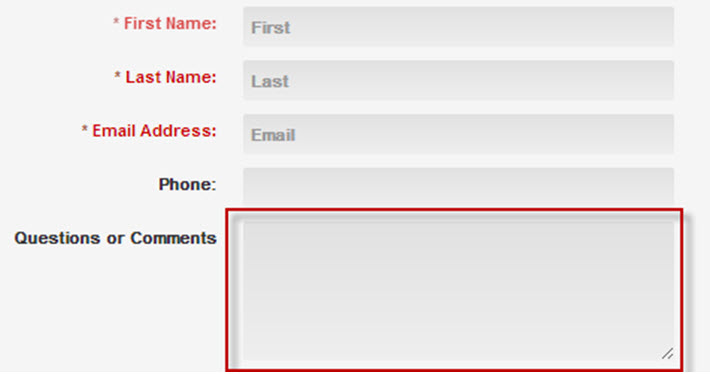
‘Contact us’ forms are similar to social media in that they provide a way to receive customer feedback — which is very valuable. Broken ‘contact us’ forms send a clear message: “we don’t care about your feedback. Don’t contact us.”

But I’m sure that’s not true. You must care about your customers’ feedback. Their satisfaction keeps you in business.

So if you have a minute, check your website’s contact forms. Make sure they’re flexible, easy to use, and most importantly, that they work. A small effort can go a long way in preventing customers from walking away for good.

Share and Enjoy:
  • LinkedIn
  • StumbleUpon
  • Facebook
  • del.icio.us
  • Digg

Rich Media Mobile Ads

March 10th, 2010 1 comment

As the mobile market continues to grow, mobile advertising opportunities are growing right along with it. The capabilities of the ads, too, are quickly expanding.

This week the Mobile Marketing Association released a Rich Media Mobile Advertising whitepaper. You can take a look at the free six-page guide to get a quick introduction to the types of rich mobile ads in the market (not including apps or games).

While mobile display advertising mimics some aspects of online display advertising, there is one key difference I noticed from the whitepaper’s examples. Mobile ads are more likely to expand into a full-screen experience—which is not a common feature in online display ads.

“As highly interactive and feature-rich smartphones continue to dominate new mobile device sales, rich media mobile ad units will comprise an ever-growing portion of the mobile advertisement display market in the U.S. and around the world,” according to the MMA’s whitepaper.

In the fourth quarter of 2009, an average of 19% of mobile advertisers used rich media mobile ad units, according to the whitepaper. These ads include:
o Ads with video, sound or interactive features
o Expandable ads
o Animated ads
o Floating ads

Take a look at the report for great examples from promotions involving The Weather Channel, Alice in Wonderland and Lincoln. The examples include high-quality screenshots and brief descriptions of the ads’ functionality.

If you’re interested in rich mobile advertising, the report can give you a few examples for inspiration, and a few guidelines around sizing, functionality, and why you should give users “close” and “skip” buttons in the ads.

Are you buying these types of ads? If so, let us know what you think of them in the comments…

Share and Enjoy:
  • LinkedIn
  • StumbleUpon
  • Facebook
  • del.icio.us
  • Digg