
Archive

Archive for 2009

How to Be Cool

August 12th, 2009

Referrals from friends are a strong influence on how teens and tweens learn about “new brands and cool new stuff,” according to survey results released last week by Pangea Media.

Pangea is an entertainment an online advertising company that operates a network of quiz-related websites. The survey received 2,396 responses, and allowed for multiple selections when asking “How do you find out about new brands and cool new stuff?” The results:

o 76.4 % friends
o 75.5% stores
o 56.8% television commercials
o 52.6% magazine ads
o 39.8% online ads
o 35.0% Web/search engines
o 27.7% television shows

The results from asking how they “learn about new stuff” online (only one answer could be given):

o 27% ads in search engines
o 24% social networking sites
o 21% when friends email or IM
o 15% pop-up ads
o 13% trusted website

The results underscore that one of the best ways to earn your brand the elusive “cool factor” among consumers age 10 to 19 is have your brand referred to them by a friend. Stores are another powerful place to reach this demographic, even more so than any type of advertising queried, according to the survey.
Pennies in Direct Mail

August 5th, 2009

Every once in a while I hear about a marketing promotion gone horribly wrong. When I first heard about a 1956 Reader’s Digest campaign that involved pennies, I thought it was another marketer’s tale of woe.

The late Walter H. Weintz, a direct mail pioneer and the circulation director at Reader’s Digest in the 50s, mailed 100 million pennies as part of a subscription campaign. The pennies were mailed with a letter encouraging recipients to mail back one penny as a down payment on a subscription, according to the New York Times article linked above.

Here’s what happened, according to this random fact book:

“The magazine planned to send out 50 million letters, which meant they needed 100 million coins–enough to deplete the entire New York area of pennies. The U.S. Mint intervened, forcing Reader’s Digest to make quick arrangements to ship in 60 million more pennies from all over the country. Then, when the company finally got all the pennies it needed, it stored them all in one room–and the floor collapsed under the weight.”

Sounds like a total disaster right? Not exactly. The promotion drew a record number of responses.

“That mailing, along with other direct marketing campaigns that Mr. Weintz conceived, was credited in large part for raising the magazine’s circulation” from about 4.5 million in 1948 to over 12 million in 1959, according to the New York Times.

Weintz took a big risk on that campaign, and it paid off big time. It goes to show that marketing far out on a limb can yield the best fruit–but only if the branch doesn’t break under your feet.

Ad Strategies in the Down Economy

July 27th, 2009

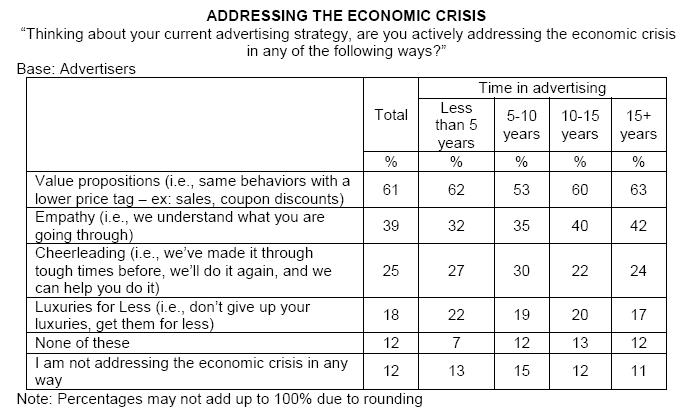
Well over half of marketers report that they’re using strategies that emphasize value propositions–such as sales, coupons and discounts–to pull through the down economy. The data comes from a collaborative survey from LinkedIn and Harris Interactive, published last week.

The survey queried 1,015 advertisers between June 22 and June 30, and 2,025 adult consumers between June 24 and June 26, to get both groups’ opinions on ad effectiveness. You can read the full release here.

Three in five advertisers (61%) say they are using a value proposition strategy and almost three in five consumers (57%) say that the strategy is working ‘very well’ or ‘well’ to help marketers sell.

From the charts below, empathetic messaging was the second most reported strategy used by marketers to address the economic crisis at 39%, and 24% of consumers say the strategy is effective.

Addressing the Economic Crisis: Advertisers

Addressing the Economic Crisis: Consumers

Interestingly only 18% of marketers report using a ‘luxuries for less’ strategy, while 34% of consumers say that it works ‘very well’ or ‘well’ to help sell products. This disconnect could be due to a low number of luxury product marketers in the survey–or it could be a genuine disconnect between what consumers say they want and what advertisers are giving them.

Take a look at the survey’s results to see if you are using any types of messaging or tactics that are being reported to be less effective than others. You might just be able to make a few tweaks to your efforts to boost performance.

38% Decline in Direct Mail Predicted

July 14th, 2009

I recently had a conversation with Gordon Borrell, CEO, Borrell Associates, Inc., in which he made some startling predictions for the future of several advertising markets. Borrell’s team specializes in tracking local advertising and reporting how much advertisers are spending in a channel by region.

The most surprising prediction Borrell shared is that spending on direct mail will decline 38% over the next five years. Marketers spent about $48 billion on direct mail last year, Borrell says. While that size might suggest stability, Borrell says that it is actually an indication that the platform is in line for a mighty fall.

“When something grows really fast and gets up to a high level, and there’s a disrupter in the market place, some other technology that provides pretty much the same level of service but in a more efficient way, then you can expect there to be a roller coaster decline.”

That disruptor is Internet marketing in general, and email marketing in particular, Borrell says. Email is an affordable way to send personalized and targeted messages, and the technology continues to improve.

Also, recent reports that the United States Postal Service is considering eliminating Saturday service is contributing to his team’s prediction, Borrell says.

“If the day they cut is Saturday, then that really hurts direct mail. Marketers love to get pieces into homes on Friday and Saturday, because that’s when the buying is done in households.”

Borrell and his team base their predictions, in part, on a disruption model. They analyze what happened to markets of the past when disrupted by a new technology, and apply those lessons to current events.

Has your team cut direct mail this year? Or do you plan to in the next five years? Let us know in the comments…

CompuServe Is No More — But Will Email Addresses Remain Active?

July 7th, 2009

CompuServe, the pioneering online service, quietly ended its 30-year run on June 30. Current owner AOL made the shutdown announcement via email to its dwindling ranks of subscribers, prompting blog eulogies from nostalgic fans — and a little bit of snark from the peanut gallery (“CompuWHAT?”).

The news caught my eye, not only because I’m a former user.

I remember logging on to CompuServe to check stock market quotes and search a Lexis-Nexis-style periodical database during my first reporting job out of college. I also shared one of those now-ludicrous numerical email addresses with about four other reporters.

More relevant to the here and now is the notice that current subscribers can retain their existing CompuServe Classic email addresses.

The process requires subscribers to migrate their old accounts to a new, Web-mail service through an online registration form — but how many of those address will, indeed, remain active?

Subscriber apathy, user error, or technical glitches could cause many of those addresses to stop functioning. And if you’ve got CompuServe address in your email database, that could mean more bounces in the coming weeks.

So take a look at your database. See how many @compuserve.com addresses you’re currently mailing, and watch for bounces or other signs of inactivity in future campaigns. You don’t want to purge those addresses from your list immediately, but you also don’t want the ghosts of past ISPs threatening your list hygiene.

CompuServe Classic Mail Migration:
http://member.compuserve.com/mailcenter/default.jsp

CompuServe Eulogy from The PaperPC
http://paperpc.blogspot.com/2009/06/compuserve-classic-so-long-old-friend.html

Branded Value via Mobile

July 7th, 2009

Getting your target audience to have a positive experience with your brand is, of course, beneficial. However, not enough marketers are providing real value to their audiences, says Steve Rubel, SVP and Director of Insights, Edelman Digital. More marketers should strive to create a positive and useful experience in a branded context, he says.

Rubel is responsible for keeping Edelman Digital and its clients “ahead of the curve” with the latest ways to effectively manage public relations and marketing. He is also the author of the popular Micro Persuasion blog and maintains a personal Twitter feed with over 27,000 followers. Edelman is the largest independent PR firm in the world with 3,300 employees in 50 offices worldwide, Rubel says.

Rubel cited two companies that are providing useful, branded experiences via the iPhone:

1. Kraft’s iFood Assistant – this app sells for $0.99 in Apple’s iPhone store. It has the following features:
o Recipe browsing
o Recipe of the day
o Shopping lists
o Directions to nearby markets
o How-to cooking videos

2. Tylenol PM’s Sleep Tracker – this app is free and has the following features:
o Log your sleep hours and moods
o View your sleep and mood history over time
o Create a sleep journal
o Get tips for better sleeping

Of course, the iPhone is not the only channel for providing a valuable, branded experience. I am currently working on a Sherpa article that describes how marketers for a cable television channel created a series of SMS alerts that provided valuable, relevant tips alongside a reminder to tune in to a weekly show. The team was able to take a weekly reminder and make it more attractive by adding useful information.

Leveling with Vendors

June 24th, 2009

Buyers have more power these days, and that can be distressing for marketers. But it doesn’t always have to be. Marketers are customers, too.

Last week, we published an article with strategies for negotiating better rates from website technology vendors. The article describes the strategy of Ben Kirshner, CEO, CoffeeForLess.com. Kirshner has negotiated the rates and trials of dozens of solutions, and he says that vendors are being more flexible this year.

The additional flexibility is because the vendors — like many marketers — are not seeing the same level of sales as years passed. They’re hard pressed to sign new accounts and keep their businesses growing. Sound familiar? The economic plight of the vendor and marketer are one and the same. If your team is struggling, the vendors will likely understand.

One tip that did not make it into the article: If your sales are down, Kirshner suggests giving your vendors a call an asking them for a break on your rates.

“Tell them that your sales are off 10, 20%, or whatever the case may be, and ask them ‘can you do anything?’” he says. “The worst they can say is ‘no,’ and the best they can say is ‘yeah, how much do you need us to knock off.”

More Efficient Marketing

June 15th, 2009

“In a bad economy, the last thing you want to cut back on is marketing,” says Jeremy Farber, President and Founder, PC Recycler.

Farber’s team added between 20% and 30% to its marketing budget over the last year to avoid losing ground, and in hopes of gaining market share, he says. That created several new processes and a lot more work for the electronic waste management service’s marketing team.

Last fall, after the budget increase, the marketing team was distressed. It could not keep up with looming deadlines unless cuts were made or an additional person hired. Being based in the metro Washington D.C. area, Farber did not want to hire another marketing manager.

“A white collar job around here is expensive.”

Instead, the team tested using Lyris HQ, a search, email and analytics software package. The tool combined several of the team’s separate processes into one platform — saving a ton of time, Farber says.

“We’re getting more work done now with the same budget and the same people, which obviously is translating into better ROI.”

Farber estimates that using the tool is about 60% to 70% less than the cost of hiring another person. On top of that, the tool proved more effective than some of the separate systems that the team previously used. For example, the insights gleaned from Lyris’ Web analytics revealed ways to boost conversion rates from paid search marketing — the team’s number one lead generator.

So even though the Chinese word for crisis is not exactly “danger” and “opportunity,” a down economy is still not a good time to cut a marketing budget. Instead, it’s a time to look for greater efficiencies.

Google Making Waves

June 4th, 2009

Google is rocking the boat in the blogosphere with its latest announcement: Google Wave. I had a chance today to check out the video of a developer’s preview of the tool. It’s long — about 80 minutes — but it’s very clear and jam-packed with feature demos.

At first glance, Wave looks like an email and instant messaging hybrid built for the browser — but that’s just the beginning. Users can take their conversations and embed them into blogs and other websites with ease — and the conversations can be added to at the blog or the users’ account page. Users have a centralized place where they can add to conversations that are happening all over the web, “which will make flame wars so much more effective,” quips Lars Rasmussen, Software Engineer Manager, Google, and co-founder of the Wave team, in the video.

The tool has many other features, including:
– Drag and drop photo functionality
– Drag and drop friends into conversations
– Reply to specific portions of conversations
– Watch replays of how conversations developed (useful for those coming late to a discussion)
– Real-time conversation capability — to the point where you can watch your friends’ every keystroke
-And there’s more

Also interesting is a comment during the presentation’s introduction by Vic Gundotra, VP of Engineering, Google, that those watching the demo will surely forget that they were watching a browser client — not downloaded software. And in my case, he was right. I was blown away when I realized that the tool is hosted elsewhere — like Gmail. The only capability that requires a download is the photo functionality, which requires downloading Google Gears.

On top of all this, Google Wave will be open sourced — allowing any developer to create new uses and features — which is huge. The feature set will likely explode after launch.

Ah, yes — launch. Did I forget to mention that this is not yet available to the public? If you’re interested, Google will notify you when Wave is ready to go live sometime later this year — as my colleague Sean Donahue noted last week.

The potential for businesses — and communication in the Web in general — is large. Businesses can have an easy, free way to communicate and collaborate on projects. And it will be much easier for the public to socialize and interact online — which might give a very large booster shot to Web 2.0 in its infancy. This is certainly worth keeping an eye on — and it’s Google — you know that ads will eventually be squeezed in somewhere.

Start a Company Blog?

June 3rd, 2009

A company blog can be a great way to build brand, credibility and site traffic–but blogging is often more work than first expected. And positive results rarely come quickly. The benefits gradually build as you toil through post after post.

Also, there are blogs on topics from fruit to adhesives, and there are likely a couple that relate to your business. That means a new blog would have to compete. However, you don’t have to compete with blogs to enter the blogosphere, says Jay Krall, Internet Media Research Manager, Cision.

“Too many times, I think, people fall into the trap of thinking that they need to start a blog, when in fact they would do much better to take six months to engage heavily with the blogs in their space,” Krall says. “I don’t want to discourage people from writing a blog, but you have to listen first. You have to take some time to make sure that you understand what’s already being said in that space.”

If you’re thinking of starting a blog for business reasons, consider the opportunity costs of the time you’ll have to invest. Would that time be better invested elsewhere? You might get better, faster results (in the shorter term) by doing blogger outreach.