Archive

Archive for 2009

Capitalize on media attention to build relationships: Two approaches

May 29th, 2009

This week brought us dueling product announcements from Google and Microsoft that, naturally, got a lot of attention from media and bloggers. But as I was reading about Microsoft’s new search engine, Bing, and Google’s upcoming Wave communication tool, I noticed something interesting about how the companies are trying to capitalize on crush of media attention and Web traffic.

– Google’s Wave homepage features a prominent blue button that says, “Let me know when it’s ready,” which takes users to a quick survey and email sign-up form to be sent future updates about the product.

It’s a smart tactic: Product-launch alert campaigns are a great way to capture opt-ins, and those messages tend to generate strong open and clickthrough rates.

– Microsoft’s Bing homepage, on the other hand, doesn’t feature an email sign-up form (as far as I could see). Instead, it appears the Microsoft team is using social media to make connections with interested visitors.

The Bing site features a link to a Bing Facebook group, and invites visitors to follow Bing on Twitter.

I haven’t seen data or done a case study yet on using social media to keep potential customers in the loop about product announcements. I’d be very interested to see how it compares to email in generating interest and activity after launch.

But in both cases, Google and Microsoft are being smart about weaving an engagement strategy into a big publicity push. Whether you’re using email, Twitter or another channel, you can make a direct connection with your audience that turns a sudden, transitory wave of interest in your company or products into the first step of a long-term relationship.

Consumers’ Mobile Shopping Preferences

May 27th, 2009

Billing Revolution released some results today from a survey it commissioned on consumers’ mobile shopping preferences. Harris Interactive conducted the survey and queried 2,029 US adults, ages 18 and older, from April 29 to May 1 of this year.

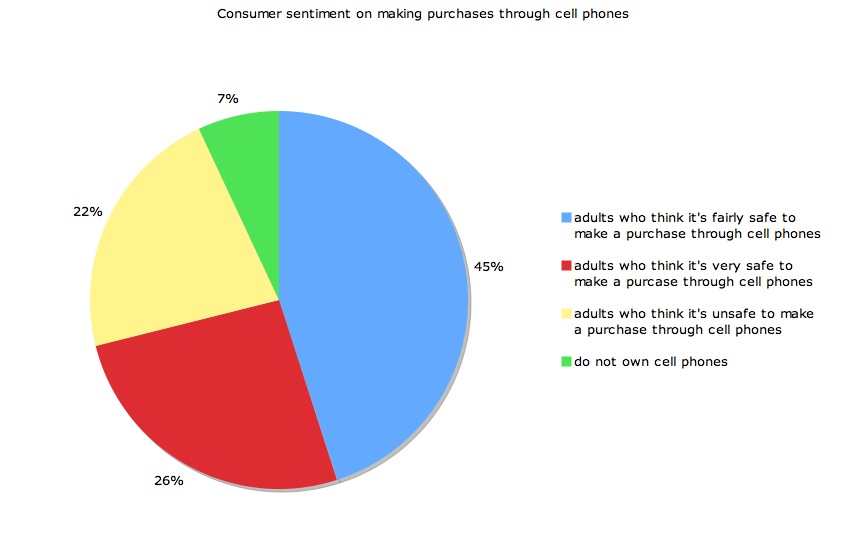
Of adults who receive bills from cell phone and credit card companies, 57% said they trust card companies more than cell phone companies for accurate billing. Here’s a pie chart with more results (you can click it for a larger version):

consumer-sentiment_safety_final

Of mobile users, more younger users (59%; ages 18 to 34) thought it was at least somewhat safe to purchase through a mobile phone than older users (34%; ages 55+). More male mobile users thought it was at least somewhat safe (50%) than female users (39%).

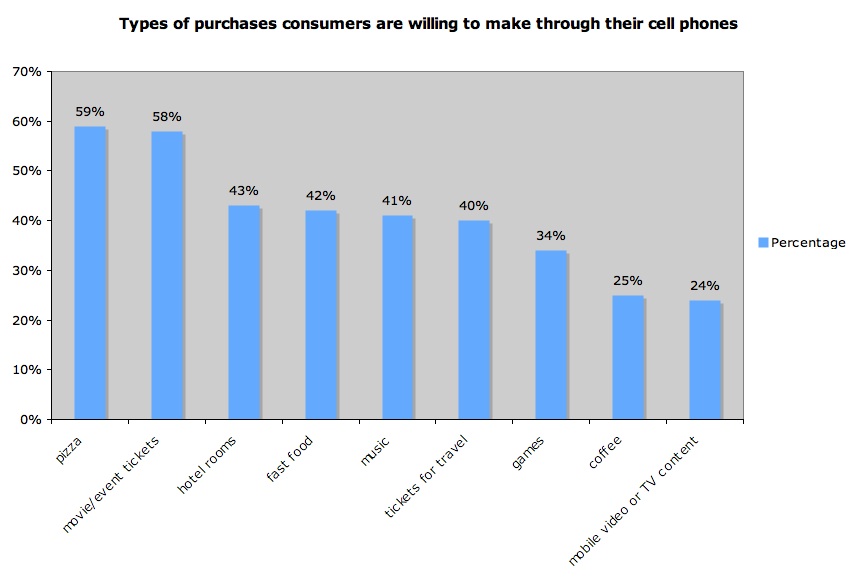
Of those willing to make purchases:
o 75% would be willing to buy entertainment items, such as:
– Event/movie tickets (58%)
– Music (41%)
– Games (34%)
– Mobile video or TV content (24%)

o 68% would be willing to purchase food or drink items, such as:
– Pizza (59%)
– Fast food (42%)
– Coffee (25%)

o 43% would be willing to purchase hotel rooms
o 40% would be willing to purchase travel tickets

types-of-purchases_broken-into-categories

Twitter Surveys for Quick Opinions

May 19th, 2009

Marketing decisions are best made with a level of certainty about an audience’s preferences. You don’t want to start offering a feature that customers aren’t interested in. And you don’t want to push a marketing offer that they don’t care about.

Social media and data mining can be used to find an audience’s preferences. And as we outline in a case study recently, online surveys are still effective strategy. Then last week I interviewed Glenn Edelman, VP Marketing, Wine Enthusiast, who has recently combined social media and surveying.

Edelman is responsible for Wine Enthusiast’s wine accessories ecommerce site, and WineExpress.com’s direct-to-consumer ecommerce wine sales. His team uncovered a great strategy for selling wine via email with product pages that include “virtual wine tastings” in two- to three-minute videos (the case study will be published by eTail later this month, and then by MarketingSherpa).

When adding video to the wines’ product pages, Edelman’s team wondered whether the videos should automatically play, or wait to be clicked by visitors before playing. The team asked Wine Enthusiast’s Twitter followers about the idea.

“We thought about testing it but said ‘hey, let’s ask our audience.’ And we got a huge, huge response to never do auto-play. ‘We hate auto-play,’ they said. It was such as negative response that we didn’t even bother testing,” Edelman says.

There you have it. Twitter can be used as a quick way to get your audience’s opinion, in addition to its other marketing applications, such as branding, PR, and promotion.

Reaching Local Searchers

May 12th, 2009

I had an interesting conversation with Scott Dunlap, CEO, NearbyNow, last week. NearbyNow helps consumers find products in local stores through its website, mobile apps, and the major search engines.

A consumer looking for a particular product in his or her area will typically be alerted via an email or a text message on the product’s availability. This service has several interesting applications for marketers–such its OnTheWay ads. These ads allow marketers to advertise in the alert messages to consumers who’ve indicated that they’re planning to visit a store near their own.

Some marketers, Dunlap says, have leveraged these ads to emphasize the core motivations that consumers have for searching for local products. The top three motivations that Dunlap’s team has uncovered,:
1. Consumers want the products immediately
2. They want to see, hold, and test the products (particularly relevant for apparel, shoes and gadgets, Dunlap says)
3. They do not like the hassles or costs of shipping

How have these motivations been applied to the ads? Some marketers are pushing immediacy to the extreme. They will give 20% off products in their stores for the next two hours. That can force some consumers to consider visiting the advertiser’s store before visiting their intended destination.

Local search and sales for products–with real time inventory updates–looks like it holds a lot of potential for retailers and brands alike. I expect the major search engines to start rolling out more ways for marketers to connect with consumers looking for products locally.

Two Weeks Notice: Seeking Speakers For Demand Generation Summit

May 7th, 2009

In case you haven’t seen the link in our newsletters or on our homepage, we’re currently accepting speaking proposals for our 2009 B-to-B Demand Generation Summit.

With the deadline for submissions just two weeks away — May 21 — I wanted to give our readers another heads up. This is your chance to stand up and share your best practices, most successful campaign tactics, or insights into what works now in B2B marketing.

Again, we’re most interested in your own experiences, campaign war stories, case studies and lessons learned in areas such as:
o Lead nurturing
o Lead scoring
o International demand generation
o B-to-B email
o Paid search advertising and SEO
o Social media marketing
o Events
o Creating marketing content

Take a few minutes to submit your proposal here.

Don’t forget, this the the Summit will be held September 23-24 in San Francisco, and October 5-6 in Waltham, MA.

Online Leads and Offline Conversion

May 5th, 2009

I recently talked with Chris Knoch, Principal Consultant in the Best Practices Group at Omniture, about how to best measure and monitor a site’s SEO results (keep an eye out for the article in our search newsletter).

Knoch provided a wealth of information. One bit I found particularly interesting was about connecting offline conversions to online behavior. Many marketers invest loads of time and effort into search marketing to generate leads that will convert offline. Most of these marketers are certain of how many leads they’re getting, but are less certain of which channels generate the best leads; those most likely to convert.

A rental car company, for example, might collect leads online by pointing traffic to an online registration form. The customers convert and pay when they arrive on-site to pick up the car. So leads are generated online, but not all of them will arrive on-site to complete the conversion.

For marketers in this boat, connecting online lead gen to offline conversions is essential to determining which efforts are pulling in the best leads. Is it paid search? If so, which keywords? Is it natural search? Is it display advertising? You should strive to segment the performance of each channel, Knoch says.

“If you’re not mapping your online [lead gen] to your [in-store] conversions, you may be judging your natural search just the same as your display–which is not a good thing to do,” Knoch says. “If you’re not optimizing to offline data metrics, then you’re missing the full picture and you may be spending money on the wrong keywords or the wrong channels.”

Improving ROI: 5 Insights

April 29th, 2009

Return on investment is top of mind for marketers these days as most marketing efforts come under the scrutiny of ROI justification.

Here are a few insights gleaned from an interview with Jim Lenskold, President of the Lenskold Group, about how to improve and optimize the measurement of marketing ROI:

1. The biggest challenge in improving marketing ROI is removing cultural barriers and instilling a sense of discipline in planning and assessing the financial contribution of marketing.

2. Marketing strategies that do a better job targeting higher value, higher converting segments have the greatest impact on ROI.

3. Measurements that use market testing and modeling are most conclusive and often under-utilized when measuring marketing effectiveness.

4. Choosing measurements that provide insight about how to improve future initiatives is the most important step in generating greater performance and profitability.

5. Using revenue instead of profits as the return is a basic financial error that marketers make. It must be corrected for accurate ROI calculations and credibility with executives.

Great Idea for Tracking Organic Search Results

April 23rd, 2009

When speaking with Erick Barney, VP of Marketing, at Motorcycle Superstore, about how his team saves precious marketing dollars for the company I couldn’t help overhearing a really innovative way they track organic search rankings.

The team creates thousands of web pages for key search terms to improve the site’s SEO. To make sure SEO efforts are effective they produce a monthly “Keyword Visibility Report.” It’s basically a report of how well the company’s top 100 keywords are performing.

“We have a scoring system to assign any movement,” Barney says. “Anything that’s 30 or above we just put an N/A. We track anything that’s got a position from 1 to 30 and we’ll plot it each month and as it moves around we’ll assign a new rank.”

The report makes it easy for them to see if their SEO efforts are paying off. In addition, Barney has an incentive program tied to the report, giving the team a reason to push the bar even further. How cool is that?

Twitter is Growing–and Aging

April 21st, 2009

Think Twitter is going down? Think it’s just for kids? You might want to think again. A graph from comScore shows an enormous spike in visits in January and February. Eyeballing the graph shows about 100% growth worldwide, about 5 million more unique visitors.

More recent comScore data on the US market shows a continued surge in visits to the micro-blogging site, from 2 million UVs in January to 9.3 million in March. That’s a 365% increase!

My guess is that Twitter’s most recent explosion in traffic has been magnified by the press. A search for “twitter” in Google News for the past month retrieved over 65,000 results. The same search for all of 2008 retrieved 25,500 results. I don’t understand the nuts and bolts of Google News nearly enough to consider this solid data–but I can say for a fact that I’ve heard more talk and press about Twitter in the past six weeks than I have since the site’s 2006 founding.

Also, traditional mass media typically has an older audience in the US, and this generation has been checking out Twitter–a lot. The largest portion of February’s 4 million UVs were age 45 to 54, according to comScore’s second chart on this page. The second largest group was age 25 to 34, followed by age 35 to 44. (The chart’s time period is not mentioned, but we called to check–it’s for Feb.)

What does this mean? Twitter is exploding, the media is talking about it, and people older than 20-something are checking it out. You cannot assume that the platform is insignificant and only appeals to a younger audience.

Market Research via Social Media

April 17th, 2009

Consumers are expressing themselves in thousands of ways online, including in videos, images, forums, and blogs. The diary-like style of blogs can offer unique insight into a person’s life and opinions. And, since they’re written in text, blogs can be more easily aggregated and mined for insights than other media, such as video.

I recently had the pleasure of interviewing Janet Eden-Harris, VP of Web Intelligence, J.D. Power and Associates, on this topic. Eden-Harris works in a division of the market research firm that is responsible for mining social media for market insights. Information gathered this way can, at times, be more valuable than a survey, she says.

“People go to their blogs, to message boards, chat rooms, and forums, really, to talk to one another. And they talk spontaneously about products, services, and their lives… You’re not prejudicing them by asking a question. You are listening in, or overhearing conversations that are taking place spontaneously.”

Well-read bloggers also tend be very passionate and knowledgeable about a specific topic, she says. “These are the people that you very likely want to listen to most because they are more or less your thought leaders and opinion leaders.”

Eden-Harris and her team gather data from publicly available social media sites across the Web. They do not gather information from any sources that require a password, such as Facebook. Other social media sites, such as MySpace, do not always require a password. The team is not concerned with the gathering information about specific bloggers, she says. Instead, they are concerned with their topics and opinions.

“Essentially what we’re doing is collecting [this information] into a database, and we mine millions of posts every week and continually mine them,” she says. “It goes beyond demographics. It goes into what motivations do people have for buying or using a product or responding to a trend.”

Her team uses Natural Language Processing, a branch of computer science, to scan the posts for insights. NLP can be used to analyze text for subject matter, sentiment, and assumptions about a person’s background, such as sex and age. By scanning millions of posts, the team can uncover who is saying what about products and companies, and create reports.

Types of Reports

There are four main categories of information that companies ask J.D. Power to research that can involve mining social media, Eden-Harris says. They are:

1. Brand monitoring – This is the most common type. Marketers want to know what consumers are saying about their companies and their competitors. Marketers could survey their own customers, but it is much more difficult to survey their competitors’ customers themselves.

2. Trend analysis – Marketers also ask for analysis on the current trends in a market, and where the market is heading. It can be difficult to pick up on trends in surveys, but you can often pick up on them through blog and social media research, Eden-Harris says.

3. Customer information – Marketers also ask for more information about their current and potential customers. Blogs provide particular insight in this category since many consumers will identify themselves as a customer in one post, and talk about their personal lives in other posts. The posts can also provide information on the best language to use when communicating to customers.

4. Unmet needs – it is also possible to collect information about what products consumers wish they had. “Consumers are classically not particularly good at coming up with product innovations, but, boy, are we good at saying what annoys us and what we wish we had,” Eden-Harris says.