Archive

Archive for 2010

Ten Numbers Every Email Marketer Should Commit to Memory

November 2nd, 2010

Earlier this month I led my ninth full-day Email Marketing Essentials Workshop Training for MarketingSherpa. One of the most popular parts of the day is the on-the-spot critiques of email creative. They are gentle critiques – attendees send samples and as a group we talk about how they follow standards and best practices and what the marketer might test to improve performance. I’ve had people tell me that the critiques of their pieces alone were worth the cost of admission, but I digress.

Creative is nice, but quantitative data is where the rubber meets the road for me. So I often ask attendees about the performance of the creative we’re viewing. What’s your abandon rate on that email sign-up page? How was the click-through rate on this email? Why do you send this every month – does the ROI justify it?

And it surprises me how many marketers don’t know these numbers off the top of their heads.

Now, I admit it; I’ve always had a head for figures. When I check-in to a hotel my room number always imprints on my mind right away. Early in my career I was a fixture at upper level meetings, because my bosses knew that I’d be able to answer, off the top of my head, just about any quantitative query that arose.

But still…

In my perfect world, here are the ten numbers that every email marketer would have committed to memory (join us in Miami or Los Angeles and impress me!):

1. Percentage of New Website Visitors that Sign-up for Email

New, rather than returning, Website visitors are a key audience for email acquisition. Anyone who visits your Website and likes what they see is someone you want on your email list. That way you have the ability to begin a relationship with them via email – and sell them, over time, on your company and your offerings.

There’s no “magic number” for this type of conversion. But there’s also no reason that you shouldn’t always be trying to improve it. I’ve seen new visitor conversion rates from 0% to 25%. They key is to know what your conversion rate is and to always be looking for ways to improve it.

2. Abandon Rate on Your Online Sign-up Process

How many people that start your sign-up process bail out before they are finished? This is important because if you can figure out why they left and address the issue, you have an instant boost in your list growth.

There’s no golden rule for what your abandon rate should be, except the lower the better. I’ve seen abandon rates as high as 90%, meaning that 9 out of 10 people that thought they wanted an email relationship changed their mind during sign-up. If you’ve got 50% or more of the folks abandoning your sign-up process, you have plenty of room for improvement. And even if it’s only 25%, making changes to get it to 20% would provide a nice lift in list growth.

3. List Size

Everyone should know how many email addresses they have on their email list. This is a basic and most people do have this information close at hand, I’ll admit. But be sure you get monthly updates.

As with some of the other figures, there’s no perfect size for a list. I’d rather work with a client that has a small but responsive list than a large list that’s unresponsive. It’s usually more difficult to do any statistically significant testing with a list of less than 40,000 email addresses. The key here is to know the universe of your target audience and work to get as many of them as possible to sign-up for your email program.

4. Monthly List Growth Rate

How much is your list growing, or declining, each month? It’s an important question to be able to answer since it goes directly to the long-term viability of your email marketing program.

MarketingSherpa’s 2010 Email Marketing Benchmark Report reported that lists that were growing did so at an average rate of 19.2% every six months. Those with declining lists reported a 10.3% decline over the same six-month period.

If you do the math, that’s an average monthly list growth of 3.2% for those with lists that are increasing. If your list is growing more quickly than this, great – but you still want to be thinking about how you can boost acquisition performance.

5. Bounce Rate

Bounces shouldn’t be a large part of your email send – but you should know this figure cold. If it’s higher than the industry average, then you may have serious issues with your list, list management and/or with being blacklisted (since some, but not all blacklists return a bounce message).

The Epsilon Q2 2010 Email Trends and Benchmarks Study reported an average bounce rate of 5.2%. If yours is higher, it’s worth some analysis to figure out why.

6. Open Rate

What percentage of your email audience is opening your missives? Opening is the first step to action, so this figure directly impacts your overall campaign performance. Open rates are somewhat controversial, but if you look at them as a relative, rather than an absolute, metric, they are still very useful.

Open rates are running from 16.4% to 31.5%, depending on industry, according to the Epsilon Q2 2010 Email Trends and Benchmarks Study. The average across all industries is 22.1%. If your open rates are below this it gives you something to shoot for. If you’re exceeding these metrics, there’s still always room to do better.

7. Click-through Rate

Click-through rate, calculated by dividing unique clicks by the quantity assumed delivered (send quantity minus bounces), is an important figure. Don’t get it confused with your click-to-open rate (sometimes referred to as the “engagement rate”) – which is useful but very different.

The Epsilon Q2 2010 Email Trends and Benchmarks Study is reporting an average open rate of 5.3%; the range across industries is 3.2% to 10.1%. As with opens, you should always know where you are in relation to industry benchmarks – and always be striving to improve your performance.

8. Conversion Rate

There are many different types of conversion rates, but the one I’m speaking of here is related to the bottom line goal of your email. If you’re looking to generate leads, then it’s the number of leads you generated divided by the quantity of email messages assumed delivered (quantity sent minus bounces). If you’re going for direct sales, then substitute direct sales for leads generated. If your email has some other goal, like driving traffic to a brick and mortar location, then substitute that.

Conversion rates are all over the board. Much depends on what your goal is and how much effort and/or commitment is required from the respondent to achieve it. I’ve seen conversion rates as high as 40% (and this conversion required a purchase!) – and as low as 0%. As with many of the other metrics, there’s no hard and fast measure of success here – but you always want to do better.

9. Return on Investment

Return on investment is calculated as how much revenue you generate for each dollar you spend on your email program. Some email marketers I’ve met shy away from even trying to calculate ROI because either (a) they have no way to track revenue associated with email or (b) they don’t feel they have a clear way to delineate the costs of their email program. While it’s great to have an absolutely accurate ROI, even an estimate can be useful. As long as you use the same formula to calculate ROI send-over-send and month-over-month, you can get a relative read on whether it’s improving or not.

The Direct Marketing Association projected that email will return $42.08 for each dollar spent on it in 2010. That figure is somewhat controversial, many feel it’s too high, but remember that it’s not a measure of success or failure. If your email marketing is profitable, returning more than $1 for each dollar you spend, it’s a success. And if you are making more than $42 for each dollar you spend, then your goal should be $50.

10. Dollar Value of an Email Address

What is an email address worth to your company? This is another figure which few marketers know, but it’s critical to the success of your acquisition efforts. The easiest way to calculate it is to divide the overall revenue generated from your in-house email efforts by the average number of people on your house list. When you know how much revenue you can expect from an email address, then you know how much you can spend on acquisition.

There’s no right or wrong answer here, and no industry benchmarks which would be valuable to gauge against. But that shouldn’t stop you from generating a quantitative figure. And as with the other metrics, you should strive to be sure that the value of each email address goes up, not down, with time.

Editor’s Note: Jeanne Jennings is teaching MarketingSherpa’s Email Essentials Workshop Training in 12 locations across North America this year; the next one takes place in Miami on November 9th. She’ll be blogging about the course material and her experiences during the tour. We’re excited to have her on board and contributing to the blog.

Related resources

MarketingSherpa Email Awards 2011

MarketingSherpa Email Summit 2011

MarketingSherpa Email Marketing Essentials Workshop Training
Email Marketing Manager: Look past campaigns to boost your career

October 29th, 2010

Hey email marketing managers…are you working hard to create the best possible campaigns? If so, you may be missing a huge opportunity. Check out my recent chat with noted marketing strategist and best-selling author David Meerman Scott at the recent MarketingSherpa B2B Marketing Summit

I like campaigns myself. I’m a plan-ahead kind of guy. But David makes an excellent case for real-time marketing. In a 24/7 news world, we can’t be complacent and just set it and forget it.

He also makes a good point that massive, monolithic corporations are so…impersonal. As MECLABS Managing Director (CEO) Flint McGlaughlin says, “People don’t buy from websites, people buy from people.

So look past your campaigns, get all of your real people out from beyond the corporate façade…and hopefully advance your career in the process.

To hear more from David Meerman Scott, join us in Las Vegas from January 24-26 for MarketingSherpa Email Summit 2011. Thanks to a generous sponsorship by ExactTarget, David will be the keynote speaker. And Flint will be speaking there as well.

Related Resources

Email Summit 2011 – Learn from Sherpa’s Latest Research, Case Studies and Training

B2B Marketing Summit Wrap-up: Quick takeaways distilled from 478 marketers on lead nurturing, social media marketing, and more

Transparent Marketing: How to earn the trust of a skeptical consumer

B2B Marketing: Are tradeshows on the way out?

October 28th, 2010

Bet that title got your attention. And the answer is, “Of course not.” Tradeshows, seminars, expositions and conferences have been a key way to connect with customers and colleagues for a long time (see the recently completed MarketingSherpa B2B Summit for just one example), but these events are facing some stiff competition from cyberspace.

The MarketingSherpa 2011 B2B Marketing Benchmark Report just came out and I had the chance to review it a couple of weeks ago. The report covers B2B marketing tactics, budgeting, challenges for the coming year and more. The information was gathered through 935 marketer surveys and the report includes 167 charts and tables.

The Benchmark Report is full of great material, but one particular chart really caught my eye:

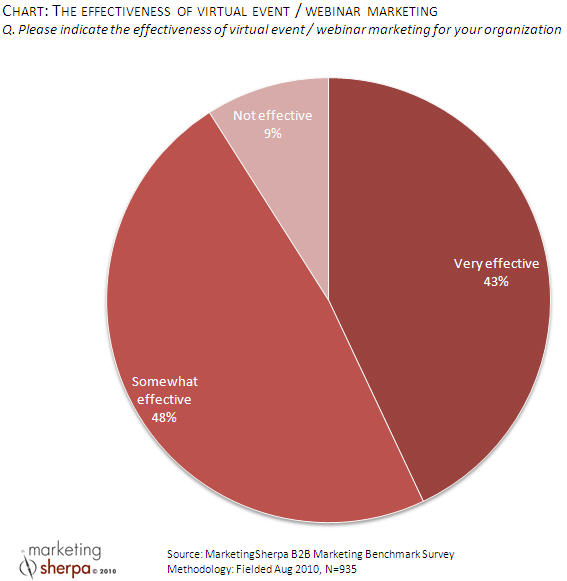
The effectiveness of webinars is significantly greater than tradeshows

Now you’re probably thinking, “What gives?” I grabbed your attention with a dramatic title and immediately calmed things down with a reassurance that tradeshows aren’t going away anytime soon. Now this bit about effectiveness? The strong numbers for the effectiveness of virtual events and webinars are very intriguing, but maybe because they are so much less expensive to execute, marketers are placing too much value in the online events.

I asked Jen Doyle, Senior Research Analyst at MarketingSherpa and Lead Author of the 2011 B2B Marketing Benchmark Report, if some of this effectiveness is related to savings over tradeshows. Here is Jen’s response, “Absolutely. In addition to the benefit of cost effectiveness, webinars also offer a balance between having one-on-one conversations with prospects as with tradeshows, and reaching a high volume of prospects which isn’t always easily accomplished at these events.

“Our 2011 B2B Marketing Benchmark Study of nearly 1,000 B2B marketers revealed that the effectiveness of webinars is significantly greater than tradeshows.”

The emphasis on her final sentence is mine. So virtual events and webinars are seen as effective, but that view comes from a lot more than simple savings over tradeshows.

What makes live events and webinars effective?

Just how effective do marketers find virtual events and webinars? Here is Jen once again, “When executed properly, virtual events or webinars can be highly effective methods in both lead generation and lead nurturing. With the execution of webinars, organizations are able to generate interest, build brand credibility and gain thought-leadership recognition – all of which will lead to results that impact a B2B organization’s bottom line.

“In this year’s B2B study, we learned that 43% of B2B organizations found virtual events or webinars to be highly effective, and another 48% to find them somewhat effective. When we compared these ratings of effectiveness to other B2B marketing tactics such as email marketing, search, telemarketing, direct mail, etc., webinars came in as the second most effective B2B marketing tactic overall, just behind website design, management and optimization.”

At MarketingSherpa, we host both live events (like the upcoming Email Summit) and webinars (like the upcoming B2B Marketing Summit Wrap-up which, ironically, is “virtual” yet based on a live event).

Webinars are a great way to maintain a regular conversation and provide consistent information to our audience throughout the year. Live events offer the opportunity to really have some deep interaction with our audience, and allows them to share knowledge peer-to-peer, marketer-to-marketer.

So both live and virtual events work for us. It’s about finding the right place and time for each, and ensuring we have a steady stream of information for our audience through the year. What about your company? What have you found works best for you?

Related resources

2011 B2B Marketing Benchmark Report

Free Executive Summary: 2011 B2B Marketing Benchmark Report

Marketing Webinar Optimization: Five questions to ask yourself about webinars

Internet Marketing Research: A behind-the scenes look at MarketingExperiments Web clinics

Break Barriers to Understand Customers

October 26th, 2010

Sales, marketing and customer services teams can each have slightly different views of customers. In large organizations, differences in perception can coexist within the same department.

For example, a search marketing team can perceive customers’ interests differently than an email marketing team. A customer service team can perceive customers’ needs differently than the sales team. In both cases, the two teams connect with customers through different platforms and analyze their behavior through different data.

“Siloed” departments that have teams separated from one another can prevent organizations from understanding and communicating with customers effectively, says Dave Lewis, CMO, Message Systems, a messaging management solutions vendor.

As the number of marketing channels continues to expand with the growth of mobile and social media marketing, Lewis sees opportunities, but also the potential for additional channels to deepen the problem.

“You’re only furthering the fragmentation that gets in the way of understanding your customers on a holistic basis and being able to communicate with them on that basis,” Lewis says

That’s why Lewis says more teams need to pursue marketing integration (Lisa Arthur, CMO, Aprimo, expressed a similar sentiment in our post last week). By having a central platform from which to communicate with customers and monitor their behavior, teams can get a more well-rounded understanding of their customers and how best to reach them.

Several months ago, Lewis’ team launched a new solution called Mobile Momentum, to help marketers avoid further fragmenting their customer data and messaging. The software combines email and SMS messaging into a single platform that can track customers’ delivery preferences and provide reports on the channels’ performance jointly and separately.

Lewis anticipates incorporating more messaging services into the platform, such as MMS and social media. His team started by combining email and SMS because of the tremendous volume of SMS messages consumers send per day, and because more marketers can benefit from SMS than are currently, he says.

“My view is that the overlooked opportunity associated with text (messaging) is in using it to strengthen the customer relationship over time,” Lewis says.

By offering a platform that combines email and SMS, Lewis’ team is helping marketers better understand their audiences, better meet their needs and provide a better experience. Marketers who feel pulled in too many directions should take note that combining several marketing channels into a single platform may provide more insight into how best to reach customers.

Internet Marketing for Beginners: Email marketing optimization 101

October 21st, 2010

If you are new to email marketing this post should provide a framework to build on, and if you’re an experienced pro it never hurts to think about the basics every once in a while.

Let me tell you what this blog post – and optimization in general – is not about: it’s not about a set of “best practices” rules that you follow time and time again to achieve the best possible outcome. What this blog post is about is taking a look at the basic series of priorities in email marketing that are critical to optimizing any campaign, and how to better understand the psychology of your target audience in order to make continuing improvements to any email marketing efforts.

As a new reporter at MarketingSherpa, I’m currently taking the online certification and training courses offered by our sister company, MarketingExperiments. The first course I’m taking is about email marketing optimization. Here are a few beginner tips I’ve noticed…

Why should I give you my email address?

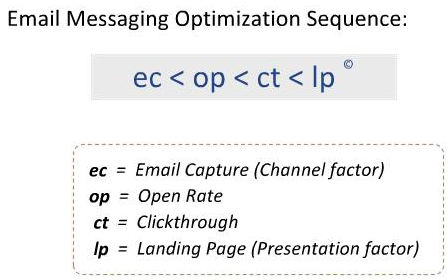
What are the basic priorities in email marketing? MarketingExperiments has developed a simple heuristic that puts the four critical optimization categories in order of importance:


The order of importance is probably pretty obvious – if you don’t capture an email address there’s no message to be opened. If the message isn’t opened there’s no possibility of clickthrough, and if there’s no clickthrough then the landing page won’t get visited.

All of this leads to the single biggest issue in email marketing right now – email capture has become very difficult. The people in front of the other computer screen have become very wary about spam and privacy, and very reluctantly give out their email address.

I know this. In fact I have more than one free Web-based email address, and I bet you are no different. The same goes for the people we’re trying to reach.

The value prop of an email capture form

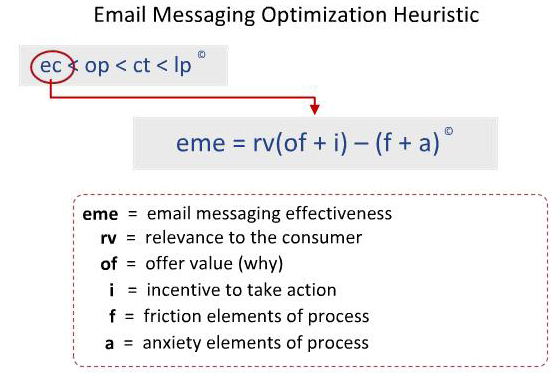
MarketingExperiments has developed a second heuristic that is applied to each of the four categories listed above:

Don’t be put off by the possibly complex-looking formula. This heuristic is the key to understanding the psychology of your target audience. Since email capture has become something of an email marketing problem, and is the most important step in any campaign, let’s look at this formula through the email capture lens, but keep in mind it should be applied to all four critical categories.

For effective email capture (eme in this example) your audience needs to see two kinds of relevance – the offer and the incentive. The offer simply answers the “why” question, as in, “Why should I give my email address to this person/company/website?,” and is the value you promise in exchange for the address. The incentive is just what it sounds like – an appealing element in the process that helps you get an email capture. Both offer relevance and incentive relevance, done correctly, are working for you.

On the other side of the ledger, and working against your success, are friction and anxiety. Friction is psychological resistance in your audience and anxiety is psychological concern. You want to remove any concern your audience might have about providing their email addresses, but friction is a little different because you need to have some friction.

Just asking for an email address is an element of friction, and if you don’t ask for it, it’s going to be pretty tough to get that address. What you want to do is minimize the resistance in your audience and remove any concern they might have.

When you look at email marketing optimization in terms of four critical categories that can be broken down into a handful of elements shared by each category, it’s obvious that no singular set of best practices rules will give you optimal results. But thinking about each element in each category, and repeating that process on a regular basis, will help you achieve continuing improvement. Now that’s optimization.

Related resources

MarketingExperiments Online Training and Certification Courses

MarketingExperiments Email Marketing Course

Email Marketing: “I am not dead yet”

Email Marketing: Drip Campaigns Drive Revenue

October 20th, 2010

I always love attending MarketingSherpa events – the presentations are not only enlightening but also entertaining and the networking between sessions rocks! This year’s B2B Marketing Summit in San Francisco was fabulous — and for those of you who missed it, we’re doing an encore performance in Boston October 25th and 26th 2010 .

My contribution to the event was a one-hour session on effective B2B drip campaigns which was very well received. It included seven case studies of successful B2B drip campaigns from my consulting work for clients and the MarketingSherpa archives. While I don’t have space to give you all the details here (join us in Boston if you need to know!) I wanted to share some of the keys to success.

But first: are you currently doing drip email campaigns? How many of you don’t even know what a drip campaign is? About a quarter of the audience responded affirmatively to the first question – and another quarter raised their hands when I asked the latter question. So, just to get us all on the same page…

Drip campaigns take their name from drip irrigation, which saves resources by allowing water and fertilizer to be consistently delivered directly to the roots of plants. There’s less waste than with sprinklers and topical fertilizer application; drip irrigation also provides a consistent level of moisture to the soil, rather than the “soak and dry” experience that sprinklers provide.

Drip marketing campaigns are most commonly delivered via the email channel because of its short turn-around, quick delivery time and cost-effective nature. A drip campaign involves a series of messages that are sent or “dripped” in a predefined order at a predefined interval. Each message in the campaign stands on its own but also builds on the missives that have come before it. A drip campaign is a response to a specific behavior or status of the recipient – and it encourages a specific action.

Drip campaigns are most commonly used to nurture leads – they often use education, testimonials and other tactics to move prospects through the early part of the sales cycle and take them from “less than hot” to “hot,” or at least “very warm.” As with drip irrigation, drip marketing campaigns are a resource-efficient way to serve a large group of constituents.

I shared seven case studies with the audience in San Francisco – here are the key takeaways:

1. Define your Goal(s): Know what you’re trying to achieve going in – and go further to define what specific action(s) you want the recipients of your drip campaign to take.

2. Understand that Content is King: When people contact me about drip campaigns, they usually want to talk about the timing and frequency of efforts. But those factors have much less impact than the content of your program. And once you’ve fleshed out the content, the timing and frequency fall in line naturally.

3. Develop a Message Map: The first cut of this should be a brainstorming session to determine the key messages which need to be conveyed to get recipients to take the action desired. The second cut is to figure out what real-life examples you can use to illustrate these key messages.

4. Bucket your Content: After your message map is done, it’s time to separate this information into a series of efforts. There should be some content that appears in every message; but each individual email needs to focus and go into detail on some aspect of your message map. It’s not a drip campaign if you send the same information over and over again. This exercise will determine how many efforts or individual sends are in your drip campaign.

5. Decide on Your Email Format(s): Although the majority of drip campaigns utilize letter-style email messages, but newsletter, short-form editorial and other formats can be just as effective. Don’t limit yourself to one – make the format support the content.

6. Utilize Design Strategically: Typically the copy is front and center in drip campaigns; design and images should be used to support, but not overshadow, the copy. Video and other interactive media can be effective as well, but only if they support the business goals.

7. Adding Segmentation to a Drip Campaign can Increase Its Effectiveness: Creating sub-campaigns which are based on lead quality, behavior or other actions increases the relevancy of your efforts and will increase overall campaign performance when done properly.

8. Detail Your Efforts in Advance: Developing a decision tree and/or flow chart of your drip campaign provides a blueprint for implementation and will help keep you in line with your business goals.

9. Use Social Media to Drive Acquisition: Social media allows you to communicate a single message to a large group – use it to entice people to opt-in to your drip campaign so you can deliver more relevant, targeted content to specific segments of your audience.

10. Look at Overall Campaign Performance: Obviously you’ll look at standard metrics like opens, clicks and conversions by effort and then look at the average of all efforts. But be sure to take the next step and evaluate the cumulative unique campaign metrics. A key link in a recent campaign garnered an average 25% increase in unique opens send-over-send. The unique clicks on the key link increased by more than 100% after the second send; after the sixth and final send, nearly five times as many unique recipients had clicked and visited this key landing page.

Integrate Online Marketing Channels

October 19th, 2010

Marketers have many software vendors to choose from. There are laundry lists of companies willing to upgrade your website analytics, email marketing, display ads and almost any other part of your online business.

The growing list of platforms is making the job more complex. Work is done through several dashboards, and data comes from several directions. You have to spend time with each platform to achieve a single goal.

That is why Lisa Arthur, CMO, Aprimo, argues for marketing integration. Aprimo is an integrated marketing software provider. Arthur says integration can help marketers get back to focusing on driving higher ROI.

“The goal and promise of marketing integration is to simplify the complexity of marketing and allow marketers to spend more time on the strategy, the messages and the content, instead of chasing data and ad hoc processes,” she says.

Integration essentially pulls fragmented marketing processes under a single, centralized platform. The approach can free up some of your time, as well as:
o Streamline a multi-channel ROI calculation
o Cut campaign launch time
o Align disparate marketing goals
o Give executives and managers a quick view of overall marketing performance
o Give multiple marketing teams a central platform to work from

A key to starting the integration process is to align business strategy and marketing objectives with the goals of the effort. Consider how aligning marketing data and technology under a central platform help your company achieve its goals.

Second, marketing integration is more of an on-going journey than a short project. The process can continue for years and will require an executive sponsor. If you’re interested in integration and you’re not an executive yourself, find an executive to champion the project and point to how it will improve business goals.

Third, you should track and benchmark operational and strategic metrics. For example, on an operational level, will your team get campaigns planned and launched faster after integration? Strategically, will your team improve campaign performance?

Not all of your marketing needs to be integrated at once. Your team can start small by centralizing a disparate and manual process — such as creative review. Emails, ads and landing pages can be viewed and approved from a single, central location, rather than through an endless chain of emails.

Your team may not have a conversation around integration tomorrow, but if your number of marketing channels continues to grow, you might want to consider having the conversation soon.

Email Marketing: “I am not dead yet”

October 12th, 2010

News of email marketing’s demise has been around for years.

Cases in point:

  • I’ve been on many panels where the topic is “Email is Dead; Long Live <Fill in the Blank>” where “the blank” is Blogs, RSS, MySpace, Facebook, LinkedIn, Twitter, YouTube – you name it. Typically it’s a point-counterpoint format, where I’m alone on one side of the stage and there are at least three “experts” on the other side dissing on email.
  • News sources, from About.com to iMedia Connection to the Wall Street Journal have run articles about  all the latest online marketing tactics – and how they will displace email in a matter of months or years.
  • I recently did an audit of a large organization’s email program, from acquisition through creative development and into conversions and overall performance. At a presentation to the field reps, it only took a few slides for an attendee to raise his hand and ask why we were bothering, since no one used email anymore (even though their members are career professionals in their early 20s through retirement age).
  • Ever since I started my email marketing consultancy, over nine years ago, people have asked me what I was going to do when email died. Confidence in my career choice was not high.

All that said, email is NOT dead yet. Nor is it dying.

Each year, the Direct Marketing Association ranks marketing channels by the ROI generated. Email has led their rankings for a number of years; in 2010 they project that email marketing will return an average of $42 for each dollar spent, down from more than $43 in 2009. Email is the leader by more than a nose; the #2 channel was Internet search advertising, which returned just under $22 per dollar spent in 2009.

Forrester also weighed in on email earlier this year, projecting that U.S. spending on email marketing will increase by a compound annual rate of 11% until at least 2014, when it will reach $2 billion.

A recent MarketingSherpa survey found that email was one of only two tactics where more organizations increased budgets than decreased them in 2009. Nearly 50% of companies reported that their email budget increased, compared to 14% who said it decreased (the balance said that their email marketing budget stayed constant). The only other tactic where more budgets increased than decreased? Social networks and blogs, where 48% of companies increased budgets and 20% decreased them.

The latest report that supports the life left in email marketing comes from Yahoo! Hotjobs, which recently  published an article on six new careers they felt were “coming of age.” Number five? You guessed it – Email Marketing Manager. Yahoo! reports it delivers an average salary of $69,000 and encourages those interested in moving into email marketing management to pursue an MBA.

My experience in the trenches supports the health of email marketing. My email marketing consultancy has been busier than ever in the past few years. I continue to grow my client base and just brought on a new employee to help me meet the demand.

So the next time someone suggests to you that email is dying, smile and just hum the tune to Monty Python’s “He’s Not Dead Yet.” Then go back to the office and continue to hone your skills to succeed in this exciting industry which is very much alive.

Editor’s Note: Jeanne Jennings is teaching MarketingSherpa’s Email Essentials Workshop Training in 12 locations across North America this year; the next one takes place in Toronto on October 19th. She’ll be blogging about the course material and her experiences during the tour. We’re excited to have her on board and contributing to the blog.

Related Resources

Master the Essentials of Email Marketing in One Day with MarketingSherpa Email Trainer Jeanne Jennings

Email marketing Case Studies, How To Articles and Interviews

Email Marketing Awards Gallery 2010: Winning Campaign Details and Creative Samples

Marketing Webinar Optimization: Five questions to ask yourself about webinars

October 6th, 2010

What’s the difference between a webinar and a website? The last four letters.

At first, this seems like a bad joke out of the “1,001 Wacky Jokes for Children of Marketers” (which I believe is out in paperback now). But take a step back from your website and webinar, look at the big picture, and you’ll quickly find that they both have the same goal – a conversion.

At MarketingExperiments and MarketingSherpa, not only do we research and publish information about the most effective marketing practices – the “what really works” – we also conduct webinars ourselves.

With that in mind, here are five questions we ask ourselves when staring in the mirror on the morning of a webinar…

Are you providing value?

According to MarketingExperiments research, the most important positive element to conversion is motivation. A negative element that hurts conversion is friction. Not to be overly simplistic, but given this paradigm, the ideal situation to use a webinar is when you have customers motivated enough to overcome the friction of having to take an hour or so out of their day and spend it with you.

Of course, this is why so many B2B companies conduct webinars. They have complex knowledge and products that customers are, at some level, motivated to find out more about. But let’s drill a little deeper into that thought, and perhaps address that second question as well. For any conversion to happen there must be a value exchange, and webinar attendance, while not a final sale, is a mini-conversion. So the best kind of customer to reach is the one you can truly provide value for.

Your knee-jerk reaction might be, “I provide value to every possible customer.” However, it will better serve your efforts if you take an honest self-assessment of your possible content, and decide who (if anyone) would give something for this content. Because attendees are paying with their time.

Are you communicating that value?

Every activity that happens before the webinar is your chance to make this sale. Remember, this is essentially a sale and the price is your audience’s time.

Your title, the description of your webinar, promotion blog posts, tweets, social media conversation – these all must be focused on a challenge or objective the customer has, not on your product’s features and functions.

All of your pre-webinar activity must create a solution to that challenge on three levels.

  • It must be relevant. If your audience is mid-level warehouse managers, telling them how to recreate an entire manufacturing process over which they have no control is not relevant to their challenge of meeting their production goals within the current process.
  • It must be urgent. Your customers will not spend an hour with you to solve a problem that is 15 months away. They have to meet this quarter’s goals and numbers and that is where their greatest motivation lies. In the long run there is no long run if they don’t fix short-term problems. Or, as noted economist John Maynard Keynes has said, “In the long run we are all dead.”
  • It must be important. Your audience likely has many challenges in their job. But if you are only addressing something minor, why should they spend an hour with you? Put another way, would you try to sell better tires for an airplane that has no wings?

Take an unbiased look at your efforts and make sure you truly are addressing your customer’s most pressing issues, and not just, like many companies, putting new wrapping on the same sales pitch.

Are you constantly engaging your audience?

For the host, the key is value, value, value. Why start the webinar with an ad for yourself, as so many do? What is the value for the customer? Every minute they remain on the webinar is a micro-sale to get them to stay on for the next minute.

As Flint McGlaughlin, the Director of MECLABS Group, teaches, “Dazzle me gradually.” Continuously provide value to your audience, to overcome the inherent friction of staying on any webinar.

From a technology standpoint, have a conversation with them using polls and answering submitted questions throughout. Have staff on hand to conduct Q&A through your platform since you won’t likely have the time to address every question on the call. Encourage them to have a conversation with each other by using a Twitter hashtag.

Again, your focus is not the sale, its helping and providing value to your audience.

Are you listening to your audience?

Once you have dazzled your audience, give them a way to learn more about how your company can help them. Over time, you can start to measure the value of these leads with your sales team and then discern how many leads you get per webinar and how much these leads are worth. Are they more likely to close than a bought list or other cold lead? Do they end up being higher-value deals since they are from more motivated, more engaged customers? Answers to these questions will help you determine ROI.

Beyond ROI and independent of leads, make sure you keep a finger on the pulse of your webinars themselves by making sure your audience has a way to provide you feedback and let you know how much value and help you provide through them. By keeping an eye on this soft metric, you can use your webinars to help educate a community instead of alienating potential customers.

Are you building a community?

Before, during and after a webinar, social media and other content marketing is an excellent fit to building a community around your solution (and, as the name suggests, your solution is not your product but rather the value you provide to customers).

Before a webinar, solicit feedback through LinkedIn to understand what topics your customers want more information about. Then, perhaps release a juicy whitepaper that you can dissect live on the webinar. During the webinar, use a Twitter hashtag to facilitate conversation with (and between) attendees. After the webinar, write follow-up blog posts (with audio and video replays) to share information with those who couldn’t attend, and interest them in attending your next webinar and further feeding the virtuous value cycle.

Remember, a webinar – just like social media – is a channel. It has no inherent value. Your job is to provide that value.

Related Resources

“Double the Value of Your Online Testing: Don’t just get a result, get the maximum customer insights” Web clinic

Top Five B2B Marketing Practices For 2011” webinar

How to Promote Your Webinar Via Google News

The Art of Inventing Must-Attend Webinar Topics: Real-life Inspiration

Marketing with white papers and/or webinars

Photo attribution: royblumenthal

SEO Raises Awareness and Reputation Better than PPC

October 5th, 2010

Pay-per-click advertising in search engines is a veritable money machine for some companies. They put money in, turn some wrenches, and money comes out the other end.

However, PPC is not a miracle worker. Turning those wrenches can take a lot of work. And there are several marketing goals PPC achieves less effectively than SEO.

Comparing data from MarketingSherpa’s 2011 Search Marketing Benchmark Reports: SEO and PPC Editions, more marketers reported SEO as “very effective” at achieving the following objectives:

o Increasing brand or product awareness: SEO: 42%; PPC: 34%

o Improving brand or product reputation: SEO: 29%; PPC: 19%

o Improving public relations: SEO: 27%; PPC: 6%

Clearly, more marketers believe SEO is more effective than PPC at changing people’s opinions about their products and brands. However, when it comes to conversion-related objectives such as increasing lead generation and online sales revenue, more marketers report PPC as “very effective” than SEO.

The data lead me to believe that people searching to learn more about a company or industry are more interested in natural search results than paid results. Ads take on a larger role as searchers make purchase decisions or consider other conversions (such as reaching out for more information).

If your team is hoping to lift brand awareness and reputation, you’re better off working to improve your natural search performance than increasing your PPC budget. PPC is not necessarily ineffective, but it’s likely to have a smaller return than time invested elsewhere.