
Recent Comments

  • Jeanne Jennings: Hi Suresh, Thanks for your question! We mailed the efforts over a 12 week (3 month) period, with...
  • Suresh: Nice post and thanks for sharing. Just curious, what was the time interval between mailings in your series?
  • Melanie Rivera: I completely agree with Denise.How many people are going to want to waste a stamp sending this thing...
  • Denise Tarbox: Personally, I think the U.S. Census Bureau could boost response rates by simply paying for return...
  • Sharon Ritchey: Thanks for the interesting statistic. I too had the same thought when my letter arrived. I was even...

5 Most Popular Blog Posts

Recognition

Big List - Search Marketing Blogs

Adam T. Sutton

Ad Strategies in the Down Economy

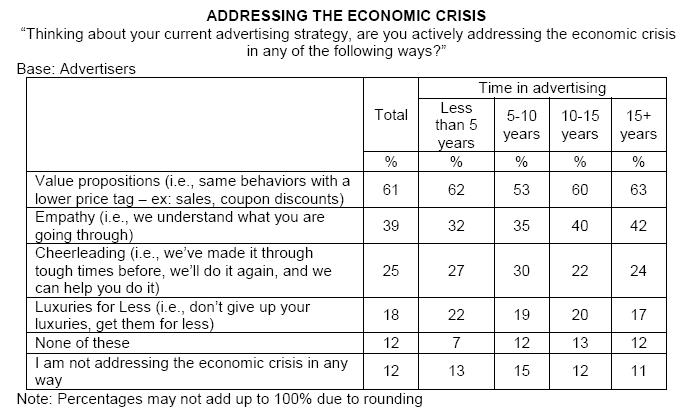
Well over half of marketers report that they’re using strategies that emphasize value propositions–such as sales, coupons and discounts–to pull through the down economy. The data comes from a collaborative survey from LinkedIn and Harris Interactive, published last week.

The survey queried 1,015 advertisers between June 22 and June 30, and 2,025 adult consumers between June 24 and June 26, to get both groups’ opinions on ad effectiveness. You can read the full release here.

Three in five advertisers (61%) say they are using a value proposition strategy and almost three in five consumers (57%) say that the strategy is working ‘very well’ or ‘well’ to help marketers sell.

From the charts below, empathetic messaging was the second most reported strategy used by marketers to address the economic crisis at 39%, and 24% of consumers say the strategy is effective.
Addressing the Economic Crisis: Advertisers

Addressing the Economic Crisis: Consumers

Interestingly only 18% of marketers report using a ‘luxuries for less’ strategy, while 34% of consumers say that it works ‘very well’ or ‘well’ to help sell products. This disconnect could be due to a low number of luxury product marketers in the survey–or it could be a genuine disconnect between what consumers say they want and what advertisers are giving them.

Take a look at the survey’s results to see if you are using any types of messaging or tactics that are being reported to be less effective than others. You might just be able to make a few tweaks to your efforts to boost performance.

 

No Comments


Adam T. Sutton

38% Decline in Direct Mail Predicted

I recently had a conversation with Gordon Borrell, CEO, Borrell Associates, Inc., in which he made some startling predictions for the future of several advertising markets. Borrell’s team specializes in tracking local advertising and reporting how much advertisers are spending in a channel by region.

The most surprising prediction Borrell shared is that spending on direct mail will decline 38% over the next five years. Marketers spent about $48 billion on direct mail last year, Borrell says. While that size might suggest stability, Borrell says that it is actually an indication that the platform is in line for a mighty fall.

“When something grows really fast and gets up to a high level, and there’s a disrupter in the market place, some other technology that provides pretty much the same level of service but in a more efficient way, then you can expect there to be a roller coaster decline.”

That disruptor is Internet marketing in general, and email marketing in particular, Borrell says. Email is an affordable way to send personalized and targeted messages, and the technology continues to improve.

Also, recent reports that the United States Postal Service is considering eliminating Saturday service is contributing to his team’s prediction, Borrell says.

“If the day they cut is Saturday, then that really hurts direct mail. Marketers love to get pieces into homes on Friday and Saturday, because that’s when the buying is done in households.”

Borrell and his team base their predictions, in part, on a disruption model. They analyze what happened to markets of the past when disrupted by a new technology, and apply those lessons to current events.

Has your team cut direct mail this year? Or do you plan to in the next five years? Let us know in the comments…


14 Comments »


Sean Donahue

CompuServe Is No More — But Will Email Addresses Remain Active?

CompuServe, the pioneering online service, quietly ended its 30-year run on June 30. Current owner AOL made the shutdown announcement via email to its dwindling ranks of subscribers, prompting blog eulogies from nostalgic fans — and a little bit of snark from the peanut gallery (“CompuWHAT?”).

The news caught my eye, not only because I’m a former user.

I remember logging on to CompuServe to check stock market quotes and search a Lexis-Nexis-style periodical database during my first reporting job out of college. I also shared one of those now-ludicrous numerical email addresses with about four other reporters.

More relevant to the here and now is the notice that current subscribers can retain their existing CompuServe Classic email addresses.

The process requires subscribers to migrate their old accounts to a new, Web-mail service through an online registration form — but how many of those address will, indeed, remain active?

Subscriber apathy, user error, or technical glitches could cause many of those addresses to stop functioning. And if you’ve got CompuServe address in your email database, that could mean more bounces in the coming weeks.

So take a look at your database. See how many @compuserve.com addresses you’re currently mailing, and watch for bounces or other signs of inactivity in future campaigns. You don’t want to purge those addresses from your list immediately, but you also don’t want the ghosts of past ISPs threatening your list hygiene.

CompuServe Classic Mail Migration:
http://member.compuserve.com/mailcenter/default.jsp

CompuServe Eulogy from The PaperPC
http://paperpc.blogspot.com/2009/06/compuserve-classic-so-long-old-friend.html


No Comments


Adam T. Sutton

Branded Value via Mobile

Getting your target audience to have a positive experience with your brand is, of course, beneficial. However, not enough marketers are providing real value to their audiences, says Steve Rubel, SVP and Director of Insights, Edelman Digital. More marketers should strive to create a positive and useful experience in a branded context, he says.

Rubel is responsible for keeping Edelman Digital and its clients “ahead of the curve” with the latest ways to effectively manage public relations and marketing. He is also the author of the popular Micro Persuasion blog and maintains a personal Twitter feed with over 27,000 followers. Edelman is the largest independent PR firm in the world with 3,300 employees in 50 offices worldwide, Rubel says.

Rubel cited two companies that are providing useful, branded experiences via the iPhone:

1. Kraft’s iFood Assistant – this app sells for $0.99 in Apple’s iPhone store. It has the following features:
o Recipe browsing
o Recipe of the day
o Shopping lists
o Directions to nearby markets
o How-to cooking videos

2. Tylenol PM’s Sleep Tracker – this app is free and has the following features:
o Log your sleep hours and moods
o View your sleep and mood history over time
o Create a sleep journal
o Get tips for better sleeping

Of course, the iPhone is not the only channel for providing a valuable, branded experience. I am currently working on a Sherpa article that describes how marketers for a cable television channel created a series of SMS alerts that provided valuable, relevant tips alongside a reminder to tune in to a weekly show. The team was able to take a weekly reminder and make it more attractive by adding useful information.


No Comments