I’ve been a writer my entire adult life. But sometimes I feel that people see me as more of a magician.
So let me first tell you all the things that a good copywriter can’t do:
- Substitute for an utter lack of a value proposition
- Solve a product or offer problem
- Replace seamless UI and UX
- Forge instant trust when your brand has burned the customer before
- Create an elevator pitch based on the ‘how’ (logistics) not the ‘why’ (benefits)
I’m amazed how many times I’ve been asked to write a TV ad or website with near zero meaningful info about the product or service. They expect me to conjure value and desirability from thin air. That’s not good writing. It’s magic.
Can I put words together in a script or on a homepage that sound good? Sure. But it’s just blandvertising. I can make the words sparkle. But they won’t actually be conveying meaningful information. It’s all sleight of hand. Misdirection. An illusion.
And I think that’s why so many marketers and entrepreneurs who aren’t professional writers think they can’t write. They’ve set the bar too high. They think great marketing copy can do more than it really can. And don’t realize that they have the most important information at their disposal and just need a little guidance on the craft.
While copywriting shouldn’t be doing the things I previously mentioned, it can do one thing so darn well it is (semi) magical:
- Help the ideal customer perceive the value of a product or service
So in this blog post, I’ll do what no magician can – reveal how it’s done. Because while mystery and wonder are key to tricks, clarity and understanding is essential for marketing copywriting.
And I’ll do one better. I’ll give you your own magic wand – MECLABS AI (MECLABS is the parent organization of MarketingSherpa). It’s free to use, and you don’t even have to register (for now).
The below screenshots are from MECLABS AI’s ‘Write a powerful headline’ guided path, which can write optimized headlines based on your guidance. While it was just released two days ago and is still in an early beta phase, it can already be a helpful assistant for your headline writing.
Generative AI can already write headlines, of course. In fact, I let MECLABS AI write the headline for this blog post by talking to it. But what makes the headline generation pathway different is that it immerses you in the process, and gives you the opportunity to provide the right input and make key choices.
Step #1: Have something worth saying
“You don’t write because you want to say something, you write because you have something to say.” – F. Scott Fitzgerald
When I lay these steps out, they’re going to seem equal. That’s just the nature of outlining a process in a blog post.
But they’re not. I always say – 80% of good writing is having something worth saying, the other 20% is saying it well.
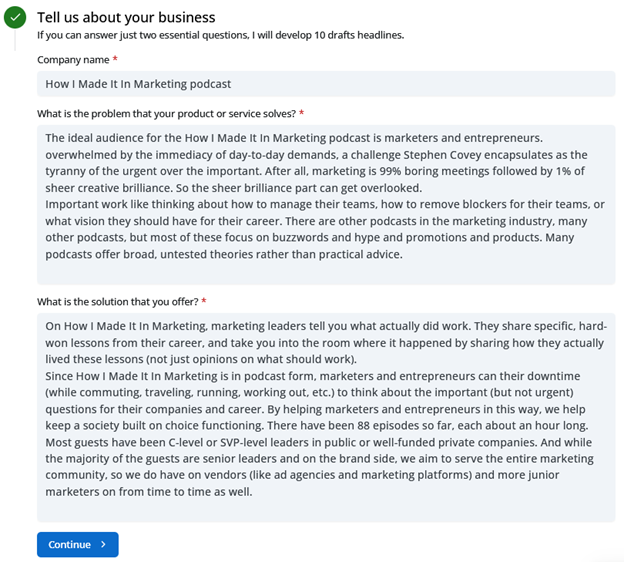
To help you say it well, the first thing MECLABS AI asks you to do is tell it about your business. The focus is on the customers’ problem and the solution you offer, not your conversion goal or what you’re trying to sell or get.
What you can give is worth saying to a customer. They do not care what you want.
As a specific example, I’ll go step-by-step through the MECLABS AI headline generation guided pathway by writing a headline for the How I Made It In Marketing podcast.
Here are my answers for the first step. I’m trying to provide precise and detailed my answers. But also notice that they aren’t necessarily worded that great. Marketers make a mistake when they focus on the exact sprinkle of perfect words too soon. First be clear, then be clever.
My inputs…
How I Made It In Marketing podcast
What is the problem that your product or service solves?
The ideal audience for the How I Made It In Marketing podcast is marketers and entrepreneurs. overwhelmed by the immediacy of day-to-day demands, a challenge Stephen Covey encapsulates as the tyranny of the urgent over the important. After all, marketing is 99% boring meetings followed by 1% of sheer creative brilliance. So the sheer brilliance part can get overlooked.
Important work like thinking about how to manage their teams, how to remove blockers for their teams, or what vision they should have for their career. There are other podcasts in the marketing industry, many other podcasts, but most of these focus on buzzwords and hype and promotions and products. Many podcasts offer broad, untested theories rather than practical advice.
What is the solution that you offer?
On How I Made It In Marketing, marketing leaders tell you what actually did work. They share specific, hard-won lessons from their career, and take you into the room where it happened by sharing how they actually lived these lessons (not just opinions on what should work).
Since How I Made It In Marketing is in podcast form, marketers and entrepreneurs can their downtime (while commuting, traveling, running, working out, etc.) to think about the important (but not urgent) questions for their companies and career. By helping marketers and entrepreneurs in this way, we help keep a society built on choice functioning. There have been 88 episodes so far, each about an hour long.
Most guests have been C-level or SVP-level leaders in public or well-funded private companies. And while the majority of the guests are senior leaders and on the brand side, we aim to serve the entire marketing community, so we do have on vendors (like ad agencies and marketing platforms) and more junior marketers on from time to time as well.
And here’s what it looks like in MECLABS AI…
Creative Sample #1: ‘Tell us about your business’ step in MECLABS AI headline generation guided pathway
Act #2: Understand where your reader is
“Description begins in the writer’s imagination but should finish in the reader’s.” – Stephen King
No, I don’t mean Pittsburgh or Peoria.
When it comes to the thing you have to say, where are they in the customer journey?
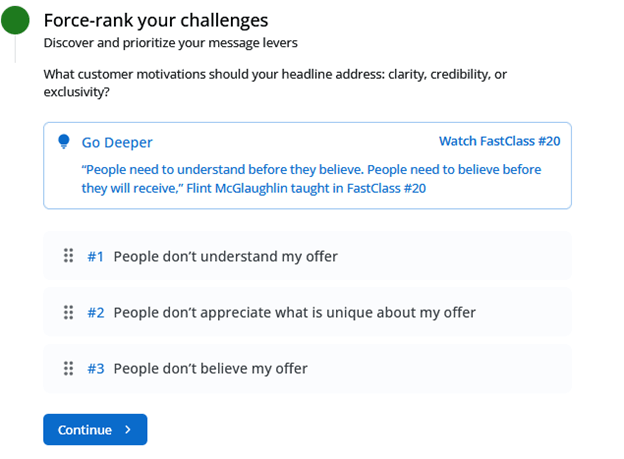
For the How I Made It In Marketing podcast, my focus is awareness, and you can see below how that affected how I ranked challenges in MECLABS AI.
Creative Sample #2: ‘Force-rank your challenges’ step in MECLABS AI headline generation guided pathway
Act #3: Find your voice
“Be yourself; everyone else is already taken.” – Oscar Wilde
There are many ways to communicate something, how will your writing, and your brand, communicate it?
Kind of like in high school where you had to figure out your archetype – jock or nerd, class clown or socialite, theater kid or rebel.
In MECLABS AI, I chose an ‘informative’ tone and then starred my favorite headline ‘Sifting the Gold from the Grind: Rare Marketing Brilliance Revealed.’ That’s not quite right yet, it is just a draft at this stage. But that headline is marketing copy with earfeel – it was viscerally communicating what I’m trying to say.
Creative Sample #3: ‘Review and star your preferred headline’ step in MECLABS AI headline generation guided pathway
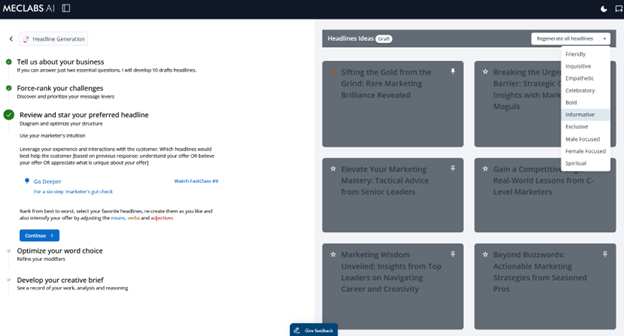
The best way to write one really good headline is to not write one really good headline. Write 18 headlines. Write 57 headlines. Write 70 headlines.
As a copywriter, I used to paper the walls of my office with marker comps of concepts. MECLABS AI makes it easy for you, giving you half a dozen headlines at a time that you can keep regenerating.
Act #4: Writing is choices
“The difference between the almost right word and the right word is really a large matter. ’tis the difference between the lightning bug and the lightning.” – Mark Twain
Bill Shakespeare could have written, “To be, or not to be, I’d kind of like to know.”
It would have had the same general meaning, but it wouldn’t have gotten it across the same way. There are somewhere between 171,476 (Oxford English Dictionary) and 1,022,000 words (Harvard and Google) in the English language, depending on who you ask. There’s fudgel and grawlix and groak and a whole lot more.
Which means, you have a lot of choices.
I remember early in my days as a copywriter, I had written dozens and dozens of potential tag lines for a client. I brought them to my boss, and none of them were quite right in his estimation. He had a giant dictionary on his desk, he put his hand on it, looked at me, and said, “Well, it’s in here somewhere.”
The specific word choices you make will affect how well people understand what you write, and how they feel about it. For example, on the Curb Your Enthusiasm episode “The Survivor,” a Holocaust survivor and a former contestant of the TV show Survivor engage in a discussion regarding their respective challenges and experiences. It’s the same word, right? But the joke (and social commentary) lies in the difference between the gravity and significance of two uses of the same word with the same meaning. This isn’t the same word with different meanings. Which is you must consider not only the denotation, but also the connotation for every word in your headline.
To make it easier, MECLABS AI color codes nouns, verbs, and adjectives, and then gives me alternative choices for the words.
Creative Sample #4: ‘Optimize your word choice’ step in MECLABS AI headline generation guided pathway
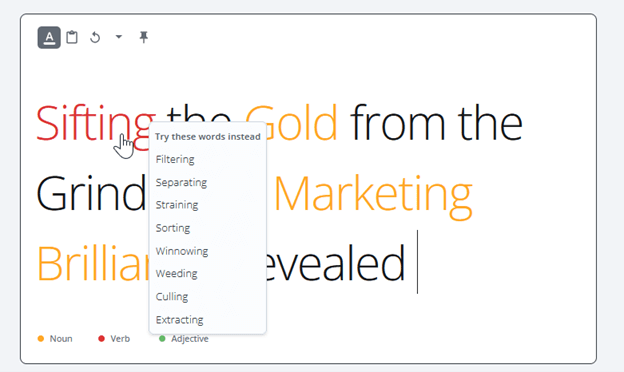
Based on the options it gave, I changed ‘sifting to ‘extracting.’ I wanted the reader to get the feeling of actually taking those key nuggets out of the podcast, not just sorting through them.
I kept ‘gold.’ I appreciated the alliteration MECLABS AI made with ‘grind.’
I changed ‘rare’ to ‘uncommon.’ It just felt like it was, ironically enough, less commonly used than ‘rare,’ which I feel like I see in a lot of headline.
‘Marketing’ is spot on. That is exactly what the podcast is about.
I changed ‘brilliance’ to ‘ingenuity.’ ‘Brilliance’ just feels braggadocios.
I then used the ability to type in the headline box to add – ‘In These Deep-Dive Conversations.’ The fact that these are conversations is an important fact I wanted to convey. I then asked MECLABS AI to highlight modifiers again and give me more choices.
Creative Sample #5: ‘Optimize your word choice’ step in MECLABS AI headline generation guided pathway (further edits)
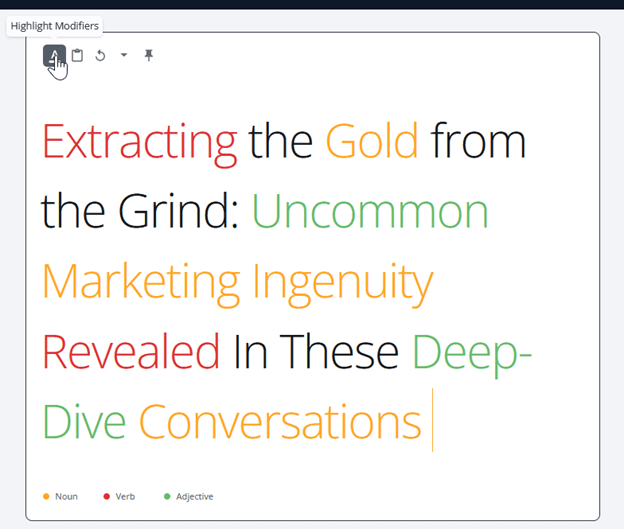
I changed ‘revealed’ to ‘brought to light.’ Revealed felt a little too clickbait-y while brought to light felt illuminating, which is what I am going for.
I kept ‘deep dive,’ although MECLABS AI suggested ‘in-depth’ which I actually liked better. But I didn’t want it to sound repetitive with the word ‘in’ just two words earlier in the headline.
I changed ‘conversations’ to discussions.’ As for how the words felt, it was a tossup for me. But I did like that discussions is one syllable shorter.
Act #5: Make sure there is substance behind the style
“Easy reading is damn hard writing.” – Nathaniel Hawthorne
I’ve interviewed a lot of writers for jobs. Here’s what separates the wheat from the chafe – having a ‘why’ beneath the headline.
And that has always been my favorite part of showing off my own work. It’s not that the text on the page was ‘magic’ (there’s that word again). It’s understanding ‘why’ those words were chosen.
In the final step, MECLABS AI gives that explanation, and includes all of your work.
Creative Sample #6: ‘Develop your creative brief’ step in MECLABS AI headline generation guided pathway (further edits)
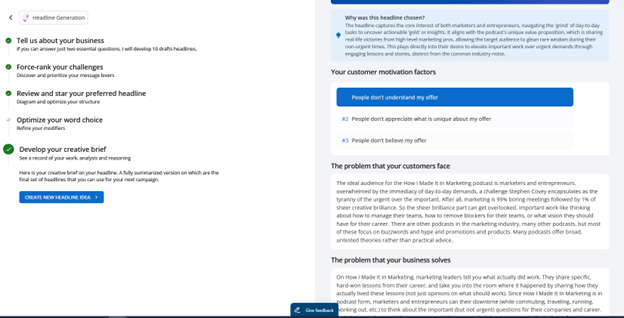
Here’s what it said about my headline…
The headline captures the core interest of both marketers and entrepreneurs, navigating the ‘grind’ of day-to-day tasks to uncover actionable ‘gold’ or insights. It aligns with the podcast’s unique value proposition, which is sharing real-life victories from high-level marketing pros, allowing the target audience to glean rare wisdom during their non-urgent times. This plays directly into their desire to elevate important work over urgent demands through engaging lessons and stories, distinct from the common industry noise.
Is the end result a perfect headline? No, far from it. Maybe this is my own ego speaking, but I feel like I could write a better headline with a yellow legal pad, blue pen, and zero restrictions.
But it is 80% of the way there. And that’s the goal of this blog post. If you’re not a professional writer, here are the steps – and even a free tool – you can use to get some pretty good headlines.
And if you are a professional writer, you can try it out as well, but you need the right mindset. If I think of the tool as the writer, it chafes a little. But if I think of the tool as a colleague to brainstorm with and bounce ideas off of, it excites me. It’s like The Sorcerer’s Apprentice in ‘Fantasia.’ I have to go from mopping the floor, to conducting an orchestra of mops. Therein lies the magic.
I don’t have an actual ad budget for this, but I didn’t want to waste the headline. So I clicked the clipboard feature to copy it, and posted the headline on social media. You can see how it’s doing for yourself on:
LinkedIn
Facebook
Twitter