Archive

Archive for September, 2010

B2B Marketing: On Occam’s razor and value propositions

September 30th, 2010

If you’re in B2B marketing, chances are you have a complex sale. And I’m not just talking about your sales process. I mean the communication involved to make the sale itself happen – starting with the value proposition. Does it clearly answer this question, “What value does your company provide to your customers?”

Sometimes, the problem with marketers is that we think like marketers. We add powerful marketing words to everything we write – “New!” “Easy!” “ShamWow!” We want to include every possible feature and function (with no small prodding from product development). We also want to cast a wide net to gain market share with every possible audience segment.

The result can be long and confusing. Because we marketers aren’t really trying to make this complexity any clearer, we’re trying to make it more compelling. But what if, instead of thinking like a marketer, we thought like scientists?

“Everything should be made as simple as possible, but no simpler.” – Albert Einstein

Scientists, unlike marketers, are actually trying to understand something – usually something of breathtaking complexity. As Occam’s razor loosely states, “…the simplest explanation is usually the correct one.”

Now, there are a few caveats here. If you’ve ever read anything from a scientist, you certainly know that the writing itself isn’t simple and clear. But this heuristic does help keep scientists focused when delving into theoretical models.

Just what the heck does your company do?

With this in mind, take another look at your value proposition. And remember that all-important word – value.

Hey, I have a background as a copywriter. So no one appreciates clever wordplay more than yours truly.  But as a communications consultant to B2B companies, I’ve also encountered far too many companies that didn’t clearly demonstrate what they do…and certainly not why anyone should part with scarce budget dollars to acquire it.

Crafting a value proposition is tough, and this blog post alone won’t help you do it – but if you can clearly communicate with your audience, at the very least you’re off to a good start.

MarketingSherpa B2B Marketing Summit ‘10

Looking for more B2B marketing strategies and techniques? At the upcoming MarketingSherpa B2B Summits in San Francisco and Boston, attendees will gain in-depth knowledge from the top of the funnel to the bottom line. But not just from the people here at MECLABS.

MarketingSherpa is fortunate to have a large community of experienced marketers who frequently share their expertise. B2B Summit attendees will listen to a variety of case studies presented by their B2B marketing peers.

PLUS: If you’re attending, you can share the lessons you learn with your peers by sending us your key takeaways for our Summit Wrap-up Report. If you have something good to say, we’ll quote you in the article.
Email Marketing Trends Toward Integration

September 23rd, 2010

Despite the rocky environment for marketing budgets during the last two years, a much larger percentage of organizations increased their email marketing budgets in 2009 than decreased them, according to MarketingSherpa’s 2010 Email Marketing Benchmark Report.

We spoke with several marketers this week to uncover a few more email marketing trends. We asked for their impressions on this vital tactic’s role in today’s marketing. Here are the highlights we found:

Deeper Integration with Digital Channels

Email marketing is becoming less of an isolated silo and is taking on a more cohesive role as marketing channels further integrate. Email has long tied directly to companies’ websites, but lately it has expanded to connect with audiences via:

– Social media

Click-to-share buttons added to email messages with strong, relevant content are expanding the reach of marketing campaigns.

– Mobile

Mobile devices are frequently used to read email, and marketers are formatting messages to ensure they render clearly.

– And others

Companies are asking for customers’ email address as the points-of-sale, and they’re linking emails to videos on YouTube.

The next step, says Blaine Mathieu, CMO, Lyris, is that companies should develop an integrated mindset and plan how marketing channels could be best combined to achieve the most effective results.

Tactical Advances from Technology

– More Sophisticated Segmentation

Email marketers have long segmented their audiences to deliver customized content to increase relevancy and response rates. In the beginning, segments were often broadly determined, such as by product category or topic of interest.

Now, behavioral segmentation is more common. Marketing teams are studying their subscribers’ actions and timing and crafting messages based on their positions in the buying cycle. This technology has been around for several years, but more marketing teams are taking advantage.

– Automated messaging

“There is no way any company can interact one-to-one in a relevant manner with thousands, tens of thousands, even hundreds of thousands of people,” says Dylan Boyd, VP Sales & Strategy, eROI.

The increasing need for relevance and volume in email communication has driven the rise of automated email marketing. More teams are establishing automated email series based on events, such as abandoned shopping carts and white paper downloads. The growing sophistication of product suggestion and other personalization technologies has given these messages a personal, tailored touch.

Less Tactical, More Strategic Planning

Digital marketing has witnessed a boom in third-party solutions over the past few years. The growing lists of targeting and analytics platforms have outpaced many market teams’ abilities to leverage them, especially since many require a high-level of technological expertise to establish. However, the adoption process is simplifying.

“Especially in the last year, the tools of an email marketer and an online marketer are finally becoming simple enough to use and connected enough to each other across channels that the marketers no longer have to be a technologists – they can be marketers again,” Mathieu says.

Instant Speculation on New Google

September 13th, 2010

Google rocked the search world last week by introducing a new feature that automatically predicts and displays search results as users type their queries.

Google Instant met with a swarm of speculation, including predictions that it would kill SEO, change SEO, and not change SEO.

All commentary is speculation at this point. Google Instant’s impact on search marketing will not likely be clear for another 30 to 60 days. The change will likely affect some marketers more than others, depending on search’s role in your marketing.

The folks at search agency and software provider Covario sent me a seven-page brief on the topic they wrote for their clients. Three highlights from their analysis and predictions:

1. Top organic positions are more important than ever
Google Instant pushes down organic results
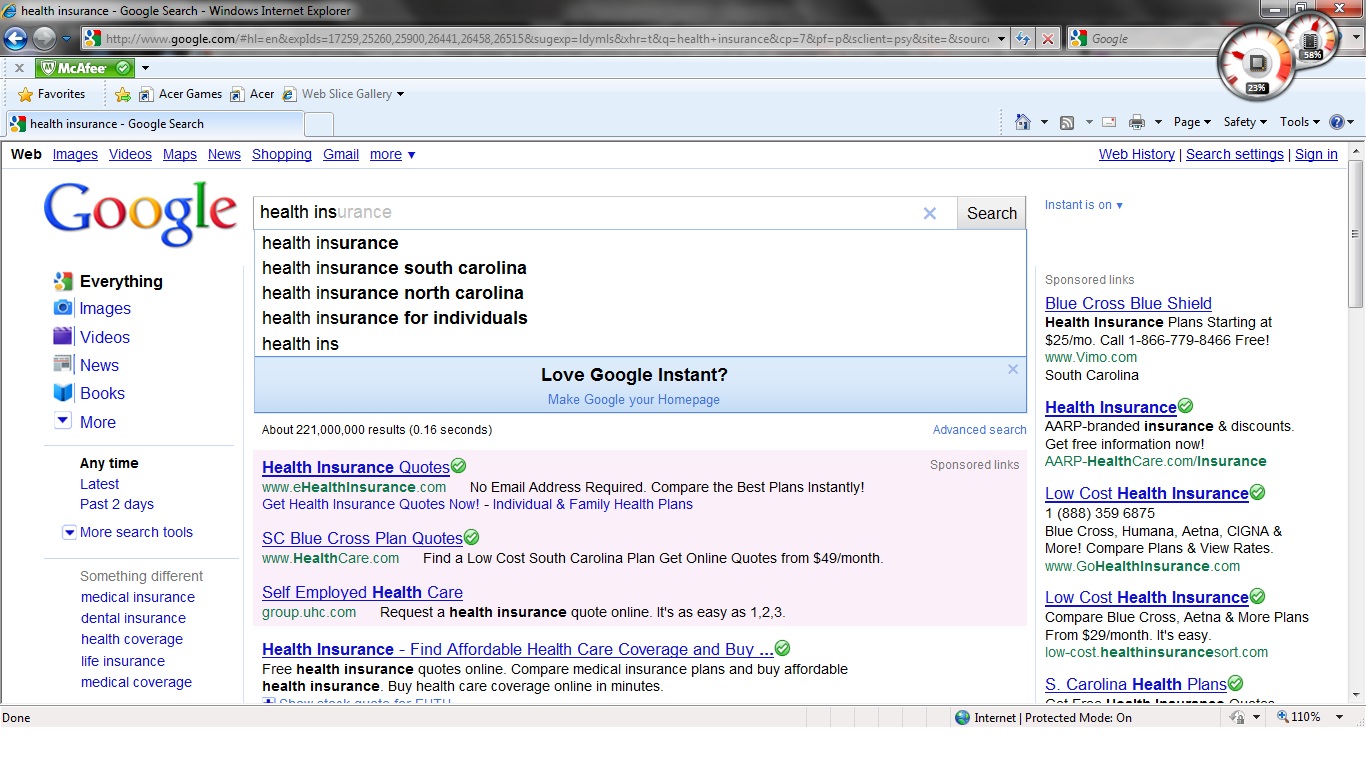
As users type search queries using the new feature, a drop-down “suggestion box” appears, pushing down paid and organic search results, and pushing some organic results below the fold.

Results pages with three or four ads in the top position sometimes only list one organic link above the fold (see image). The links pushed below the fold will likely experience a drop in traffic.

2. More ‘broad matching’ in PPC

Since users see results as they type, marketers will migrate toward strategies that use broad matching on the first keywords of popular multi-keyword queries.

In the short term, CPCs will increase and advertisers will have to budget more toward Google to drive similar volume, according Covario’s brief.

3. Not all searches are “Instant”

Google’s new feature is designed to work in the following browsers:
o Internet Explorer v8
o Safari for Mac v5
o Firefox v3
o Chrome v5, v6

Users running other browsers will perform traditional Google searches. Filtering your website analytics to track visitors by browser will help your team better understand how Google Instant changes your visitors’ behavior.

Please note: Covario’s brief emphasized that its analysis is strictly speculation. Only time and rigorous testing can determine what impact Google’s latest feature will have on your marketing and the marketing community as a whole.

Interactive Print Ads via Mobile

September 8th, 2010

Offline ads are likely to get a refreshing breath of relevance as 2D barcode technology becomes more prevalent in mobile phones. The pixelated images can be added to magazine and billboard ads, for example, and scanned by mobiles phones to pull up various media, such as a product videos or landing pages.

Smartphone users who have the technology or who download and install the software simply have to point their phone’s camera and at one of the barcodes. The software then communicates with a server to send the user to a registration page, video, app download, or whatever the desired media may be.

Although less efficient, feature-phone users can take a picture of a code and send it via MMS to a specified phone number to load the desired media.

“There’s really nothing the end-user needs to know other than how to turn on their camera for this to work,” says Mike Wehrs, CEO, Scanbuy.

Scanbuy creates technology to enable cell phones to read barcodes, and also runs a backend system for renting 2D codes to businesses. Marketers can purchase one or a handful of codes and a set number of “scans,” or impressions. Then it’s as simple as defining what you want a phone to load after scanning a barcode, and adding the code to marketing materials.

“Done appropriately with the right kind of support and end-user prompting, you can get enormous positive results from the inclusion of a barcode,” Wehrs says.

Wehrs cites his team’s work with Verizon. Advertisements in Verizon stores encouraged new Android smartphone owners to scan 2D barcodes to instantly download new apps (samples of the ads). The team achieved 175,000 app downloads in the first month, Wehrs says.

Wehrs can rattle off many marketing opportunities the codes present. The codes, for example, can have the media they load changed over time. Products can have codes permanently applied to them, and when scanned, offer a new piece of media every month, creating on-going customer engagement.

There are many 2D barcode standards. Google has embraced the QR standard, which Scanbuy’s technology supports along with several other popular ones, Wehrs says. Take a look if you think your offline ads could benefit from offering mobile consumers deeper interaction.

Always Integrate Social Marketing?

September 2nd, 2010

A new report from ExactTarget and CoTweet reveals interesting differences in consumers’ motivations and habits when connecting with brands via email and social media. Take a look to find out more about why your customers are listening to you.

The report (you’ll be asked for an email address and phone number) is the result of three types of focus groups conducted with 44 people, and a 1,506-person survey (see methodology). It is loaded with interesting stats, such as:
o 38% of U.S. online consumers are fans of a brand on Facebook
o 5% follow at least one brand on Twitter
o 93% receive at least one permission-based email per day

The report offers plenty of other great metrics, and touches on useful topics, such as the motivational differences between consumers who first check email in the morning and consumers who first check Facebook. Check out the report for more.

The report also offers great best-practice advice for communicating with customers via social channels. However, there was one piece of advice I want to offer a different opinion on.

The report suggests that marketers avoid promoting exclusive, channel-specific offers in social media, and that “tone and content should be the primary differentiators in our channel strategies, not promotions.”

In general, this is sound advice. Integrating campaigns through multiple channels always drives stronger performance. And you do not want to condition followers to receiving special deals.

However, I feel like marketers should throw their social media followers an occasional treat. They are often truly fans of your brand. I do not think it could hurt to make them feel special, say, once every six months.

The “treat” does not have to be a discount or offer, either. For example, it could be a hint of a product launch sent to the audience two days before a press release is issued. And if it is a deal, it does not have to be exclusive to social media followers. Maybe, just once, they receive a coupon code a few days before your email subscribers.

How do you feel about occasionally giving social followers and fans special treatment? Waste of time? Vital display of gratitude? Let us know…