Archive

Archive for 2010

B2B Marketers: Please Take our 2011 B2B Marketing Benchmark Survey

August 3rd, 2010

This week marks the launch of MarketingSherpa’s 2011 B2B Marketing Benchmark Survey, which gathers data from members of the B2B marketing community to benchmark their latest best practices, tactics and results.

If you’re involved in B2B marketing, please take the next 5 to 15 minutes to share data and insights:

Click here to take the survey now.

As a thank you for your participation, you will receive an offer for a free copy of the Executive Summary of the 2011 B2B Marketing Benchmark Report, which will include highlights and key findings from the study.

We’re excited to see how your responses illuminate what’s working in B2B marketing today. The B2B community has been humbled by the recent recession and has been forced to operate with limited resources — while producing a higher level of quality leads than ever before.

The organizations that have persevered through budget cuts and increased expectations are the ones that could apply the most efficient marketing tactics for every stage of the buying cycle — and in the process, improve the overall efficiency of their marketing and sales departments.

The greatest challenge for B2B marketers is generating high-quality leads to deliver to their sales teams. Because of this challenge, marketing automation, lead nurturing and lead scoring have become critical tactics for B2B organizations.

In order to optimize the efficiency of marketing and sales departments, walls between these teams are coming down to enable more collaboration. Sales and marketing are working together to identify various stages of the buying cycle for the complex sale, and to determine what marketing collateral or level of sales contact is appropriate for each stage. Through this process, marketing’s role has changed from just generating leads to generating and nurturing leads to the point that they are qualified, and ready for sales involvement.

The next year will be pivotal to the success of these organizations. With signs of an improving economy, the B2B marketing community is feeling more optimistic and reacting with the greatest budget increases we have seen since before the recession. It is critical that these organizations take the lessons they have learned during the recession and apply them efficiently with their now-increasing marketing budgets.

MarketingSherpa’s 2011 B2B Marketing Benchmark Survey will focus on organizations’ best practices, tactics and results in the key areas of marketing automation, lead nurturing, lead scoring and managing the complex sale.

Please feel free to tweet or post the following invitation:

B2B marketers share your insights. Take the 2011 B2B Marketing Benchmark Survey http://www.surveygizmo.com/s/341299/8gnpw @MarketingSherpa

Thank you!
Blogs are Becoming the New Front Door for Prospects: Is Yours Open?

July 29th, 2010

If you’re still on the fence about the importance of a company blog, consider this trend: Many B2B marketers report that their team’s blog — not the company homepage — is now the most popular entry point for online visitors.

While judging our Viral and Social Marketing Hall of Fame entries earlier this month, I reviewed several strong entries from B2B marketers that cited impressive statistics for their company blogs. Thanks to a solid blogging strategy and the inherent SEO benefits of blog content, these marketers reported that their blogs were now outpacing their company homepages for key metrics such as:
o Total visits
o Time spent on site
o Number of pages viewed

For example, the team from the ESP Delivra (who just missed the cut for our Viral and Social Hall of Fame honors but nonetheless had a strong entry) reported that their company blog and social networking activity have become the primary ways they get thought-leadership content in front of prospects.

Carissa Newton, Director, Marketing, Delivra, shared these stats:

– They now see 4x more blog traffic than website traffic.

– Visitors are now staying 3x-4x longer to read blog content and website links included in that blog.

“In previous years, visitors went straight to our website,” says Newton. “With social media and blogging, it’s kind of changing that dynamic.”

Two factors are at work here: Blog content that is frequently updated and loaded with your team’s most important keywords lead to greater visibility on search engines. Plus, social sharing tools now enable your readers to share that content with their extended networks, further extending your reach and visibility.

In fact, Delivra has jumped more than 20 pages in Google search results for key phrases such as “email marketing” since starting its concerted blogging and social media effort. And since last October, the team has seen a 70% increase in inbound leads.

So if you’re not yet using a company blog for your own marketing efforts, now is the time to develop a strategy. To make the most of that tool, Newton offers these three tips:

Tip #1. Recruit multiple bloggers

Effective blogs are updated frequently. But many small marketing teams struggle to find the time to continually feed the beast. Newton’s team uses nine or 10 regular contributors from within the company, as well as three to four frequent guest bloggers, including customers.

Having multiple contributors ensures your blog will be a compilation of multiple viewpoints and relevant expertise that attracts a variety of readers. Plus, each blogger’s writing style will incorporate keywords in different ways to attract search engines.

Tip #2. Enforce regular posting

Maintaining a consistent schedule is essential to a successful blogging strategy. Newton’s team posts at least once a day during the work week.

How did they enforce that rule? They got the company CEO, Neil Berman, on board, and he made it a requirement that the blog be updated five days a week. He also leads by example: Berman contributes to the blog each Monday.

Tip #3. Share metrics and reward success

Newton also recommends using carrots alongside the stick of mandatory blog posts to keep bloggers motivated.

In the early days of their blogging effort, she ran internal contests to single out the blogger whose post was shared the most. She also used gift cards as rewards for the most successful posts.

Now, she simply shares the metrics from the team’s blogging and social efforts to show the rest of the company how important their contributions are.

“By sharing results, such as traffic increases, people’s eyes get opened differently.”

Mobile Marketing and Commerce in Japan

July 27th, 2010

As the mobile Internet steadily gains in popularity, the future of mobile commerce in the U.S. is anybody’s guess. However, countries with widespread mobile Web access might provide some clues.

“Japan had a more-advanced mobile market,” says Matthew Snyder, CEO, ADObjects, a mobile strategy consultancy and agency. “It’s debatable whether it is more advanced or not these days.”

Snyder has worked in mobile and consumer electronics for over two decades. He spent much of that time in Japan, where access to the mobile Web is above 90%, he says. In the U.S., 31.9% of mobile subscribers used a mobile Web browser in a three-month average ending in May 2010, according to comScore.

Widespread mobile Web adoption has created a variety of opportunities for Japanese businesses to reach consumers, and also a variety of opportunities for consumers to interact with businesses.

For example, “every single McDonalds in Japan is equipped with mobile payments,” Snyder says. “It started about two years ago. As of this summer, every single McDonald’s was equipped.”

Tools such as mobile wallets have not caught on in the U.S., due in part to our comparatively limited mobile Web adoption — but change may be on the horizon.

“Even though the analysts have said it’s going to take a few years before we see 50% mobile Internet penetration, my gut tells me that we’ll be in 70% to 80% over the next couple of years very rapidly,” Snyder says.

Even if the U.S. market adopts some characteristics of the Japanese and other well-developed mobile markets, the U.S. is likely to be unique in some respects due to the strong presence of branded apps.

“In terms of mobile usage and mobile marketing, Japan is much more advanced. In terms of what we’ve seen in engagement, rich media, applications, and brand penetration into the space, we’re seeing a lot more in North America through the iPhone and the Android,” Snyder says.

I spoke with Snyder for an up-coming article on tactics for testing mobile marketing as part of a team’s overall marketing strategy — not as a one-off, tack-on tactic. Keep an eye on our newsletters to learn more.

Powerful Viral Video from Old Spice

July 16th, 2010

Old Spice wrapped up a phenomenal viral marketing campaign this week that significantly leveraged social media channels, just as MarketingSherpa published our 2010 Viral and Social Marketing Hall of Fame.

What started as a funny Super Bowl Ad featuring a spokesman with an over-the-top ego and a penchant for manly nonsense turned into millions of views on YouTube this winter. The agency behind the ad, Wieden+Kennedy, followed up with additional videos, but the effort didn’t stop there.

For two days this week, the agency posted dozens of video responses to comments on Old Spice’s YouTube, Facebook and Twitter profiles. Every response is a unique, hilarious video of the Old Spice spokesman, actor Isaiah Mustafa, standing in a towel in front of a shower.

The videos are steeped in the same humor as the initial ads — supplying dozens of additional videos to an audience that expressed a strong craving for them. They also gave the campaign an exciting, real-time creative edge by directly interacting with the audience and quickly churning out videos.

To further the campaign’s reach, the team posted video responses to celebrities and other folks with major online followings, including:
o Perez Hilton — celebrity gossip blogger
o George Stephanopoulos — ABC News journalist
o Gizmodo — technology blog
o Alyssa Milano — American actress
o Kevin Rose — founder of Digg and other startups

Responding to these gatekeepers with personalized, high-profile and hilarious videos proved flattering enough to earn mentions in their respective media outlets. This brought the campaign to new audiences, further building the viral snowball.

Iain Tait, Global Interactive Creative Director, Wieden+Kennedy, told Kai Ryssdal on American Public Media’s Marketplace that the effort “certainly makes people kind of consider Old Spice in a new light again. And that has certainly been brought out in some of the conversations that we’re seeing online.”

With such a stunning viral success, where does the campaign go from here?

UPDATE 7/28: The campaign is proving to be a smashing success. Nielsen reports sales of Old Spice Body Wash increased 107% over the past month and 55% over the last three months, according to Brandweek.

Focus on Tests, Not Tools

July 9th, 2010

There is an array of webpage testing solutions available, helping marketers improve their landing pages, homepages and other online real estate. With so many options, it’s easy to get wrapped up in selecting tools, setting them up and testing them.

The problem is some marketers will spend months selecting and deploying a tool only to A/B test button colors, or different images on the same layout, says Lance Loveday, CEO, Closed Loop Marketing.

“To me, that feels like running 25 miles of a marathon and walking the last one.”

Time is much better invested in researching page data and designing tests that have the strongest likelihood of success, Loveday says.

“90% of your time should be in the planning and actual analysis and coming up with insights, and 10% should be in the technology.”

We spoke with Loveday for an upcoming MarketingSherpa article on how to select better landing page tests. One key to Loveday’s strategy is gathering thorough research, including:
o Analytics data
o Click-tracking analysis
o Qualitative usability studies
o Expert reviews

“We try to marry up quantitative analytics data with qualitative user experience and user profile information to develop some hypotheses for what the problem areas [on a page] might be,” Loveday says.

By digging through this information, your team can identify areas for improvement, attempt to diagnose problems and test solutions. Furthermore, you can estimate tests’ potential impact and prioritize those expected to bring the greatest benefit. Keep an eye on our Great Minds newsletter for more information.

Welcome Messages: Are You Making a Good First Impression on New Opt-ins?

July 1st, 2010

I’ve just completed another MarketingSherpa Email Essentials Workshop Training session, and have another quick tale from the road:

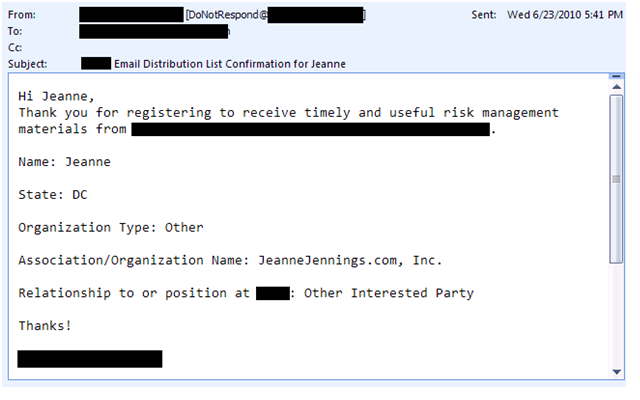
In the recent Workshop in Atlanta, one attendee submitted the URL of his email sign-up page for a critique, but said that he wasn’t submitting a welcome message because he didn’t believe there was one. Lo and behold, when I signed up for his email list I received a welcome message. I then understood why he didn’t realize it existed — it was utterly forgettable.

There are so many things that a welcome message can and should be; so many ways it can get the email relationship off on the right foot. We critiqued this welcome message during the workshop; I look forward to seeing the marketer implement the ideas we discussed to make it more effective.


Do you know if a welcome message is sent to new subscribers to your email list? If it is, do you know what it says? Whether it’s text or HTML? Who to contact if you need to update or change it?

I’m often surprised at how many marketers overlook this critical aspect of a new email relationship. Here are a few tips on welcome messages (just a small taste of what we cover in the email list growth section of the Workshop).

Welcome messages are one of the most common types of transactional email messages. A survey published in MarketingSherpa’s Best Practices in Email Marketing Handbook found that:

– 54% of respondents stated that they open and read transactional messages “very often or always.”

– Only 21% of respondents reported opening and reading other opt-in email with the same frequency.

Bottom line: Your welcome message (and other transactional messages) are probably opened and read by two-and-a-half times as many people as your email marketing messages. They are worthy of your attention.

Yet many organizations don’t think much about their welcome messages. Case in point: Exhibit A below.

text-only welcome message

This welcome isn’t bad, but it’s not reaching its full potential. It does thank the reader for subscribing. Then it reiterates the information provided at sign-up — but why? There’s really no reason.

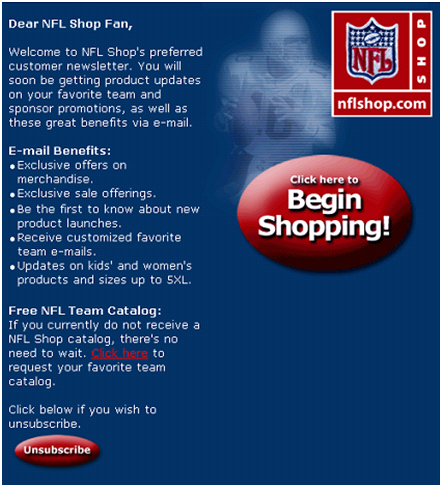
Contrast this with Exhibit B: A welcome email from NFL Shop.

HTML welcome message

NFL Shop’s welcome message is in HTML, not text. But that alone doesn’t make it better. Just as the previous message did, it thanks the recipient for subscribing. But then it goes a few steps further.

– The benefits of having an email relationship with NFL Shop are front and center, in bullet points so they are easy to skim. This gets the recipient excited about receiving future email messages from NFL Shop.

– They also provide a link to get a free team catalog. They are making it easy for people to learn more about the merchandise they offer to entice them to shop and buy.

– Speaking of which, I love the “Begin Shopping” button on the right side of the email. It drives people back to the site to browse and buy, which is NFL Shop’s bottom line goal.

As good as this welcome message is, they are still missing an opportunity. See all the blank space below the “Begin Shopping” button? Why aren’t they using it to provide a coupon for a discount on my next purchase? They could add urgency by having the offer expire a week after the date that the welcome message was sent. That would give recipients an extra incentive to go back to the NFL Shop site and buy.

In a nutshell, an effective welcome message should:

o Thank the subscriber for signing up

o Reiterate the benefits of the email relationship

o Include a call-to-action

o Offer an incentive to encourage the desired action

Dating analogies are rampant in the email world, so here’s another. When someone signs up for your email list, they’re expressing interest in having an online relationship with your organization. Sending an effective welcome message right away is critical for leveraging this “honeymoon” period and getting the relationship off on the right foot.

More Organic Conversions from Social

June 30th, 2010

Today’s the publishing date for MarketingSherpa’s 2011 Search Marketing Benchmark Report – SEO Edition, and the report has shaped up to be a valuable tool for strategic planning.

One chart I found particularly interesting (out of the 160 in the book) compares the conversion rates for organic traffic between organizations that incorporate social media into their search campaigns and those that do not. You can see the chart in the free executive summary.

Marketers who mix social and search report a 27% conversion rate for organic search traffic, while those who do not report a 17% rate. This disparity is likely due to several factors:

– First, social media marketing is known to improve brands’ reputations online, and a brand with a stronger reputation is more likely to convert visitors.

– Second, a brand’s social media profiles often appear in searches for the brand, which adds to its number of search engine results and increases the brand’s perceived credibility.

– Finally, additional links on the SERPs push down relevant competitors, making the searcher more likely to engage with the brand.

The first point is further supported by additional data in the Benchmark Report. Marketers more often reported social media than SEO as being very effective at improving reputation and public relations.

SEO, however, was more often reported as being very effective at increasing:
o Awareness
o Website traffic
o Lead generation
o Offline revenue
o Online revenue

Reviewing all of these facts reveals SEO as a much stronger contributor than social media to the bottom line — but it also shows social media can dramatically improve SEO’s impact by boosting its conversion rates.

Is your company seeing similar trends? Or something different? We welcome your comments…

Testing Interactive Ecommerce Features

June 21st, 2010

Social ecommerce technology has lifted sales and turned one-way websites into two-way conversations. Ratings and reviews, for example, have tremendously improved the consumers’ shopping experience, as well as many marketers’ conversion rates.

Frank Malsbenden, VP and General Manager, Shoeline.com and his team are already looking for the next winning interactive ecommerce feature. The team maintains several footwear ecommerce sites, including SuperShoes.com, which Maslbenden calls “the perfect sandbox.”

The team often tests new ideas on this smaller site, giving it a unique feature set that’s worth browsing for ideas. Features include:

– One-click voting and tagging

On product pages, visitors can click to declare they “like” or “hate” a product. A score is tallied on the page. They can also tag products, similar to how blog posts are tagged. Visitors can view the most “liked” or “hated” products, or products bearing the same user-generated tag.

– Drag-and-drop sharing

On product category pages, visitors can click product images and drag them onto icons to share their links on Facebook, Twitter or via email.

– Profile and live feed

Customers are given profile pages, where they can track all the shoes they’ve “liked,” “hated,” tagged and shared. They can create a vanity URL and have their profile’s page views tallied and displayed. The profile also shows a live feed of all activity on the site, such as:
o Products recently viewed
o Products recently liked, hated, shared or emailed

Malsbenden’s team is testing these features and others, such as a possible live feed integration on the homepage. Features they deem as winners will be incorporated into the fall redesign of the team’s flagship website, Shoeline.com.

Preview Panes, Image Blocking and My Pitch to Have Microsoft Outlook Turn Images on by Default

June 17th, 2010

My “official” blog post will begin in a minute, but first here’s a quick tale from the road:

Some marketers from Microsoft attended the Email Essentials Workshop in Seattle, Washington last month. The creative they brought to share didn’t leverage the preview pane as effectively as it could have when images were blocked.

We were discussing ways to address this as a group, when I just couldn’t resist. I suggested that, since Outlook was a Microsoft product, they just talk to the developers at their company and change the default from “images blocked” to “images on.”

The room broke out in laughter and a little applause; the other attendees were definitely on board with this idea. One of the people from Microsoft jokingly said he’d speak to Steve Ballmer about it right away. Who says that talking about email marketing can’t be fun!

Some of the most interesting discussions in the MarketingSherpa Email Essentials Workshop Training sessions I’ve been leading center around creative execution, preview panes and image blocking.

Workshop attendees bring samples of their email marketing efforts that we review as a group, identifying areas where the creative mirrors standards and best practices, and also looking for things the marketer might test to improve performance. It’s surprising to me how few marketers take image blocking into account when developing their email creative.

In the latest MarketingSherpa Email Marketing Benchmark Report, a survey of email recipients found that only 33% have images turned on by default. That means that 67% – or two-thirds of recipients – don’t.

The preview pane is your prime real estate to pull people into your email. In conjunction with the sender address and subject line, it’s the key to getting people to read your email. When I’m looking at image blocking, I focus on the preview pane view. This is the place that having images on, or off, makes the most impact.

More than 80% of business people and more than 50% of consumers utilize the preview pane view on their email clients. More than 75% are using a horizontal (rather than vertical) preview pane (data, again, comes from Marketing Sherpa’s 2010 Email Marketing Benchmark Report).

So you should all know what the preview pane view of your email looks like, both with and without images.

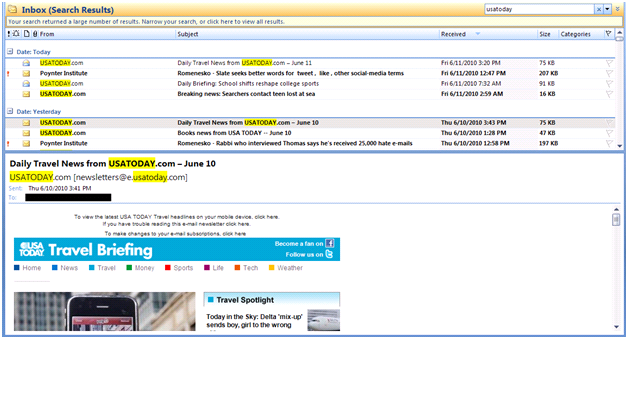
Exhibit A: A recent issue of one of USATODAY’s email newsletters (see below).

With the images turned on, I can see that it’s the Travel Briefing and even get part of an image and a headline to pull me into the email.

screenshot of the preview pane with images turned on

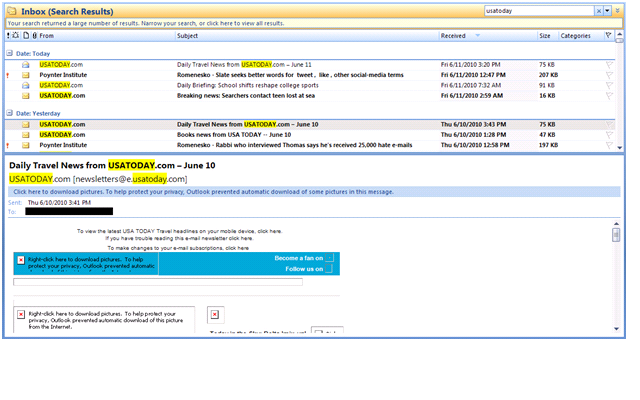
But that’s not the case when images are blocked (see below).

With images turned off I can see the “housekeeping” messages at the very top, as well as the copy associated with the Facebook and Twitter links, but nothing else.
screenshot of the preview pane with images turned off

At the very least, the “Travel Briefing” headline should be in rich text, as the social media copy is. Many companies prefer to make newsletter titles and even headlines images because it allows them control over the font for branding purposes. That’s fine on a website, but for email anything that can be rich text should be. That way the words will show even if images are blocked.

Also fine on websites are large “hero photos” which appear under the header — but they’re not so good in email. The caption for the photo at the top left, which is also the story headline, is “Top 10 Free Travel Apps.” It’s directly below the image. If USATODAY moved this above the image it would make the preview pane, with or without images blocked, much more engaging.

One more thing: With images blocked the content of the email is shifted down. So even though the headline on the right appears when images are on, it gets bumped below the preview pane when images are blocked. Without images there’s not a lot here to engage readers and pull them in to read the email.

Developing email creative to take full advantage of your preview pane prime real estate when images are blocked isn’t difficult or expensive. It just takes a little thought. If you don’t know what your email looks like in the preview pane with images blocked, now’s your chance to check.

So check how your messages appear in the preview pane when images are off. And if you don’t like what you see, fix it — and see your engagement and click-through rates rise. At least until my Microsoft marketing contact convinces Steve Ballmer to have the developers make “images on” the default setting for Outlook…

Editor’s Note: Jeanne Jennings is teaching MarketingSherpa’s Email Essentials Workshop Training in 10 locations around the country this year; the next one takes place in Atlanta on June 25th. She’ll be blogging about the course material and her experiences during the tour. We’re excited to have her on board and contributing to the blog.

Final Week for Entries: Sherpa’s Viral and Social Marketing Hall of Fame

June 15th, 2010

Just wanted to post a quick reminder that the deadline is fast approaching for entries to MarketingSherpa’s 2010 Viral and Social Marketing Hall of Fame.

You have until Friday, June 18, at 5:00 p.m. EST to enter your best-performing social media or viral marketing campaign for this year’s honors.

Enter your campaign details here

Here are a few pointers to help you with your entry:

– There is no entry fee for this program. You can submit as many campaigns as you like, as long as they used social media or audience participation to achieve strong results.

– Campaigns from 2009 or 2010 are accepted, as long as they were not entered for the 2009 Viral Hall of Fame last summer.

– Results are paramount. We’re looking for campaigns that achieved a significant business result, such as leads or revenue generated. Having millions of views isn’t too impressive in and of itself, unless you can prove that you reached the right people and encouraged them to take some action that achieved the business goal behind the campaign.

– Innovation gets attention. We’re looking for campaign tactics and creative approaches that the marketing community hasn’t seen before.

So gather up your results and creative samples and wow us with your tales of using of social media or viral marketing to record big marketing wins. The honorees will be featured in a special report later this summer that lays out all the details of the campaign approach, measurement tactics employed, results achieved and lessons learned.

Here’s the link again:

Viral and Social Marketing Hall of Fame Entry Form
(Deadline: June 18, 2010)

Thanks, and good luck!