Dave Green

B2B Marketing: The 7 most important stages in the teleprospecting funnel

April 1st, 2011

Funnel measurements have two important benefits in B2B lead generation:

1. Helping marketers forecast outcomes.  By tracking the conversion percentages, marketers can apply those conversion percentages to each new campaign and predict what the outcome will be before the campaign occurs.  Such predictions are very helpful in capacity planning and budgeting.

2. Helping marketing identify funnel leakage and optimize revenue production.  Marketers can apply both their own internal, historical baseline conversion ratios (i.e., an aggregation of conversion ratios) and industry benchmarks, like those gathered by MarketingSherpa.

Executive-level funnel metrics provide marketers with the 50,000-foot view to provide an end-to-end perspective.  But when there appears to be leakage, zooming in on a particular leak is essential.

In that context, let me share seven funnel conversions for teleprospecting.

But first, let’s agree on the scope. In B2B, there are two important functions in this  area:

  • Following up on, qualifying, educating, and nuturing marketing responses until they are sales-ready leads.
  • Prospecting into target accounts to identify and qualify existing demand and to generate demand and convert that demand into sales-ready leads.

For both of these activities, it seems the key funnel stages would be similar. But, what are they?

Before I share a point of view on this important subject, let me say that teleprospecting is very complex and the interpretation of outcomes at various stages of the funnel are more and more subjective. Plus, in one call, the teleprospecting rep may go through all the funnel stages.
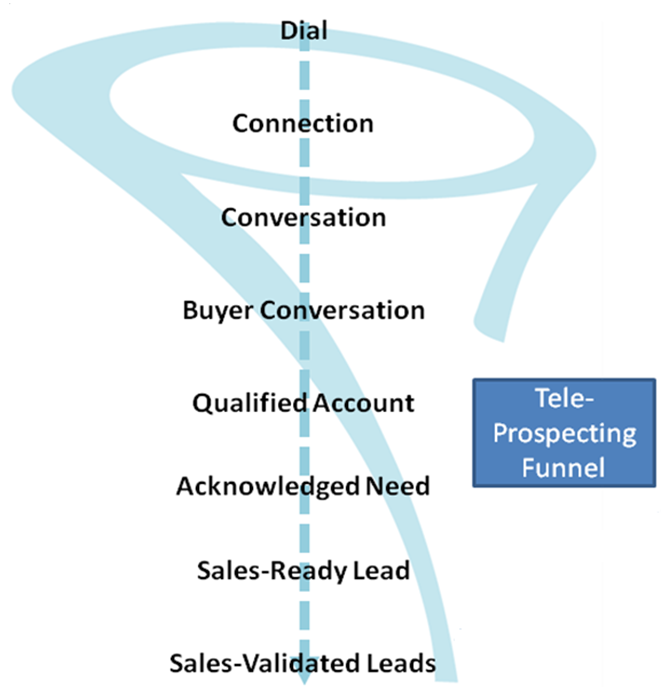
Click to enlarge

1. Dial – a teleprospecting rep making an outbound dial; or a customer making an inbound call.

2. Connection – the dial converting into a connection.Those dials that do not convert into connection either have busy-outs, dials with no answers, recorded phone company messages about the number being out of service or changed. A very high percentage of dials not converting into connections means the list or lead source is problematic.

3. Conversation. – the rep reaching someone to have a conversation, however short; a prospect reaching a teleprospecting representative via an inbound call.

4. Decision-maker conversation – some of the conversations are with those who would be part of a decision and some are not, either because the teleprospecting representative is speaking merely to a receptionist or to someone otherwise not involved in the solution area.

Decision-maker/decision-influencer conversations are much more predictive of future purchase intent than non-conversations. Even when following up on marketing responses, it’s not uncommon that 20 percent of more of the leads never make it to this stage.

5. Qualified Account – Usually, the first thing a teleprospecting representative does is qualify the person. The second thing is often qualifying the account. Is the account in the target market? Those that are would get this kind of status.

At the top of the market, the funnel may end here with an attempt to set an appointment, the idea being that the sales person will take meetings with the right people in the right accounts because the buying potential is so large.

6. Acknowledged Need – The next thing a teleprospecting representative does is discover if there are buying plans, and if not, at least an acknowledged need. Those who meet the other criteria (Qualified Account, a stakeholder in the decision processs) and have an acknowledged need are the most likely to convert into a sales-ready lead.

In fact, for some larger accounts, the sales organization may decide that this level of qualification is sufficient to warrant sales follow-up. Others in this stage might warrant tele-nurturing.


7. Sales-Ready Lead. Sales-ready leads meet any other qualifying criteria, like a particular timeline for buying, the existence of a budget, etc.

And then, of couse, the overall sales-marketing funnel extends beyond the teleprospecting operation as sales people validate leads, convert them into opportunities, forecast them, and close them.

There are some problems with the above funnel however:

  • It doesn’t account for inbound or outbound emails sent to or from the teleprospecting representative or the clickthroughs that might happen.
  • It doesn’t factor in online chat sessions, where there might be an opportunity to identify the prospect, qualify their interest, role, and the account they work for, all before having a live conversation with them.
  • There is also nothing in here about leaving messages, per se, like a voice mail.
  • There could certainly be other stages, like a presentation stage, where the teleprospecting representative presents, however informally, (via WebEx, DimDim, etc.) some kind of elevator pitch to the prospect.
  • It’s also possible that by sending an Outlook meeting request or speaking to an admin, a teleprospect representative schedules a phone meeting.
  • Finally, there isn’t a stage for doing some kind of preliminary investigation of an account and/or a contact, like going to LinkedIn or the account website.

Obviously, these limitations speak to the complexity of B2B teleprospecting for the complex sale, and the evolution of this capability to include more and more Web-based tools for both discovery and communication.

What funnel stages do you see as most important?

Related Resources


B2B Lead Generation: Why teleprospecting is a bridge between sales and marketing

B2B Marketing: The FUEL methodology outlined

How and When to Use Content in the B2B Sales Process (Members library)

Free MarketingSherpa B2B Newsletter

Adam T. Sutton

Email Marketing: Reclaim abandoned shopping carts with triggered ‘remarketing’ emails

March 31st, 2011

We’ve said it before, and we’ll say it again. The most significant challenge to effective email marketing is targeting recipients with relevant content, according to the MarketingSherpa 2011 Email Marketing Benchmark Report.

The most effective tactic for increasing relevance is to send triggered emails, according to the report. In fact, 70% of consumer-marketers using email reported the tactic as “very effective” and 47% of B2B email marketers agreed.

“Remarketing” emails are a type of triggered message that can be very effective. One example is an email sent after a customer abandons a shopping cart. The message lists the items left behind and encourages the customer to return and complete the purchase.

Charles Nicholls, Founder and Chief Strategy Officer, SeeWhy, and his company specialize in abandoned-cart emails. Below, we’ve included his comments and tactics for improving your own.

Strong performance from relevant emails

An effective remarketing email is closely tied a customers’ recent activity, which makes it very relevant. On a basic level, an abandoned-cart email should:
•    Clearly be from your companyAbandoned Shopping Cart Image
•    List the products left behind
•    Supply useful information (such as a link back to the abandoned cart and your contact info)

In February, SeeWhy crunched data from emails sent in response to 65,000 abandoned shopping carts across its roughly 1,000 clients (overwhelmingly B2C companies). The average metrics are much stronger than industry benchmarks, which Nicholls attributes to the high relevance of the emails.

“You can write remarketing emails that will annoy and drive-up unsubscribe rates up,” he says. “The key is to do it in such a way that you’re really delivering a great service to the customer and they really appreciate it.”

How to Design Remarketing Emails

Here’s Nicholls’ advice for starting and improving your abandoned-shopping-cart emails:

1. Send the first email immediately

Ample industry research, including research from MarketingExperiments, emphasizes that the email should be sent immediately after the customer abandons the cart. Even waiting a single hour can pound your performance.

2. Provide a service, not a sales pitch

The email should be service-oriented, Nicholls says. “This is not a glossy promotion designed by an advertising agency.”

Tell customers that they left their cart and you want to help. Provide relevant information, list your contact information and add a link directly back to the abandoned cart.

“We tend to focus more on a text-based presentation, really delivering a customer service message where the content is incredibly personal and relevant,” Nicholls says. “Images that get used tend to be fairly limited.”

3. Start with a three-email sequence

The most important email is delivered immediately after a customer abandons a cart, Nicholls says. Beyond that, he suggests his clients start with a three email series with the following timing:
•    Email #1: Sent immediately
•    Email #2: Sent 23 hours after first email
•    Email #3: Sent 6 days and 23 hours after second email

“That gives them a starting point and they can test from there.”

4. Avoid discounts

The top two reasons customers abandon carts, Nicholls says, are price and timing. You can overcome the price issue by offering a discount, but this should be avoided. You’re likely to win back customers, but you’re also likely to condition them to abandon more carts in the future.

“Many campaigns work incredibly well without offering any promotions at all. That’s because customers clearly already have some intent.”

If you want to test a discount, Nicholls suggests doing so in the third and final email of a sequence.

5. Test timing and messaging

Of course, these tactics are only a starting point. Nicholls suggests marketers run tests to find the best approaches to fit their markets. One test he suggests applies to companies that offer free shipping after a certain price level.

“If the site has free shipping after $100, then for cart values greater than $100 we would send a different email that reiterates that their cart already qualifies for free shipping. Those types of things become really important when you get into the whole promotions area.”

Related resources

All New MarketingSherpa Email Marketing Advance Practices Handbook

MarketingSherpa 2011 Email Marketing Benchmark Report

Shopping Cart Recovery Tested

Chart: Top tactics for delivering relevant email content

Members Library — Webinar Replay: Top email tactics to improve relevancy and deliverability

Photo attribution: kevindean

Daniel Burstein

Online Advertising: How your peers optimize banner ads

March 29th, 2011
Comments Off on Online Advertising: How your peers optimize banner ads

Online display ad spending by B2C marketers increased 57 percent over the last two years…which means more competition for your ads to get that click, and more pressure to deliver ROI on your ad spending.

To help you get the most from your banner ads, we’re hosting a webinar this Thursday, sponsored by TRUSTe, to teach you “How to optimize your banner ad performance while complying with new privacy regulations.”

But before we share our discoveries, we wanted to hear what you had to say. Here are a couple of our favorite tips for optimizing display advertising…

Match your ad closely with the landing page

Create a landing page for this ad, don’t send people to your homepage and make them figure out what to do next or where to look for their answer. Your ad attracted them for a reason – usually to solve a problem, so make sure you offer a solution that they can find easily before they lose interest:

  • Make sure your ad matches the look and feel of the page they will be landing on – from wording used, to matching the colors of the display ad with the landing page. You want to ensure the person who clicked on your ad knows they have arrived at the right site.
  • Reinforce your message from the ad through headlines and copy on the page, as well as images.
  • Along with your solution, make sure both the ad and the landing page have a call to action that clearly tells the visitor what step they need to take next in order to complete the desired action. Whether it be signing up for a newsletter or adding something to their shopping cart, a direct call to action promotes user activity.
  • Test. Don’t assume your first ad you created is working out well. Always test and see what you can do to improve the ad and landing page. When you have determined a winning ad – test a new one, make it a continual process.

Rebekah May, Founder, Whole SEO


First ask “Why?”

You need to know why you’re running display ads long before you start. So many companies have said “we need to try banner” with no idea of whether they want to run a branded campaign or a direct response campaign, and whether they want to run on a CPA, CPC or CPM basis. Display will flop dramatically if you don’t have a goal.

And then make sure that whatever your goal is, you must design your creative around it. There’s no point putting a brand ad out on a direct response campaign (or vice versa). I’ve seen people create banners that are so pretty but have no call to action, and then wonder why they get no clicks.

– Carl Eisenstein, Founder, DropDigger


Related Resources

How to optimize your banner ad performance while complying with new privacy regulations — Webinar, Thursday, March  31, 2011, 1-2 PM.

Sherpa 101: Online Display Ads, Part II – Copywriting, Design Tips & Ad Networks + How to Counter ‘Banner Blindness’

Online Advertising: The 3 obstacles you must overcome to create an effective banner ad

This Just Tested: PPC vs. banner ads?

Aaron Rosenthal

Search Engine Optimization: The SEO value (or lack thereof) of domain name keywords

March 25th, 2011

Search engines rank websites by attempting to determine their relevancy to the searched keyword phrase. It makes sense for a search engine to consider the keywords in a domain name as part of the equation to determine relevancy.

That said, the search engines place less weight on internal factors that can be influenced by the webmaster, and more weight on external factors such as links, authority, etc. So, while having the keyword present in the domain name is helpful, it is just one piece of the puzzle and there are many other elements to search engine optimization (SEO).

Read more…

Dave Green

B2B Lead Generation: Why teleprospecting is a bridge between sales and marketing

March 24th, 2011

For complex B2B sales, there is no better capability than teleprospecting for optimizing funnel efficiency.  I suspect that is one of the reasons more and more marketing executives have taken ownership of this function from sales.

One of the reasons that teleprospecting is so important is that it is (or should be) a bridge between upstream marketing campaigns and downstream sales teams.  For marketing, the teleprospecting team cannot only convert marketing responses into sales-ready leads, but provide marketing with clarity on how to improve its demand generation efforts.

Let me provide two simple examples:

1. Fine-tuning lead scoring models

There is probably no more promising capability than lead scoring.  To evolve the rule set, marketing must take aggregate funnel data from teleprospecting and fine tune the scoring model.  For example, usually 20-50 percent of the leads will be unreachable after four or five dials and three or so personal emails from the teleprospecting representative.  By comparing a large pool of these unreachable leads with leads that do respond to follow-up of teleprospecting representatives, marketing can often find different characteristics that correlate to responsiveness and dial up the lead score accordingly.

2. Fine-tuning messaging and media strategy

If a large percentage of potential customers the teleprospecting team does reach are out of the target market, then marketing can often fine-tune its messaging and its media/search strategy to improve the percentage of responders who are actually in the target market.

If the teleprospecting team receives similar, simple feedback on the sales-ready leads, that feedback can help the teleprospecting team improve it’s practices.  For example, if there is a disproportionate percentage of sales-ready leads that do not respond to the follow up by sales, then the teleprospecting team (or some subset of the team) most likely needs additional training (or talent) in order to better qualify prospects.

What’s important is that there is a repeatable process and that the operation measures the right things.  What’s also important is that marketing views the teleprospecting capability as a mechanism for improving upstream marketing efficiency and that the teleprospecting operation views sales feedback in a similar light.

In this light, the real question isn’t whether sales or marketing owns the teleprospecting function, but that everyone sees the potential for teleprospecting to better connect marketing to sales and drive optimization of the funnel.

Related resources

Free Web clinic, March 30th — Converting Leads to Sales: How one B2B company generated $4.9 million in additional sales pipeline growth in only 8 months

B2B Marketing: The FUEL methodology outlined

How and When to Use Content in the B2B Sales Process (Members library)

Free MarketingSherpa B2B Newsletter

Adam T. Sutton

Inbound Marketing: A pioneering YouTube video strategy

March 22nd, 2011

Being a reporter has its ups and downs. Thankfully, some articles are a pleasure to write. I was thrilled to publish our latest inbound marketing article featuring the YouTube video strategy of Orabrush, a brand of breath-freshening tongue cleaners.

Orabrush YouTube Landing PageOrabrush’s strategy has pulled-in over 35 million video views and powers the majority of the company’s marketing. Below, I’ve pointed out three key areas that I like about this strategy.

CMO as Chief Marketing Publisher

A central tenet of inbound marketing is that marketers need to think of themselves as publishers. Rather than buying ads in a media outlet, your brand builds the media outlet. You own the newsletters, blogs, apps, webinars — or whichever platform you select.

Jeffrey Harmon is CMO at Orabrush. His team is committed to consistently delivering the videos its audience enjoys and expects. This makes for a demanding publishing schedule, but that’s the life of a Chief Marketing Publisher. Deadlines must be met and quality must be maintained.

Another tenet of inbound marketing is that your content is not advertising — it’s rich information that interests your audience. Your brand and products can be included, but they are secondary. The content must give the audience what it wants while helping to achieve your marketing goals.

Orabrush does this by creating several types of video, as described in the article. The majority of videos are intended to engage and entertain — which is what Orabrush’s audience wants. Other videos are intended to encourage conversions while also entertaining.

This isn’t just for the LOLs

Orabrush’s videos are funny and they’ve built an audience. But at the end of the day, the company needs to sell tongue brushes. Harmon’s team is not trying to build an audience to sell advertising.

That is why Orabrush’s marketers have included calls-to-action throughout its videos and YouTube page. Viewers are encouraged to:
o Watch another video
o Share the video on Facebook or Twitter
o Connect with Orabrush on other social networks
o Visit Orabrush’s website
o Request a free brush
o Locate a nearby Orabrush store
o And more

You can see a great example of their calls-to-action at the end of this short video:

This approach applies directly to inbound marketing. The content is the main attraction. It is the reason Orabrush’s YouTube page exists. But while viewers enjoy videos, they’re encouraged to interact with the brand, visit the site, and try out an Orabrush.

Experimentation and research drive the ship

Orabrush has an elaborate YouTube page. The channel is part video-viewer, part landing page, part social channel. The design is the result of several years of research and testing by Harmon and his team.

Orabrush is not afraid to test new ideas, which is how it developed this strategy. Its YouTube page was not a modified best practice. The marketers built it piece by piece through rigorous testing.

Even Orabrush’s first forays into video were experiments. As mentioned in the article, Harmon first tested adding another publisher’s video to one of Orabrush’s landing pages. That video boosted conversion rates by 200%, and it served as the first step in the long journey to build Orabrush’s video strategy as it stands today.

Without its culture of experimentation and testing, Orabrush would not likely have such a powerful presence on YouTube. You can find out a lot more about testing and optimization at the upcoming MarketingSherpa Optimization Summit in June.

Enough already!

I could go on and on about why I love Orabrush’s video strategy (including that it came from a scrappy startup and that its marketers also engage in social marketing) — but I won’t.

The last point I will make is that Harmon’s team built this channel with a small team and a limited budget. There is truly no reason why any company could not do something similar.

Related resources

Inbound Marketing: Small business builds YouTube channel from the ground up, expands to 40 countries

MarketingSherpa: Subscribe to our Inbound Marketing newsletter

MarketingSherpa Optimization Summit 2011

Inbound Marketing: Brand-powered content hub grabs top Google rank in two months

Inbound Marketing: How to pull-in customers without pushing ads

Content Marketing: How to get your subject matter experts on your corporate blog

Content Marketing: Should you lure a journalist over to the ‘dark side?’

Email Marketing: Maybe it really is an inbound tactic…

Daniel Burstein

Informed Dissent: The best marketing campaigns come from the best ideas

March 18th, 2011

“There are no bad ideas.” When I was an advertising copywriter, this is the line we would always use to enter a realm of, essentially, suspension of disbelief and start concepting our next ad. The idea being that, even if I come up with the absolute worse idea, it might spark a concept in my art director partner that would eventually lead us down the road to riches for our client and our names engraved on a gold One Show pencil.

But, of course, there are bad ideas. And according to an article in Ode magazine about research into ways to spur creativity and innovation, those bad ideas are…well…bad…

“These revelations are all the more potent considering that many organizations continue to embrace the ‘brainstorming’ technique developed by advertising executive Alex Osborn in the 1950s. According to Osborn’s now debunked system, criticism and conflict squash new ideas and should be discouraged; in hindsight, those brainstorming sessions of yore were more likely to act as echo chambers in which bad ideas were amplified by fake enthusiasm.”

“In praise of dissent” by Jeremy Mercer

A dissident is here

In essence, to get better marketing work, you must not be pulled into the groupthink.

And, while this is the first time I have personally heard anyone admonish the idea of reality-free brainstorming, dissent shouldn’t be a radically new idea, right?

More than 50 years ago, General Patton said, “If everybody’s thinking alike, somebody isn’t thinking.” More recently, we’ve heard the bland embellishments to “think outside of the box.” And yet…

So many times we don’t. From the financial crisis to the heap of blasé, color-by-numbers marketing that proliferates across the Web, so many people don’t pop their head out of the cubicle and say, “Our current way of doing things isn’t a good idea.”

Why?

Hang on, Voltaire

It’s not easy now, is it? It’s hard to be the outsider. It’s hard to tell the group, “You’re all wrong and I’m right.” It’s hard to, perhaps, put your job on the line by separating from the pack.

As Voltaire said a few hundred years ago… “Our wretched species is so made that those who walk on the well-trodden path always throw stones at those who are showing a new road.” Pretty harsh. Can you imagine how much more biting those words would be if he ever had to ask for a LinkedIn Recommendation from a former co-worker that he publicly disagreed with?

But, perhaps, as with marketing itself, it’s all how you communicate your dissent? Both your attitude and approach? To wit…

So, how do you disagree agreeably?

I’d love to hear your thoughts about this as well, but here are a few ways I’ve learned to buck the status quo in my career…

  • Ask questions – “That’s a horrible idea, our audience will hate us for it.” Or… “That’s an interesting idea. How do you think our audience will react if we sell our list to Viagara salesmen from Nigeria?” When you disagree, the last thing you want is a battle of wills, head-to-head confrontation.

    Put your ego away for a moment, and serve simply as the advocate for the idea. The best (and most non-confrontational) way to bring someone along to your side is by giving them gentle triggers to aspects they may not have considered. This way, they are discovering why an idea won’t work, instead of having you ram it down their throats. This also helps them (and you) save face. After all, no one wants to lose a head-to-head battle.

    As in the movie “Inception,” you can’t plant an idea in someone’s head, only introduce the seed, nurture it, and hope to watch it grow.

  • See things differently – In the famous “Think Different” TV ad, Richard Dreyfuss talks about those who “gaze at a red planet and see a laboratory on wheels.” You don’t have to be quite that visionary, but simply looking at everyday things in a new way can help.

    Take data, for example. I was very impressed by a comment by Greg Sherry, VP, Marketing and Business Development, Verint Systems. During his MarketingSherpa B2B Summit 2010 presentation, he mentioned that he invested in direct mail because he read in a MarketingSherpa Benchmark Report that less marketers were investing in direct mail. He figured he’d have less competition. How counterintuitive.

    Or in a recent article by Adam T. Sutton about the origin story of Orabrush’s YouTube sponsor channel, which is second only to Old Spice. This small business sponsored market research by a college class and found that 92% of people wouldn’t want to buy this product online, so the class advised against it. One dissident student raised his hand and said, “That means 8% might be interested in buying it online. That’s millions of people.”

  • Let others challenge you – Here’s what Jeremy Mercer advises in the above-referenced Ode magazine article:

    o Have executives lead by example by allowing subordinates to challenge their positions
    o Hold meetings at which diverse perspectives are welcomed
    o Surround yourself with people who think differently than you do.

  • Be right – There’s nothing worse than putting yourself on the line for a cause and being wrong. Don’t create “facts” that support your decisions, base your decisions on the facts. A great way to do this is with real-world, real-time online testing. In this way, you can experiment with your dissident idea as well as the ideas you disagree with and let your customers be the judge. Just make sure you know what those test results really mean.

In the end, you have to be a little bit Patton (the hard-nosed general shepherding an idea past any obstacle), and a little bit Voltaire (the outspoken writer finding creative means around strict censorship to criticize your organization’s dogma).

Related Resources

Marketing Wisdom: In the end, it’s all about…

The Last Blog Post: To understand life is to understand marketing

From Corporate America to Entrepreneur: Giving up steady pay for a steady say

Free MarketingSherpa Newsletters

Dave Green

B2B Marketing: Calls-to-action and the business buying cycle

March 17th, 2011

The solution's complexity also affects the business buying cycle

One way to look at the Business Buying Cycle is to break it down into stages. There are lots of potential stages and we can talk about those stages later but let’s keep it simple for now and just use these five:

  1. Connect Stage: for generating demand by helping a prospect connect a business problem or goal with the possibility of a solution
  2. Validation Stage: for validating the worthiness of that expression of interest into a priority project
  3. Investigation Stage: for doing a deep dive on one or more solutions in order to figure out what to do
  4. Purchase Stage: for picking the right solution and negotiating the right deal and terms
  5. Operational Stage: for implementing or using the solution

Calls-to-action in the form of particular pieces of content should align with these stages. In other words, you need a hypothesis of the stages of the buying cycle and a hypothesis of the content that maps to each stage.  If someone responds to content in a stage, marketing can use the interest in that content to score the level of interest higher.

By using this approach, B2B companies can use a call-to-action that is appropriate within the overall content marketing effort and extrapolates interest in the offer based on the stage of the buying cycle, testing and iterating to a more efficient demand generation and lead nurturing strategy

In this blog post, I will focus on four of these stages.

Connect Stage

When generating demand early in the connect stage, companies should use credible (often third-party) information about the business problem solved by their particular solution.

For example, research might reveal that problems with sales forecasting drive purchase decisions for sales force automation (SFA) software. To take advantage of this information, an SFA vendor might contract with a company with an industry reputation for providing credible information on sales forecasting best practices to write a white paper on sales forecasting, perhaps based upon field research.

On the other hand, if research revealed that chief financial officers (CFOs) were the individuals feeling the pain of faulty forecasts, perhaps a paper by a brand more familiar to CFOs would be more effective. In other words, B2B companies should keep in mind the target community when developing the call-to-action offer strategy.

Validation Stage

In the Validation stage, the offers need to perform a slightly different job. In this case, the responder has expressed an interest in the problem.  Now the offers need to validate the worthiness of the solution so that it becomes a priority:

  • A case study
  • An exercise to assess the potential return on investment
  • A webinar that features a current customer with a well-known brand
  • A report by an industry analyst (e.g., the Gartner Group in the computer industry)

Response to each of these offers indicates a higher probability of purchase than the initial response to an offer about the business problem.  In other words, it’s predictive of purchase intent. Again, interest in these content offers would result in a higher lead score.

Investigation  Stage

In the Investigation stage of the buying cycle, customers are generally ready to speak to sales.  Offers in this stage can identify those customers and prospects.  For example, a prospect may want to develop a request for proposal (RFP) to send out to a short list of vendors under consideration. As such, an RFP template (biased to the solution of the vendor) might be very useful to the prospect and even highly predictive of an increased likelihood of purchase.

Likewise these calls-to-action will also indicate the customer is prepared to speak with a sales representative:

  • Implementation guides
  • Technical white papers
  • Competitive guides
  • Evaluation software
  • Total cost of ownership exercises
  • Other similar content

All of these relate to the concerns of customers and prospects entering into a deeper investigation of a particular solution.

Purchase Stage

Once the buying cycle has reached the purchase stage, the sales channels should primarily deliver call-to-action offers. Purchase stage offers include discounts on a product or a service, and sales representatives can use these types of offers to win deals and to expedite the purchase process. These offers should be left to the judgment of salespeople and their managers in order to avoid unnecessary discounts.

Across the entire Business Buying Cycle, vendors can also include generic offers such as sweepstakes or free merchandise to generate demand, and move prospects toward a decision. One thing to keep in mind, is unlike the more targeted calls-to-action, these offers are not as predictive of future purchase behavior.

Related Resources

Free Web clinic, March 30th — Converting Leads to Sales: How one B2B company generated $4.9 million in additional sales pipeline growth in only 8 months

B2B Marketing: The FUEL methodology outlined

MECLABS

How and When to Use Content in the B2B Sales Process (Members library)

B2B Marketing: Relevant content must move beyond “glitz” and tell a properly sequenced story

Content Marketing: How to get your subject matter experts on your corporate blog

Adam T. Sutton

Inbound Marketing: Brand-powered content hub grabs top Google rank in two months

March 15th, 2011
Comments Off on Inbound Marketing: Brand-powered content hub grabs top Google rank in two months

When I was on the phone with Stacey Epstein, VP of Marketing, ServiceMax, I remembered some advice I heard when researching our first article for MarketingSherpa’s Inbound Marketing newsletter.

I spoke with a lot of great experts for that piece. On content marketing, I spoke with Joe Pulizzi, Founder of the Content Marketing Institute. He mentioned that marketers should avoid publishing too many types of content and focus on about three that fit their strategies.

“But you have to do one really well,” he said. “You have to do an awesome blog or the best e-book program that’s ever been run; focus on what you can do really well, better than anyone else in your industry.”

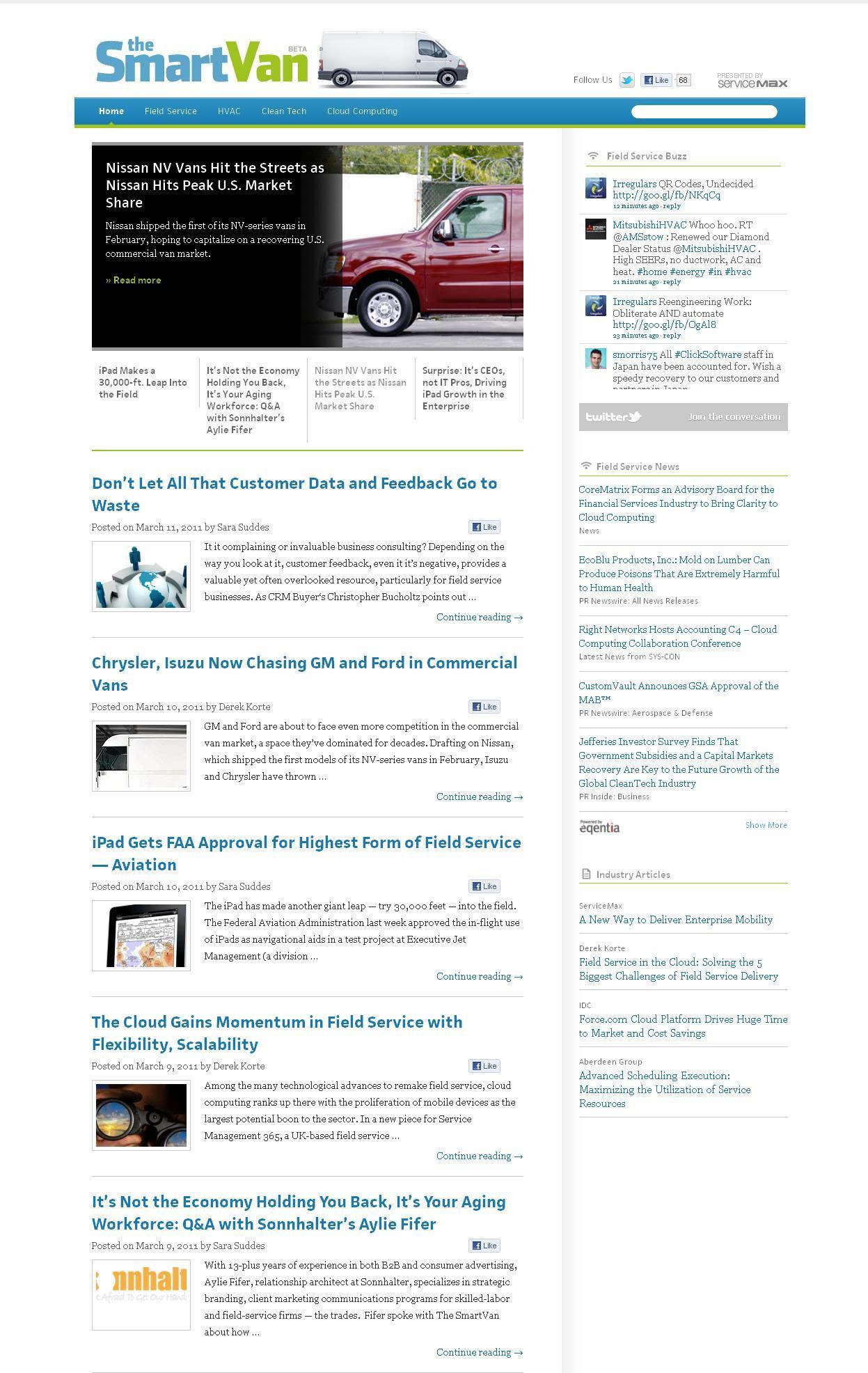
That is exactly what Epstein and her team are striving for with SmartVan. ServiceMax launched the site in January as a content portal for the field-service industry (which is served by ServiceMax), to help companies that send technicians out of the office for service, installation, and repairs.SmartVan Site Screenshot 1

“We noticed there was a complete lack of resources for these people,” Epstein says. “The site is meant to be a place for field-service professionals to educate themselves.”

Site traffic has grown faster than anticipated. After a just a few months, SmartVan holds the top Google rank for the phrase “field service news” and about 15% of its traffic comes from natural search.

“It’s great for us to be ranked so high so quickly,” Epstein says. “I think it’s a testament to how little content there is out there. It helps validate that we’re helping to serve this huge need.”

Weave the brand into the content

Epstein has big plans for SmartVan and hopes to continually grow its traffic for several years. One key principle is to avoid selling ServiceMax too directly, she says. Otherwise visitors could write-off the site as a marketing channel rather than a trusted resource for industry news.

“We’re really trying to create a resource for field-service people that doesn’t exist today… We feel that we’ll have a lot more success in getting people interested in the site and wanting to be on the site if we don’t try to sell them.”

The team does plan to incorporate ServiceMax into the site, but will do so carefully, and mostly around content. For example, a ServiceMax webinar on how the iPhone is changing the industry will be mentioned on SmartVan.

Also, a company blog written by ServiceMax executives will soon be hosted on the portal. Epstein also plans to offer an email newsletter to help build a database.

“We’ll never have a homepage that says ‘SmartVan is brought to you by ServiceMax. Go see us now and buy from us,’ etcetera. That’s not our intent.”

Content creation: easier than thought

A website that’s designed as the go-to resource for a specific topic cannot afford to have stale content. When planning SmartVan’s strategy, Epstein wondered how her team would keep up with the demands of a daily publishing schedule.

But that challenge has been easier than anticipated. The team has partnered with LaunchSquad to help manage the site and has pooled content from a variety of sources.

“We found some great contributing writers who were super interested to join us. We certainly contribute content from ServiceMax. We have a couple of guys from LaunchSquad contributing, and we aggregate content from other sources,” Epstein says.

“Between all those different people, I’m actually blown away by the amount of content. We’re serving up multiple pieces of fresh content every day.”

Changes and hurdles on the horizon

Epstein has promoted SmartVan with a press release, an email to ServiceMax’s house list, and mentions in Facebook and Twitter. She’s hoping the site will continue to grow through word-of-mouth and natural search.

A key challenge to growth, she says, will be connecting the field-service audience and encouraging visitors to interact. SmartVan will soon offer social features in hopes of fostering engagement, but this will be a pioneering effort for the industry.

“Right now, this is not necessarily a super tight-knit community,” Epstein says. “Part of that is because there isn’t a lot that brings them together. There aren’t a lot of trade shows, and there aren’t a lot of online forums.”

But that challenge is also a huge opportunity. SmartVan could become a powerful marketing channel for ServiceMax if it continues to grow at its current pace.

“If we can succeed in building this community and creating a place where all these people can go, interact and get educated, it will by far outpace any other traditional marketing strategy that we ever could have done and at a much, much lower cost and with fewer resources.”

Related resources

MarkteingSherpa’s free newsletters

Inbound Marketing: How to pull-in customers without pushing ads

Content Marketing: How to get your subject matter experts on your corporate blog

Content Marketing: Should you lure a journalist over to the ‘dark side?’

Email Marketing: Maybe it really is an inbound tactic…

Members Library – Content Marketing: Microsoft crowdsources content ideas with a viral contest for new Windows Phone 7 platform

Daniel Burstein

Marketing Career: Free salary guides for direct and online marketing

March 11th, 2011

How much money do you make?

For whatever reason, that’s a question most of us never ask our peers. It’s such an uncomfortable topic to discuss. Yet, you’re curious, aren’t you? And well, you should be. How can you benchmark your salary without knowing what other VPs of Ecommerce, Search Engine Marketing Analysts and Advertising Agency Copywriters are earning?

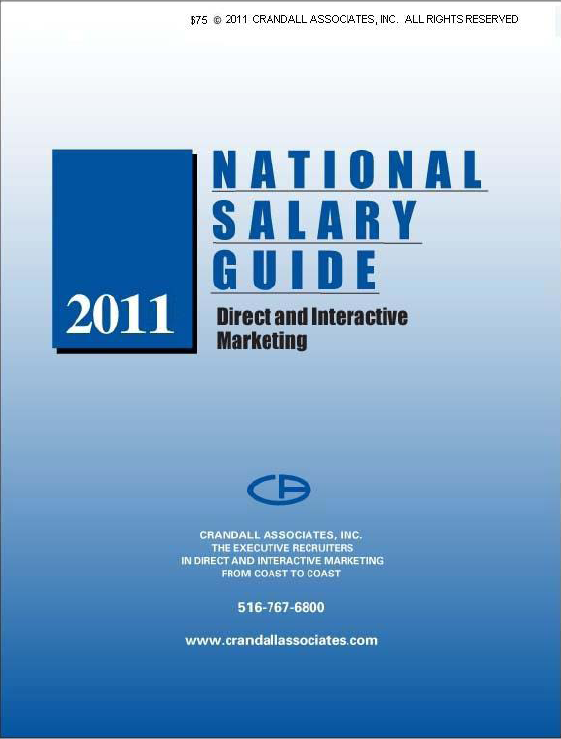
That’s why I was so intrigued when I received a “Dear Editor” email from Wendy Weber, President, Crandall Associates, with two marketing salary reports attached (the DMA directs inquiries about salaries to Crandall). I gave Wendy a call, and she was kind enough to share these guides – for free – with the MarketingSherpa audience. So, here they are:

“The guides were compiled using salary data from conversations with over 1,100 direct and online marketing professionals, including both hiring managers and job seekers,” Weber said. The executive search firm, which specializes in the direct and online marketing industry, chose not to conduct a mail survey, as they generally have a bias toward larger companies and are never random, as respondents select themselves.

So, aside from the fact that there is a Corporate Copywriter banking $135,000, what else can you learn from this data? Here are two points that stuck out (and we’d love to hear your takeaways as well):

  • Digital marketing salaries continue to grow The average annual salary for digital marketing positions has shown a steady increase, according to Weber. For example, the average salary for Web Analytics Manager has grown 2.8% since 2010 to $78,200.
  • Optimization is a valuable skill – The top-paying Internet jobs require knowledge of optimization. For the VP of Online Marketing ($169,300-$198,200 with 7+ years experience), the job description calls for the ability to “manage and merchandise…site navigation and shopability, transaction processing, onsite promotion management…” And the Director of Ecommerce ($146,200-$168,700 with 7+ years of experience) specifically asks for “landing page optimization.”

In fairness, since we just announced our new Optimization Summit, I may have optimization on the brain – so I’d love to hear your takeaways as well.

Related Resources

Optimization Summit 2011 – June 1 -3

From Corporate America to Entrepreneur: Giving up steady pay for a steady say

Marketing Career: You must be your company’s corporate conscience

Marketing Career: Can you explain your job to a six-year-old?

“How to Become Indispensable to Your CEO” Special Report

MarketingSherpa Job Listings

MarketingExperiments Careers