Archive

Author Archive

Social Media Marketing: 4 questions to ask yourself about social media buttons

June 4th, 2013

A common question we often hear about social media is “I put some social media elements onto my page and have not seen much of a difference …”

I’m sure you can relate, because social media icons are everywhere. On landing pages. In emails. Heck, I even saw some on a billboard while I was driving the other day.

Now, on behalf of Facebook, Twitter, LinkedIn and their investors, I’d first like to thank you marketers of the world for all of that free co-op advertising.

All kidding aside, let me throw the questions back at you to help you get the most value from your sharing icons. In today’s MarketingSherpa blog post, we’ll focus on three questions you should ask yourself about your company’s use of social media icons.

 

Question #1. Should we be using social media icons?

All jokes about free advertising aside, most marketers likely will find some value in using social media icons. And, here’s the key. While the value might not be great, it is likely higher than the cost.

Because, frankly, as marketing tactics go, simply slapping a few social media icons or sharing buttons on a landing page is fairly easy to do.  Almost any value you get creates an ROI since it is higher than the minimal cost involved.

For example, AT&T added Facebook and Twitter icons into an email newsletter.


This was one small part of a program that helped the AT&T Developer Program increase its Twitter audience 136% and Facebook audience 113%.

Of course, as you’ll see in the case study above, the team at AT&T did much more than just add a few icons to an email to get that lift. But since the cost, in both IT execution to add the buttons and real estate on the email, was likely so low, and it certainly couldn’t have hurt their efforts, why not add social media icons?

Well, here’s why not. For most brands, the answer is simple: not every brand needs or should be using social media icons and sharing buttons. For example, I interviewed Steve Parker, Vice President, Direct Marketing, firstSTREET, in the MarketingSherpa webinar “Optimization: A discussion about an e-commerce company’s 500% sales increase.”

“In our case given our target market, you’re looking at an age 75+ customer, they’re not big social users. And, the ones who are on social media, they really just want to see pictures of their grandkids and their kids. So they’re not going to be as interactive in the social world. So from our standpoint, it’s pretty low on the priority list. There are no social buttons on this website,” Steve said.

He went on to share, “We’ve tested a little bit of that on some of our other properties. As baby boomers, the younger part that grew up with some social media lives grow older, yes, that will get more important. For my particular target market at this point in time, it doesn’t help.”


Question #2. Which social media icons should we use?

Ask your audience in direct conversations, in surveys, through customer service interactions and other customer-facing employees: what social networks do they use?

Then, be present on those platforms. See how they’re using social media.

And, look at your analytics.

Here on the MarketingSherpa blog, you’ll notice the prime social sharing button we use is from Twitter.
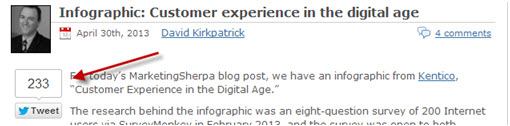
 

That’s because when we looked at our analytics, more inbound traffic came from Twitter than from any other social network.

You might also notice, at the bottom of our blog posts, we have social media sharing icons as well. 
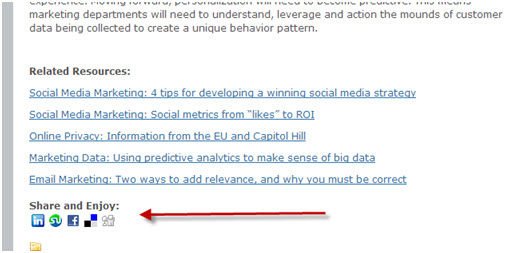
 

That’s because the rest of our inbound social network traffic came from LinkedIn, StumbleUpon, Facebook, Delicious and Digg.

Your analytics won’t be foolproof. Over time, this becomes a self-fulfilling prophesy (we receive more Twitter traffic because we encourage the audience to share on Twitter), but combining your analytics with active listening to your audience through many means will at least get you in the ballpark of how they want to interact with your brand using social media.
Read more…

Marketing Analytics: Now that marketers can collect data, interpretation is the top challenge

May 3rd, 2013

Technology is fantastic. But, it’s not magic.

Marketing analytics can be extremely powerful. However, just like any other tool or technology, it takes hard (and smart) work to turn data into knowledge.

So, in the MarketingSherpa 2013 Marketing Analytics Benchmark Report (sponsored by Paramore), we asked marketers …

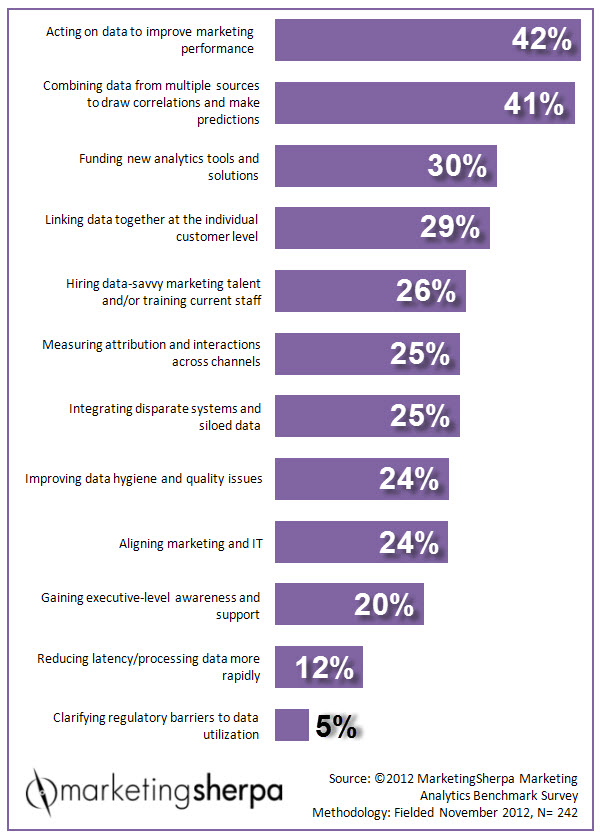
Q: What were your organization’s most frustrating challenges with marketing analytics in 2012?

Then, we asked your peers what they thought about this marketing research. Here’s what they had to say …


Interpretation of data

What is interesting is that the top two challenges are related to the interpretation of data, not the collection of data.

We have finally turned the corner on the basic blocking and tackling of data consolidation through technology and processes, and now the most important challenges are focused on how to effectively use the analytics for improved decision making.

It has taken a long time to get to this point, but it is encouraging to see that 42% of respondents stated that acting on data to improve marketing performance was their #1 challenge, followed by combining data from multiple sources to draw correlations and make predictions (41%).

Integrating systems and siloed data finally has fallen to the bottom as most marketers have the technology and tools to do this process. Now we have to do the hard part and make the data talk to us, guide us, and give us insights.

– Cyndi Greenglass, Senior Vice President, Strategic Solutions, Diamond Marketing Solutions

Read more…

Marketing Analytics: Managing through measurement and marketing as revenue center

April 26th, 2013

“What gets measured is what gets done.” So says the old business maxim, at least.

We wanted to know what marketers get done, so to speak, so in the 2013 Marketing Analytics Benchmark Report, we asked…

Q: Which of the following are you involved with tracking, analyzing or reporting on for your organization?


We asked the MarketingSherpa community about these results, and here’s what they had to say …


Managing through measurement

These results highlight the indifference, or perhaps lack of experience, when it comes to tracking marketing, especially social media marketing.

As these channels can be tracked offline (via call tracking) and online, via dynamic numbers and email tracking, it still seems as though there are trackers and non-trackers in terms of marketing specialists.

Even with a nudge effect of marketing across several channels, the ROI of these nudges is important and should be tracked.

The old adage of “managing through measurement” is still important and not having accurate measurement to call upon leaves marketing specialists arguing based on their opinions rather than facts. (And, that’s a sure way to the exit door).

– Boyd Butler, Consultant

Read more…

Email Marketing: Segmentation, integration, automation and personal interaction

April 19th, 2013

“Hey, look at me!” While strolling down the Las Vegas Strip during Email Summit 2013, I couldn’t help but notice all of the flashy signs, and individuals, trying to get my attention.

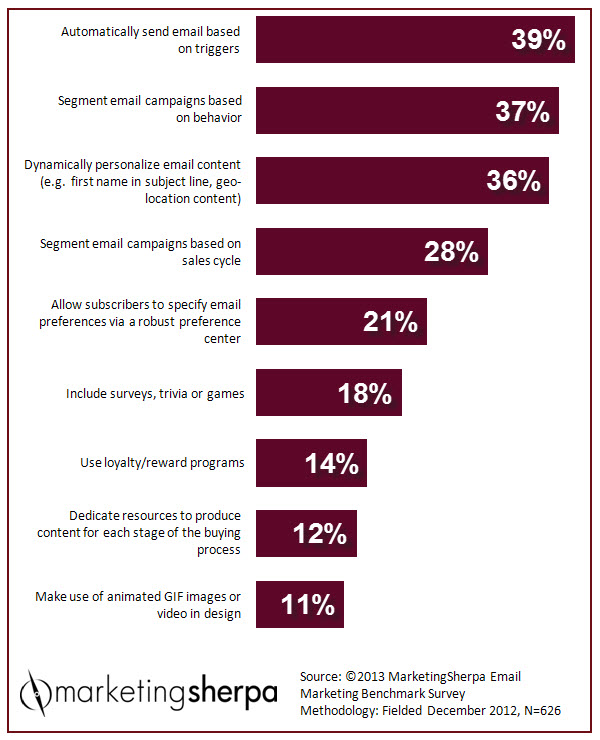
The challenge is equally difficult (although hopefully less gaudy) in the modern inbox, so in the MarketingSherpa 2013 Email Marketing Benchmark Report, we asked …

Q: Which of the following tactics is your organization using to improve the relevance and engagement of email content delivered to subscribers?

We asked your peers how they could use this data …


Segment email campaigns based on sales cycle

Stage-based marketing is the future. Breaking your marketing down to map to a consumer’s research cycle means understanding they will do research in multiple sessions, and at each session, be looking for different content. Best practice will suggest that you will need to engage with them in two or more different sessions, so you will need two or more stages.

Content needs to be short and targeted. Having a single large document is no longer best practice. Content should be targeted to each stage of the research cycle, and be easily consumed in under five pages.

– Mathew Sweezey, Marketing Evangelist, ExactTarget


How closely integrated are your sales and marketing departments?

I would have loved to see another question asked: How closely integrated are your sales and marketing departments? From my experience, those using segmentation and trigger-based emails are those who make sure that marketing and sales are closely aligned. A lot of the triggers “look” like they come from the sales team based on Web behavior with the ultimate objective to drive conversion, of course.

– April Wilson, Director of Analytic Products, RevSpring

Read more…

Email Marketing: Only 21% of marketers integrating mobile with email

April 12th, 2013

No marketing tactic is an island, so in the MarketingSherpa 2013 Email Marketing Benchmark Report, we asked marketers about which marketing channels they are integrating with their email marketing …

Q: Which marketing channels does your organization integrate with your email program? Select all that apply.

As usual, we asked your opinion of this research …


Mobile integration requires investment

A question is raised in the blog about the poor representation of mobile in email integration. That’s because the top two mediums hog up the highest share of the marketing budget, with the balance to the next three. Mobile integration requires new planning and visual strategy for which there is very little or no dollars left.

– Shailesh Merai, Creative Lead, Omesa Creative Studio

In the MarketingSherpa Chart of the Week article in which this chart originally appeared – “Marketing Research Chart: Marketing channel email integration” – Brad Bortone, Senior Research Editor, MECLABS, asked, “Are you surprised by how poorly mobile integration placed in this chart, when compared to other tactics?”

Shailesh chalks the reason up to investment, or lack thereof, in mobile. From his experience, most budget goes to the top two integrated tactics (75% of marketers integrate the website with email, 56% integrate social media with email).

According to Shailesh, the rest of the budget goes to the next three most integrated tactics with email – 40% of marketers integrate email with events (for example, tradeshows and webinars), 35% with blogs and 31% with search engine optimization and/or pay-per-click advertising.

This leaves only 21% of marketers integrating email with mobile.

To help you secure the budget and resources you need, here are a few articles to show your marketing and business leaders the benefits of mobile email integration, along with the challenges you need resources to overcome …

Mobile Email Marketing: iPhone-targeted landing pages boost conversion rate 40% for Ritz-Carlton Destination Club

Mobile Email Marketing: 50% more app downloads from device-targeted ads

Email Marketing: 58% of marketers see mobile smartphones and tablets most impacting email

Mobile Marketing: 31% of marketers don’t know their mobile email open rate

Read more…

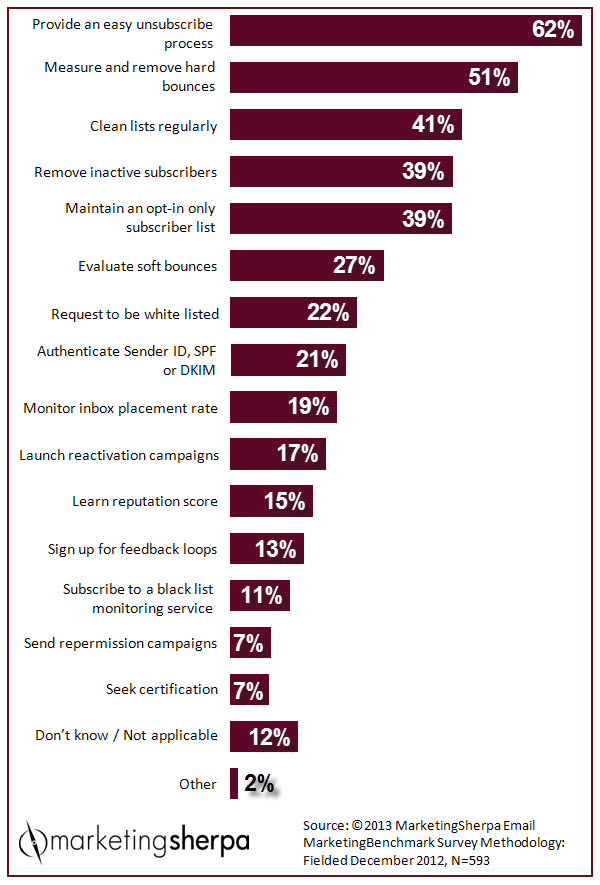
Email Deliverability: Only 39% of marketers maintain an opt-in only subscriber list

April 9th, 2013

Email marketing is an interesting animal. It has often been compared to direct mail. However, unlike direct mail, sending irrelevant and even annoying messages can really burn your entire email marketing program.

With direct mail, if a recipient didn’t like your message, they can drop it straight in the recycling bin.

However, with email marketing, your email recipients can affect your ability to reach other potential customers by, for example, marking your email as spam. Brutal.

So, to help you improve your company’s email deliverability, we asked marketers about this topic in the MarketingSherpa 2013 Email Marketing Benchmark Report

Q: Which of the following tactics is your organization using to improve email deliverability rates? Please select all that apply. 


As always, we asked your peers for their take on this data …


When is a subscriber an inactive subscriber?

For people who remove inactive subscribers, typically, how long should they be inactive for?

– Ariel Geifman, Director of Marketing, Mintigo

This is a great question, Ariel. It is the marketing equivalent of “What is the meaning of life?” on some levels.

Because, I’d say – to both questions – the answer varies.

For example, how long is your sales cycle? How frequently do you send email? Can you tell if these folks are engaging with your company in other ways? How segmented are your email sends? Do you send triggered emails?

Whatever the length, it is probably worthwhile to consider a re-engagement campaign before removing these inactive subscribers.

But, answering a question with more questions is a wholly unfulfilling answer, I readily admit. So, to give you some straightforward numbers to chew on, I did a quick dive into the MarketingSherpa Library to see how some companies define inactive subscriber.

Some examples:


Read more…

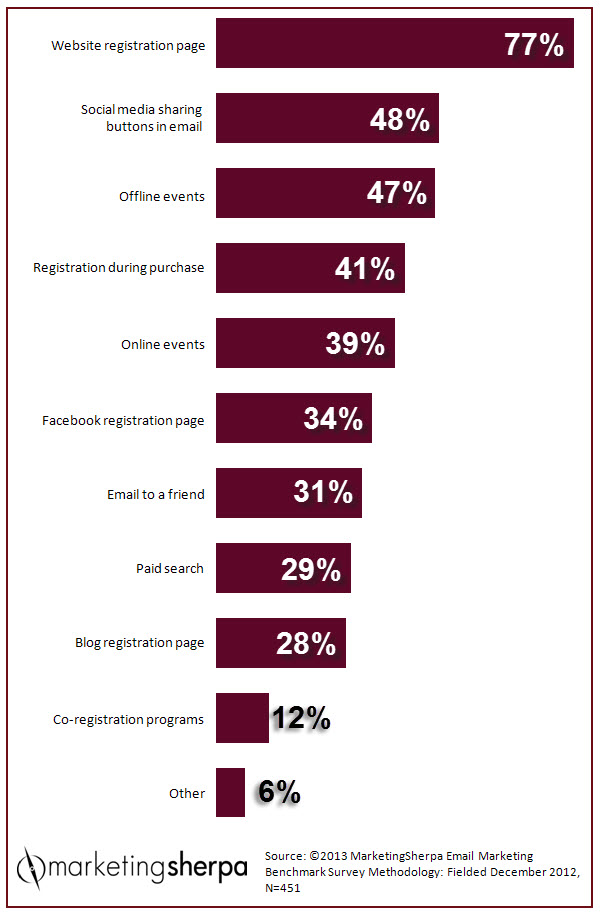
Email Marketing: 77% of marketers use website registration pages to build email lists

April 5th, 2013

In the MarketingSherpa 2013 Email Marketing Benchmark Report, we asked email marketers which list-building tactics they use …

Q: Which of the following tactics is your organization using to drive email list growth? Please select all that apply. 


As always, we asked the MarketingSherpa audience for their actionable advice based on this data …

75% increase in opt-in rate using squeeze page

When the election campaigning was in full swing last summer, I noticed that Obama was using an interesting squeeze page on whitehouse.gov. I swiped the wireframe and built a similar one of my own for my marketing tools website at AffPortal and noticed an immediate difference in my opt-in rate of about 75%. There’s a lot of value in watching what the big budget guys are doing to list build and swiping the concepts.

– Corey Bornmann, AffPortal.com


Excellent advice, Corey. For those looking to learn more from the “big budget guys,” Toby Fallsgraff, Email Director, Obama for America, and Amelia Showalter, Director of Digital Analytics, Obama for America, will be presenting a keynote case study – Email Optimization: How A/B testing generated $500 million in donations – at Optimization Summit 2013 in Boston.


77% of marketers use website registration pages to drive email list growth

Very good breakdown of marketing options and success rate.

Web page registration is one of the most trusted, hence the high success percentage.

Offline, it’s comparable to responding to a P.O. Box versus an actual address.

– Paul Harding, Jr., Creator/Publisher, iCyberSurfer


6% use other tactics to drive email list growth

How about pop-ups and slide-ins? Are these included? I’d be interested in seeing how these work for people in “quality” markets such as B2B.

I’d also like to know about email harvesting as a tactic because I think many people use it but don’t admit it. They are scared of being called spammers but in reality, if they are presenting valuable solutions, they are not [spammers]. So how about a line for email harvesting?

Personally, I think the “share with a friend tactic” is underutilized because it can be encouraged to a level that takes email capture to exponential heights. You can forward to five friends at once!

– Boyd Butler, consultant

Read more…

Email Marketing: 3 overlooked aspects of automated messages

March 26th, 2013

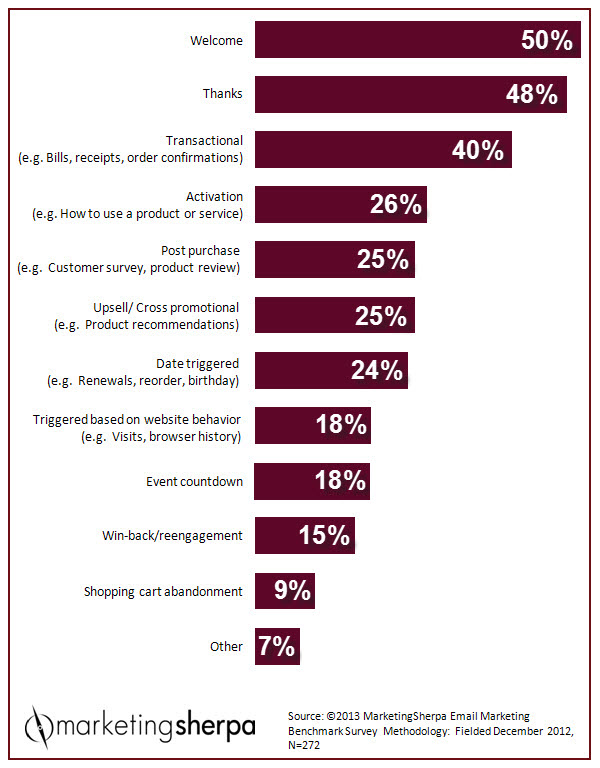
In the MarketingSherpa 2013 Email Marketing Benchmark Report, we asked email marketers how they use automation capabilities …

Q: What type of automated, event-triggered, lifecycle email messages does your organization deploy? Please check all that apply.


As always, we asked the MarketingSherpa audience for their actionable advice based on this data. We received two interesting tips from Richard Hill and one from Chris Hexton …


Nurture current customers

Most marketers use automated triggered emails to strengthen relationships with early-stage buyers (i.e., for ‘lead nurturing’).

However, one of the most under appreciated opportunities is to use triggered emails to strengthen relationships with current (and recently lost) customers:

  • Advocate social referral
  • Contract renewal reminder
  • Product education/training
  • Customer service issue management
  • Low product usage alert
  • Upsell/cross sell
  • Win/loss
  • Net promoter score segment migration
  • Win-back campaigns

All of these “customer nurturing” programs represent great ways for modern marketers to re-balance their approach, and use trigger emails (and marketing automation tools) to more consistently support the whole buying journey.

Read more…

Marketing Career: National guide to digital marketing salaries

March 22nd, 2013

If you’ve been a reader of the MarketingSherpa Blog for a while, you know I think passion is an important part of a marketing job. After all, how can you really sell a product to potential customers unless you are passionate about it, too.

That said, a marketing job is still, well, a job. If we were all independently wealthy, we might not be as motivated to take the morning train to a marketing department every day and leave our families.

So, today’s blog post is about filthy lucre. Or, to be more specific, marketing salaries.

Wendy Weber, President, Crandall Associates, Inc., has allowed us to post the 2013 Digital Marketing National Salary Guide  for free download for readers of the MarketingSherpa blog. Just click that link and the PDF will instantly download. There is no squeeze page or form fill of any kind required.

I asked Wendy about what she learned while conducting research to put together the company’s 2013 salary guides. Here is what she had to say …


MarketingSherpa: Why the new addition of social media positions?

Wendy Weber: Many companies initially held back on hiring social media marketers. They questioned whether social media was a passing fad, and since it can be difficult to quantify and monetize, they chose not to devote resources towards it.

However, social media has only grown as a marketing tool, and at this point we can conclude that it is most certainly here to stay. Big corporations, as well as your local pizza parlor, want “likes” on Facebook, and most companies of any size now have the capability to respond to customer service issues through Twitter.

The actual resources being devoted to social media vary tremendously from one organization to another. Some companies are allowing interns to maintain the corporate social media presence, and others are paying six-figure salaries to social media teams.

Just as companies who didn’t establish a website back in the 1990s eventually accepted the online channel as a new order of conducting business, companies who didn’t accept social media as a marketing channel that is “here to stay” are now realizing that they need one or more dedicated social media professionals on staff.

A truly experienced social media professional is hard to find; many fancy themselves social media pros, but few can deliver.

Job descriptions vary widely; in some organizations social media is more focused on blogging. In others, it may be more focused on Facebook contests or Pinterest … and pay varies significantly, also. Read more…

Marketing Strategy: How to find answers to the most common marketing questions

March 19th, 2013

At MarketingSherpa, we are often asked:

  • Are my open rates low?
  • What is the ideal conversion rate?
  • Why do I have a high unsubscribe rate and how can I improve it?

Unfortunately, these are the marketing equivalents of “What’s the meaning of life?” While some blogs might have a pithy response with the perfect solution usually involving the product they sell, much like the meaning of life question, the answer likely varies based on your unique situation.

But … I can help you answer these types of questions for yourself, by answering this question we received from Jim on a recent email marketing webinar

  • What is the biggest mistake people are making in today’s environment?

To me, every marketing campaign (and really, everything we do in life) can be improved by taking these three steps …

  1. Learn
  2. Test
  3. Iterate

In today’s MarketingSherpa blog post, I’m going to focus on the “learn” step, because I sometimes feel marketers don’t cast a wide enough net during this crucial step. And, that’s what we do here at MarketingSherpa – we help you learn.

Of course, once you have new ideas about what might work for your company, test them. In this way, you can try some really radical ideas to drastically improve results while mitigating risk. Our sister site, MarketingExperiments, can teach you more about testing.

And, of course, iterate. Or as the shampoo marketers like to say – repeat. What works now will not necessarily work in the future. The marketplace is not static. You must constantly learn new ideas, and try them out.


Learn

Here’s where MarketingSherpa can help. We can give you examples of what other marketers have learned through case studies and how-to articles, webinars, Benchmark Reports and blog posts such as this one.

When we look for case studies to write, we cast our net far and wide. This is where some marketers struggle. Unless the case study subject is from the same exact niche they serve, sometimes they struggle in finding the transferable principles.

On the flip side, when the case study is about a subject from the same exact niche, sometimes marketers overemphasize whether these lessons will work for them. Even if they are in the same niche, after all, they may have a very different value proposition.

So, as you try to address these challenges, ask yourself:

  • How are you learning from other marketers?
  • What biases are holding you back from learning from other marketers?
  • Are you overvaluing marketing tactics your competitors are doing simply because you’re in the same space?
  • On the flip side, do you undervalue tactics your competitor is doing because they “play for a different team?”
  • Do you look outside of your particular industry to bring new marketing ideas to your space?
  • What biases do you hold against tactics other marketers use outside your industry (B2B vs. B2C, for-profit vs. nonprofit vs. political)?
  • What biases do you hold against tactics other marketers use based on your personal opinion of their product, service or cause?

So, let me give you some examples …

In Thursday’s MarketingSherpa Inbound Marketing Newsletter, we distributed a case study called “Search Engine Marketing: E-commerce site turns an 82% bounce rate around for a 400% conversion increase.” I really like this case study because it covers one of those common, all-encompassing questions we often receive:

  • Why does my landing page have a high bounce rate?


Learn from marketers in any industry

This case study is about how Tops Products answered that question, and the resulting improvement in conversion rate. If a marketer saw the case study was about an office supply company, and they were perhaps a B2B service provider or a brick-and-mortar store, they might overlook the key transferable principles.

Tops Products was getting a huge bounce rate because the great inbound link it was sending people to the wrong page. After using a 301 redirect, Tops Products reduced bounce rate 39% and increased conversion 400%. That lesson is helpful to marketers in any industry.

Read more…