Archive

Author Archive

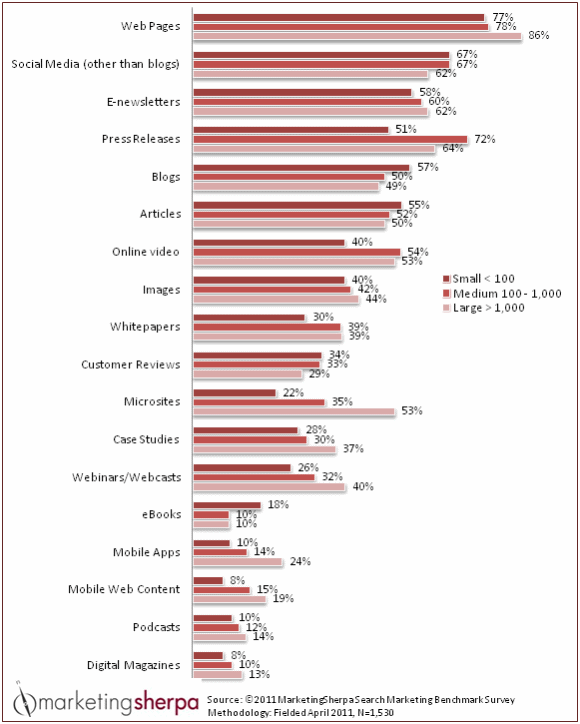
Marketing Research in Action: Content marketing data

May 24th, 2012

On the latest episode of Marketing Research in Action, I discuss research about content marketing from MarketingSherpa’s 2012 Search Marketing Benchmark Report – SEO Edition (free excerpt at that link), with Ninan Chacko, Global Chief Executive Officer, PR Newswire


Here’s a look at what Ninan and I discussed. Feel free to use these links to jump straight to that point in the video.

1:06 – Webpages

1:38 – Social media (other than blogs)

2:28 – Press releases

4:34 – How a press release should look in 2012

6:35 – Using a press release to promote other content marketing channels

8:22 – The benefit of cross-media integration


And here is a closer look at that data from the SEO Benchmark Report …

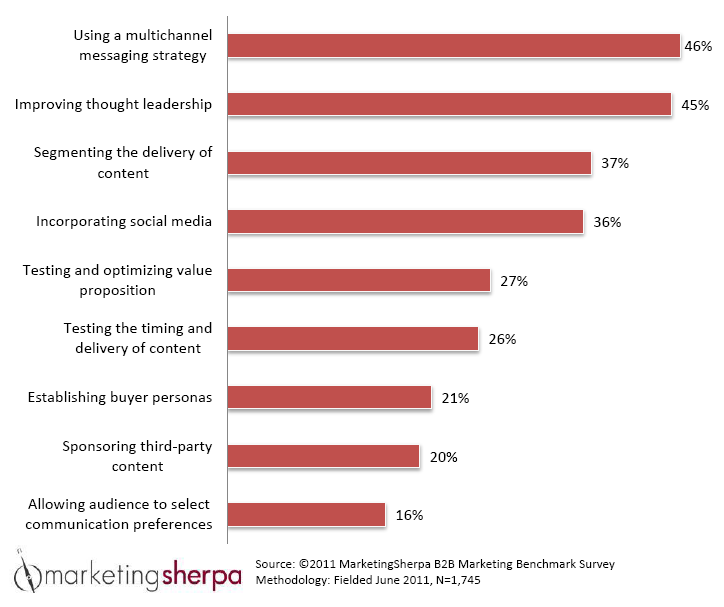
 Content marketing products, by organization size
 

Related Resources

Brand TV: Using Video to Engage Audiences (via PR Newswire)

Overall Content Marketing Strategy Leads to 2,000% Lift in Blog Traffic, 40% Boost in Revenue

Public Relations: Getting corporate data out of subject matter experts heads and into quarterly trend reports increased media coverage 261%

Combining Email, Search, Social and PR for a Content Marketing Campaign: 6 Tactics to Generate Surge in Visitor Traffic

MarketingSherpa’s 2012 Search Marketing Benchmark Report – SEO Edition
How to Write a Competitive Analysis (with 3 free templates)

May 18th, 2012

“It’s not enough that we win; all others must lose.” – Larry Ellison

Personally, I disagree with Larry, and I think that the focus should be on the customer winning. Hopefully that’s often through your product or service offering, but sometimes your competitors can serve customers looking for a solution better than you can. In those cases, I think all parties (your company, your competitor and your customer) are better served by acknowledging that.

In fairness, Larry Ellison is the fifth richest man in the world, so if that’s how you keep score, he has much more credibility than I. On the other hand, he was paraphrasing Genghis Khan with his quote, so I guess it all depends whom you want to emulate with your marketing.

Learning from the competition

But, whether you agree with Larry or me (or even Genghis), I’m sure that we can all see the value in better understanding what competitors are doing.

So you can conduct a competitive analysis for the obvious reasons — to bludgeon the competition and raze their villages. However, you can also conduct a competitive analysis to help you better communicate with your customers about how you can best serve them (and even tell them what you can’t do) while perhaps honing the fine art of “coopetition.”

Moreover, a competitive analysis is an especially helpful tool to help you craft your value proposition.

Free competitive analysis templates

To help you conduct a competitive analysis, we’ve created a few free templates loosely based on the Summary Competitive Analyses we conduct for our own Research Partners here at MECLABS.
Read more…

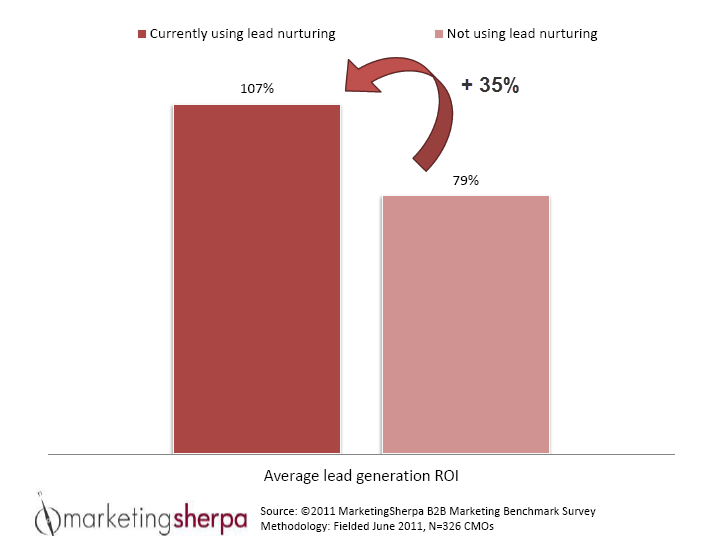
Marketing Research in Action: Marketers using lead nurturing average 107% lead gen ROI

May 17th, 2012

In our most recent episode of Marketing Research in Action, I discussed how lead nurturing could help your B2B marketing efforts with Jen Doyle, Senior Research Manager, MECLABS, based on data from her 2012 B2B Marketing Benchmark Report (free excerpt here).


Here is a look at some of the research Jen and I discussed with direct links to that part of the video.

0:38 – Organizations that are engaged in lead nurturing realize higher ROIs on their lead generation efforts.

Click to enlarge


2:01 – Top tactics for creating engaging lead nurturing content

Click to enlarge


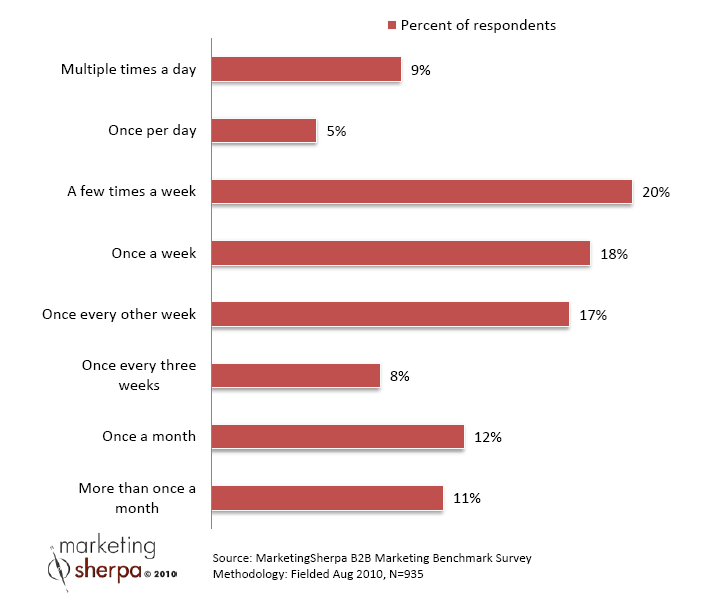
5:40 – Frequency of lead nurturing touches

Click to enlarge


Related Resources

Email Marketing: The importance of lead nurturing in the complex B2B sale

Lead Nurturing: Pilot campaign increases conversion 32.6% with automated emails

Lead Nurturing: You could be losing as much as 80% of your sales; here’s how you keep them

MarketingSherpa Webinar Replay — 5 Key Components for Establishing and Optimizing Lead Nurturing Campaigns

Mobile Search [Infographic]: 72% of smartphone users look for information on the go

May 11th, 2012

I’m a fan of gallows humor. So, as a Borders shareholder (until it went bankrupt), I love the sign a Borders store employee posted as the chain was going out of business …


Sorry
No Public Restroom
Try Amazon.com

It’s hard to deny that e-commerce has significant advantages over the traditional brick-and-mortar store:

  • Lower overhead and inventory costs
  • Open 24/7, often to any customer in the world with a connection
  • High gas prices that convince customers to drive less
  • No sales tax (although that playing field will likely level in the near future)
  • The ability for customers to easily find what they’re looking for, comparison shop, and respond to offers

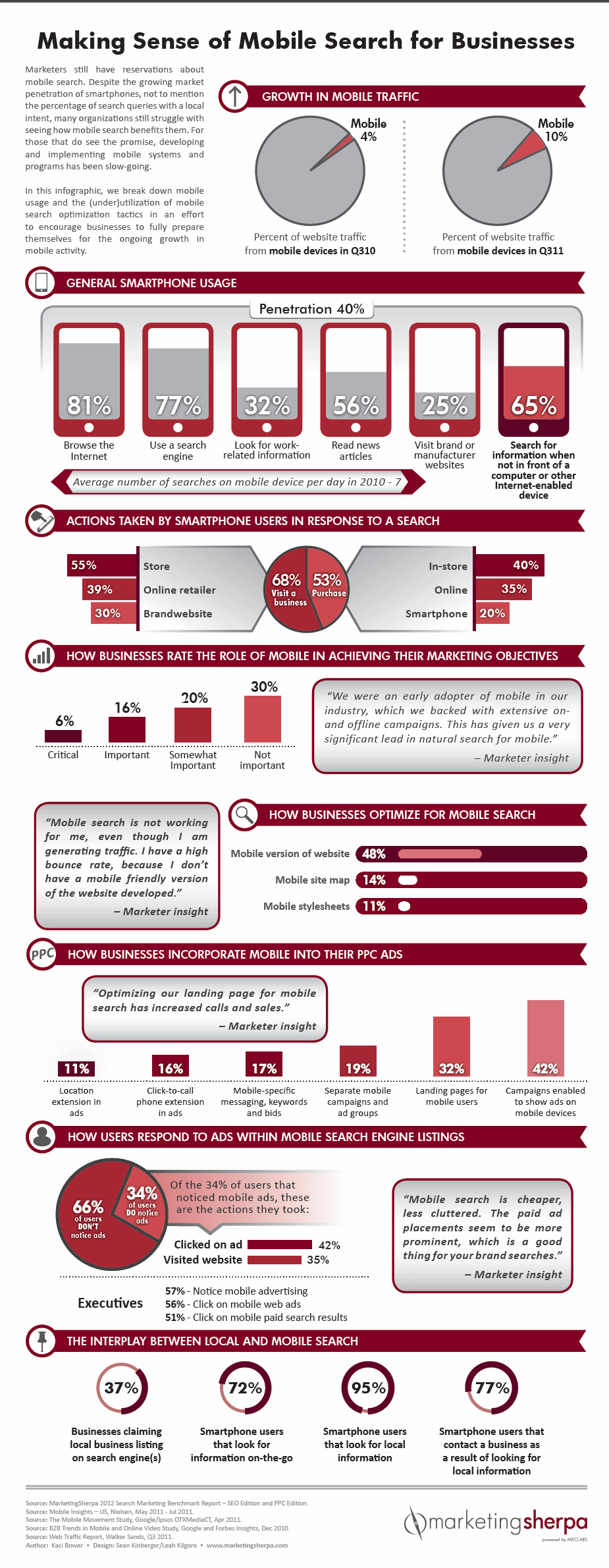
But now it’s time for B&Ms to fight back … at least when it comes to that last advantage. As this infographic created by Kaci Bower, Senior Research Analyst, MECLABS, shows, 72% of smartphone users look for information on the go.


Click to enlarge

Read more…

Meeting Agenda Template: How to run more effective and efficient meetings

May 1st, 2012

I bet you could get a lot more actual work done without meetings, eh?

An example of this is David Meerman Scott’s answer to the question, “How are you so prolific?” He lists several reasons, but my favorite is, “I don’t have to sit in any damn meetings (unless I want to).”

However, you are probably not like Mr. Meerman Scott. If you are the average marketer, you have to sit through many, many meetings. Let’s take a look at how to make your meetings more effective and efficient (and feel free to pass this advice anonymously to the biggest time wasters in your organization).


The problem – unorganized meetings

Of course, this isn’t the only problem, but one major issue torpedoing many meetings is that they are unorganized and the facilitator put in little prep work on the front end. This is why so many meetings are ineffective, underutilized, unnecessary and just plain, well, time wasters.

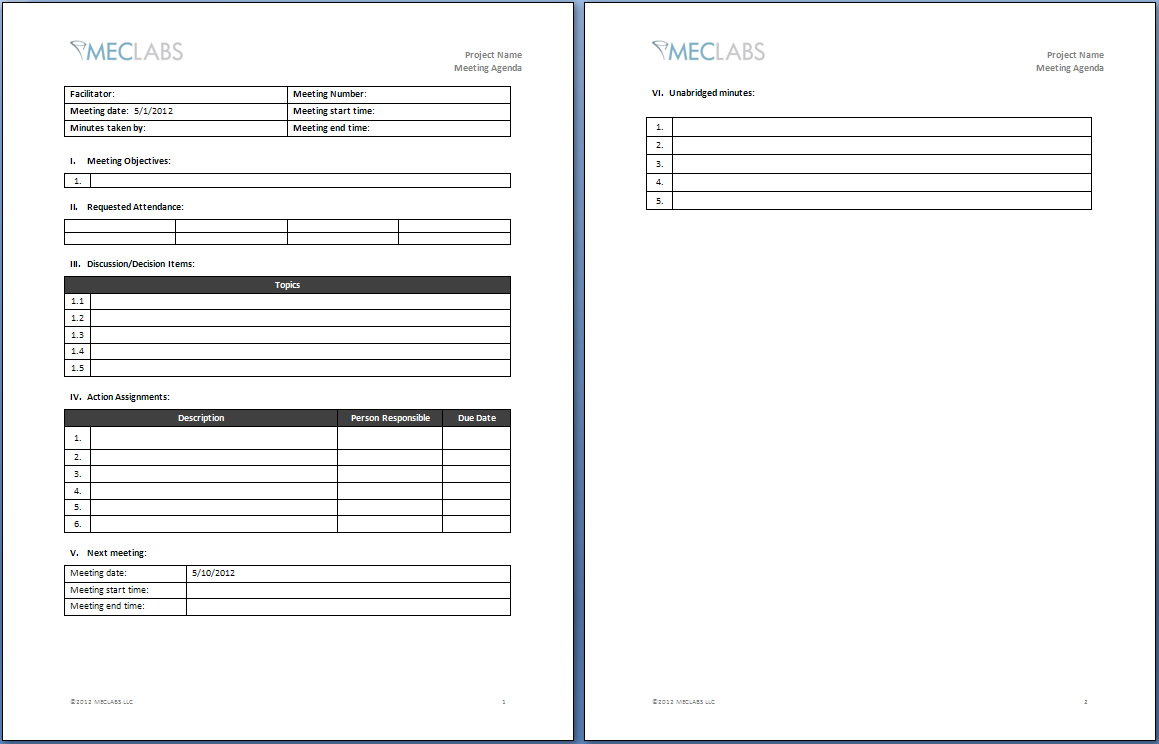
To help you improve your own meetings, here is a free meeting agenda template. It’s what we use here at MECLABS. Feel free to replace our logo with your own if you use it internally or externally.


Let’s walk through the elements of the template. This advice isn’t based on research or reporting, simply what I’ve personally learned in my career. And I’d love to hear what you’ve learned as well.

  Read more…

Marketing Research in Action: 65% of B2B marketers are not nurturing

April 27th, 2012

So I’ve got this old friend from college. At first, we had fun. Now I only hear from when he needs something. Then after I help him out … he disappears again.

Sound uncomfortably like your B2B marketing and sales efforts? Listen in as I speak with Brian Carroll, Executive Director, Revenue Optimization, MECLABS, about lead nurturing and post-sales nurturing, based on research from MarketingSherpa’s 2012 B2B Marketing Benchmark Report and MarketingSherpa’s 2012 Email Marketing Benchmark Report.


“The goal with nurturing is not just always be closing or always be selling,” Brian said. “It’s really, always be helping.” Watch the above video to see what other insights Brian shared. Here are a few key pieces of information that may help you: Read more…

Help us improve MarketingSherpa.com and get a free 30-Minute Marketer report

April 24th, 2012

We want to serve you better, so we’re conducting a quick survey to determine the best way.  We’re interested only in aggregate needs and preferences, so individual responses are anonymous.  Every respondent will, however, earn a free copy of a MarketingSherpa 30-Minute Marketer report – How to Integrate Social Media with Email and SEO.

And if there’s anything we learn from the survey that we think you might find valuable, we’ll publish it.

Take the survey now

Blog Awards: Nominate your favorite marketing blogs

April 20th, 2012

At MarketingSherpa, our job is to help you do your job better. But we’re not the only place you turn to for helpful information.

So to help your peers find quality marketing information, we’re launching the MarketingSherpa Reader’s Choice Awards. What marketing blogs do you find most valuable? Simply make a comment on this blog post with the name of the blog and the category you would like to nominate it for.

Here are the categories:

  • Best B2B Marketing Blog
  • Best Email Marketing Blog
  • Best E-commerce Blog
  • Best Inbound Marketing Blog
  • Best Copywriting Blog
  • Best PPC Blog
  • Best SEO Blog
  • Best Marketing Strategy Blog
  • Best Social Media Blog
  • Best Viral Marketing Blog
  • Best Marketing Operations Blog
  • Best Design Blog
  • Best Optimization/Testing Blog Read more…

The downside of very high conversion rates

April 13th, 2012

Almost every marketer I talk to wants to know about average conversion rates. And, I presume, they want that info so they can focus on being above average.

While a marketing Lake Wobegon, where all of your conversion rates are above average, sounds tempting on the face of it, let me make a, perhaps, counterintuitive argument …


Very high conversion rates are usually not good for your ultimate KPI — profit

And this is one reason why an obsession with average conversion rates can be harmful to your marketing health.

There are two possible downsides to very high conversion rates:

  • You are focusing too much of your marketing efforts on an audience that would buy from you anyway, and not enough on finding new customers
  • You are offering too big of an incentive

  Read more…

PURL Jam: 6 ways personalized URLS can help increase the virality of your campaigns

April 12th, 2012

Virality is that state of marketing nirvana where your campaigns are liberated from the earthly confines of your own media spends and marketing efforts, and take on a free-floating life of their own.

As I’ve said before in “Social Media Marketing: Going viral is so easy it’s hard,” I don’t believe there is any secret to going viral, but you can position yourself well for that opportunity. That blog post has a few of the factors that influence your chance of going viral, but in today’s post I want to focus on one very specific tool that can help your efforts — personalized URLs, also known as PURLs.

If you’re unfamiliar with PURLs, personalized URLs are simply, as the name implies, unique URLs for each recipient. As with many marketing terms, different people tend to use the term differently (usually to the advantage of whatever they’re selling). Some people consider a PURL actually having the person’s name in the URL (for example, I might receive a mailer with a CTA that goes to DanielBurstein.MECLABS.com, while my neighbor’s CTA would point to TheJoneses.MECLABS.com).

Others consider a PURL to be any URL that leads to a personalized landing page (so the URL might be a random string of letters and numbers; however, the landing page would say “Hello Daniel Burstein”). And still others consider a PURL to be any custom URL assigned to only one person (for the purpose of this blog post, I’ll use this, the broadest definition).

Who can use PURLS? Pretty much any marketer. “Historically, the high cost of PURLs would limit the technology to larger companies with the matching budgets,” according to Martin Thomas, founder, Purlem. “But today, PURLs have become much more affordable and easier to use.”

Now that we’ve gotten in a little background info, let’s take a look at some ways PURLs can help position your campaigns for virality:

  Read more…